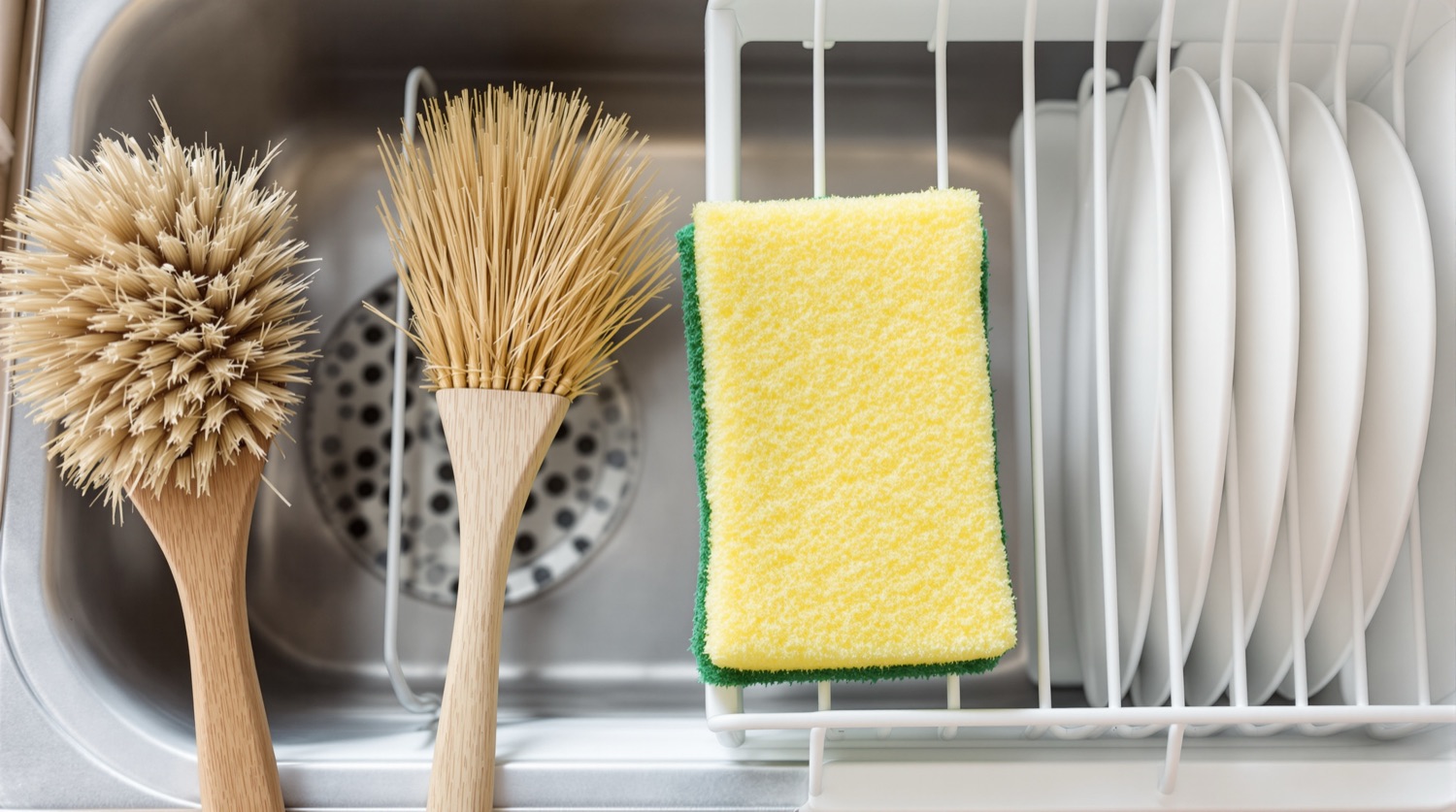
The sponge by the sink is the most-used cleaning tool in most homes, and it is almost always plastic: a polyurethane foam body with a polyester or nylon scrub pad bonded to one side. The dish brush is the obvious alternative, and the argument between the two usually runs on opinion — brushes “feel” cleaner, sponges “get into” glasses better. That argument no longer has to be settled by feel. Two separate lines of research now measure exactly the two things people worry about: how many germs each tool carries, and how much plastic each one sheds into the sink.
The first comes from Nofima, the Norwegian food research institute, which ran two studies on sponges and brushes as part of the EU-funded SafeConsume project. The second is a 2026 study led by the University of Bonn that put real household sponges and a purpose-built scrubbing machine to work to measure microplastic release. Read together, they point the same direction — and they also show where the brush’s advantage is smaller than the marketing implies.
Bottom line: Use a wood-handled brush with plant-fiber bristles for dishes, pots and pans. It dries fast, which is the property that kills food-poisoning bacteria, and it has no foam to wear down into plastic. Keep a plant-based cellulose sponge cloth for wiping counters and for the few jobs a brush handles badly. Retire the polyurethane sponge entirely — it is the worst option on both measured counts.
Is a Dish Brush More Hygienic Than a Sponge?
Yes on the measured evidence, and the reason is drying. In the 2021 Nofima study in the International Journal of Food Microbiology, Trond Møretrø and colleagues contaminated new sponges and brushes in the lab and tracked how long food-poisoning bacteria survived. On brushes, Campylobacter fell below the detection limit after one day and Salmonella after three days — a drop of more than 2.5 log, meaning more than 99.7 percent. In sponges, Campylobacter survived one day in every sponge type, and Salmonella survived more than seven days in two of the three sponge types tested.
The mechanism is simple. Bacteria need moisture, and a brush’s open bristles dry within hours, while a dense foam sponge stays wet in the middle for days. The same study found that harmless background bacteria in sponges climbed to around 9 log CFU per sponge — roughly a billion colony-forming units, the standard lab measure of live bacteria — because the sponge never dries out enough to stop them growing.
Head-to-Head: Dish Brush vs Sponge
What the published studies measured, side by side. A dash means no study has measured it.
| Feature | Synthetic Sponge | Natural-Bristle Dish Brush |
|---|---|---|
| Typical material | Polyurethane foam + polyester or nylon scrub pad | Wood or bamboo handle; tampico, sisal or coconut bristles |
| Salmonella survival (Nofima 2021) | More than 7 days in 2 of 3 sponge types | Below detection after 3 days |
| Campylobacter survival (Nofima 2021) | Survived 1 day in every sponge type | Below detection after 1 day |
| Background bacteria level | Around 9 log CFU per sponge in the lab | Lower in used brushes than in used sponges (Nofima 2022) |
| Microplastic release | 0.68–4.21 g per person per year (Bonn 2026) | — not measured; plant bristles contain no plastic to shed |
| Melamine “magic eraser” version | About 6.5 million fibers per gram worn away (ES&T 2024) | Not applicable |
| Dries between uses | Slowly — the foam core stays wet | Fast — open bristles |
| Effective cleaning methods | Chlorine, boiling or dishwasher killed Salmonella (Nofima 2021) | Same — plus hanging it to dry |
| Best at | Wiping flat surfaces, soaking up spills | Plates, pots, pans, cast iron, produce |
| Weak spot | Germ load; plastic shedding | Narrow glasses and wiping counters |
What Did the Nofima Studies Find in Real Kitchens?
The lab result held up in the field, though by less than the headline suggests. For the 2022 follow-up in the Journal of Applied Microbiology, the Nofima team collected sponges and brushes that consumers had actually been using and counted the bacteria on them. Portuguese sponges carried an extremely high median of 10.3 log CFU per item. In Norway, where both tools could be compared directly, the medians were 7.3 for sponges and 7.0 for brushes on the same log scale. The authors concluded that bacterial levels were lower in used brushes, but called the differences modest — 1.5 log or less.
One finding from that paper matters more than the averages. Salmonella numbers fell in used brushes that were left to dry overnight, but not in brushes stored damp, and not in sponges. In other words, a brush is only more hygienic if you let it behave like a brush: hang it or stand it bristles-up, away from the puddle at the bottom of the sink caddy. A brush left lying wet in a soap dish is a sponge with a handle.
The project also surveyed 9,966 consumers across ten European countries about how they actually wash up, which is why the lab tests mimic real use rather than an ideal routine. The researchers’ recommendation from that combined work was direct: brushes are more hygienic than sponges, and their use should be encouraged.
Does Microwaving or Boiling a Sponge Make It Safe?
It kills specific pathogens, but it does not reset the sponge. The 2021 Nofima study found that chlorine, boiling and a dishwasher cycle were all effective against Salmonella in both sponges and brushes. But a 2017 study in Scientific Reports by Massimiliano Cardinale and colleagues in Germany sequenced the bacteria living in used household sponges and found local densities of up to 5.4 × 10¹⁰ cells per cubic centimeter — about 54 billion in a space the size of a sugar cube. Five of the ten most abundant bacterial groups were close relatives of “risk group 2” species, the category that can cause infection in people with weakened immune systems.
The uncomfortable detail: in sponges their owners said they regularly sanitized, cleaning changed which bacteria lived there rather than clearing them out — two of the risk-group-related groups made up a larger share of the community in sanitized sponges than in the rest. The authors’ reading was that cleaning knocks the population back briefly, then the hardiest bacteria regrow into the space. Their advice was to replace kitchen sponges regularly rather than trust a microwave to keep one indefinitely.
How Much Plastic Does a Kitchen Sponge Shed?
Measurable amounts every year, and more the more plastic it contains. In the 2026 Environmental Advances study “From sink to sea,” Hamann, Galafton, Rühr, Blanke and Thonemann combined volunteer households in Germany and North America with an automated scrubbing rig they called the SpongeBot. They estimated release of 0.682 to 4.212 grams of microplastic per person per year, depending on the sponge. A sponge declared organic, which was only 15.9 percent plastic by weight, released the least; a sponge that was 59.3 percent plastic was among those that released more.
For scale, the University of Bonn’s own release extrapolates that if one specific sponge type were used in every German household, it would add up to as much as 355 tonnes of microplastic a year. Those particles go down the drain toward wastewater treatment, and some are smeared onto the plates and glasses being washed.
The study also produced a finding that cuts against the obvious headline: 85 to 97 percent of the total environmental impact of hand dishwashing came from the water used, not from the sponge material or its abrasion. So the cleanest routine is not just a better tool — it is a better tool plus a filled basin instead of a running tap. Brushes help here too, since they do not need constant rinsing to push suds out of a foam core.
Do Dish Brushes Shed Microplastics Too?
It depends entirely on the bristles, and no study we found has measured brush shedding directly. A brush with nylon or polypropylene bristles and a molded plastic handle is still plastic, and its bristles visibly fray and break with use; it is reasonable to assume those fragments go down the drain, but the amount is unmeasured. A brush with tampico (agave), sisal or coconut-coir bristles on a wood or bamboo handle contains no plastic at all, so whatever it sheds as it wears is plant fiber. That is the version worth buying, and it is the only kind we recommend below.
The worst sponge on the plastic count is the white melamine “magic eraser.” A 2024 study by Su and colleagues in Environmental Science & Technology found that melamine foam breaks into poly(melamine-formaldehyde) fibers as it scrubs, at about 6.5 million fibers per gram of sponge worn away. We cover that study in full in do kitchen sponges have microplastics, and the material itself in is melamine safe.
Which One Should You Use?
For most kitchens the answer is both tools, just not the plastic sponge.
Reach for a dish brush for:
- Plates, bowls, cutlery and cutting boards
- Pots, sheet pans and baked-on residue
- Cast iron and carbon steel, where soap and soaking are not wanted
- Scrubbing potatoes and root vegetables
Reach for a cellulose cloth for:
- Wiping counters, tables and stovetops
- Soaking up spills
- The inside of narrow glasses and jars
- Anything a plastic sponge did before — it dries flat and stiff between uses
Whatever you choose, the drying rule is the habit that the Nofima work says matters most: hang the brush or stand it bristles-up, and wring and spread the cloth so it dries between uses. For the wider kitchen, our kitchen plastic detox guide ranks the swaps by impact, 7 kitchen mistakes that put microplastics in your food covers the habits, and if you are cleaning bare iron pans, carbon steel vs cast iron cookware explains why a stiff brush is the right tool for both. The full ranked lists are in the best plastic-free dish brushes and the best plastic-free kitchen sponges.
The Four Worth Buying
Two plant-bristle brushes for the dishes and two plant-based cloths for the wiping — the combination that replaces a plastic sponge completely.
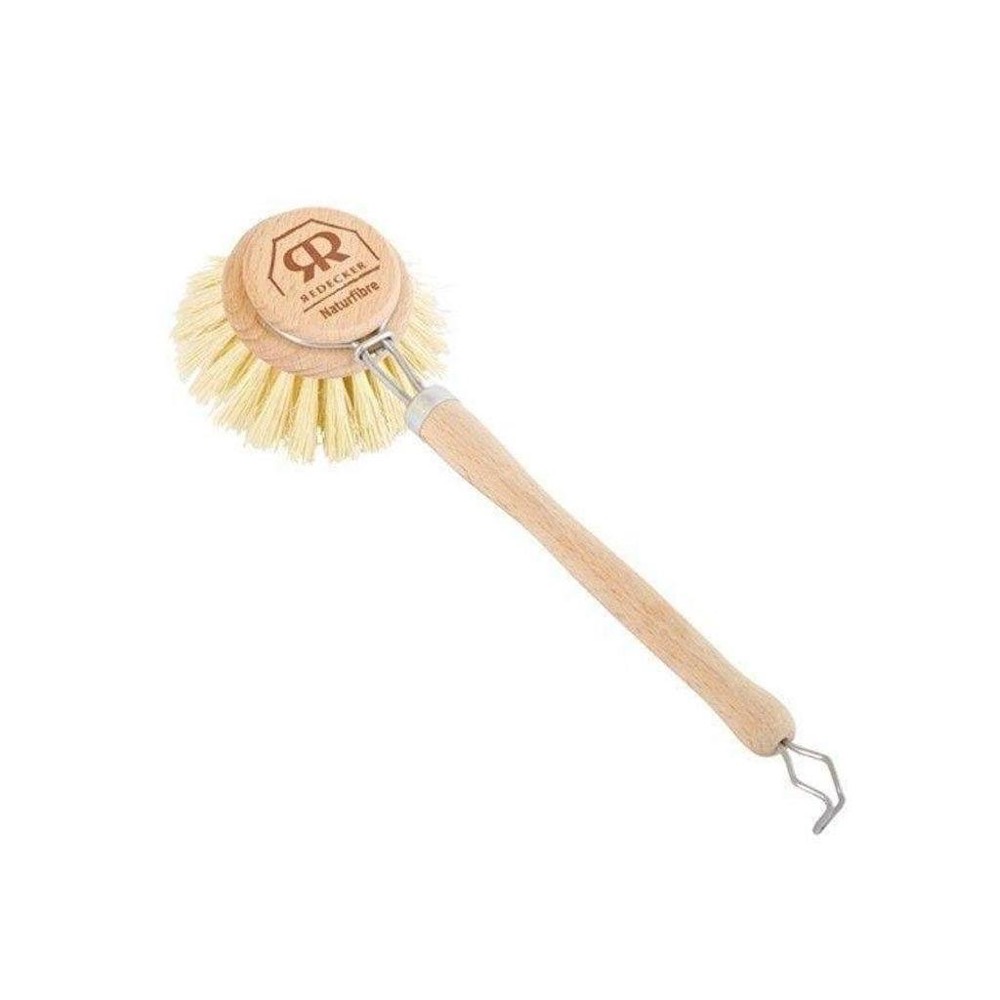 Best Dish Brush
The hook on the handle is the reason this is our first pick for this comparison. Nofima’s field study found Salmonella fell in brushes that were dried overnight and not in brushes stored damp, and a brush that hangs from a hook dries all the way around. Tampico is agave plant fiber, so nothing in the head or the handle is plastic. Redecker also sells replacement heads, so the handle can stay in service when the bristles wear.
Pros
- No plastic in the bristles or the handle
- Hangs to dry, which is what kills bacteria on a brush
- Replaceable head extends its life
Cons
- Costs more than bamboo-handled budget brushes
- Wood needs to dry out — do not leave it soaking
- Round head will not reach the bottom of a tall narrow glass
The brush that replaces the sponge for dishes and pots.
Why it is the safer choice: Plant fiber and wood only, so there is no foam or nylon to wear into microplastics — and an open head that dries fast enough to starve the bacteria a sponge keeps.
Check Today's Price on Amazon →Amazon prices change daily — tap to see today's price and any current discount.
- Free delivery for Prime members
- Made in Germany
- Easy 30-day returns
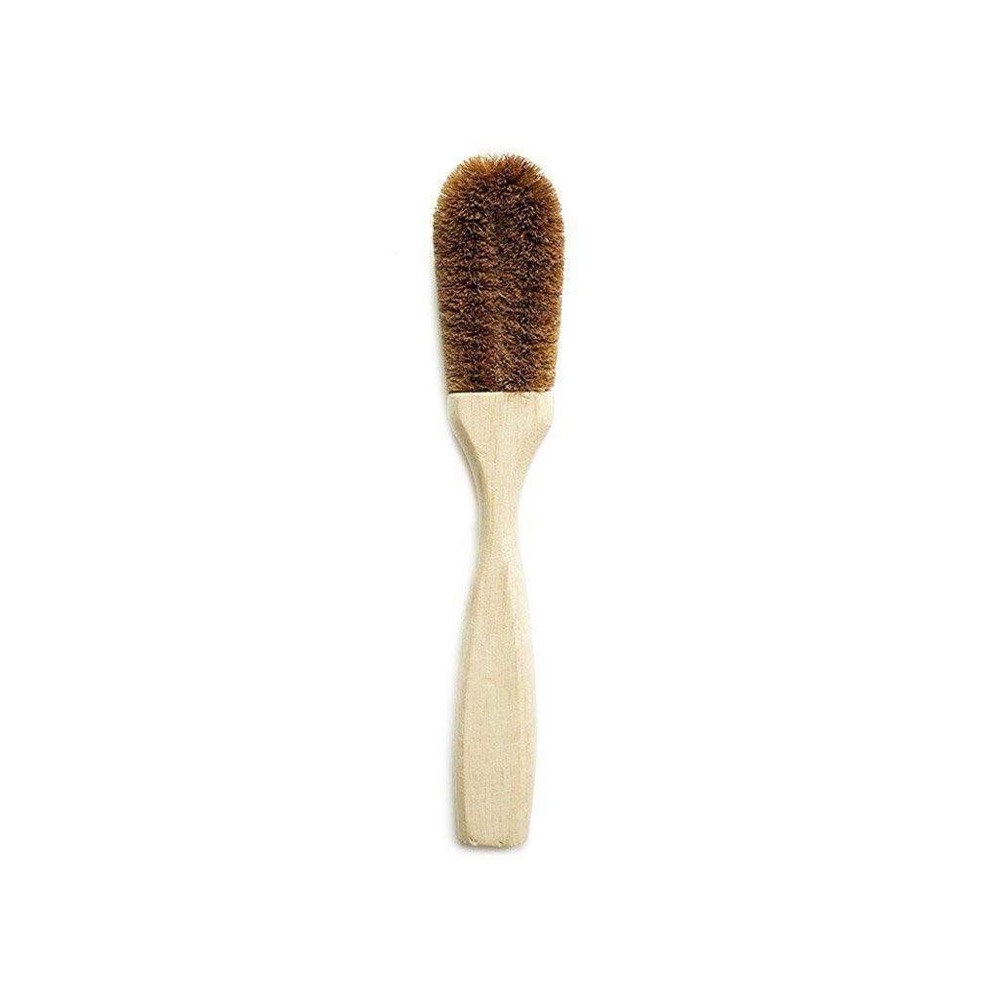 Best for Pots & Cast Iron
The green scrub layer on a standard kitchen sponge is the part that wears fastest, and it is polyester or nylon. Coconut coir does the same scouring job with a plant fiber. It is stiff enough to clean a seasoned cast iron pan without soap, which is how bare iron should be cleaned anyway, and every part of the brush is natural material that composts at the end of its life.
Pros
- Replaces the nylon scour pad, the fastest-wearing part of a sponge
- Right tool for cast iron and carbon steel
- Fully plant-based and compostable
Cons
- Too stiff for delicate glassware
- No hanging hook — stand it bristles-up to dry
- Too abrasive for coated nonstick pans
Scouring power without the nylon scrub pad.
Why it is the safer choice: Coconut fiber and wood, so the abrasion that turns a sponge’s scrub layer into plastic fragments produces plant fiber instead.
Check Today's Price on Amazon →Amazon prices change daily — tap to see today's price and any current discount.
- Free delivery for Prime members
- Compostable at end of life
- Easy 30-day returns
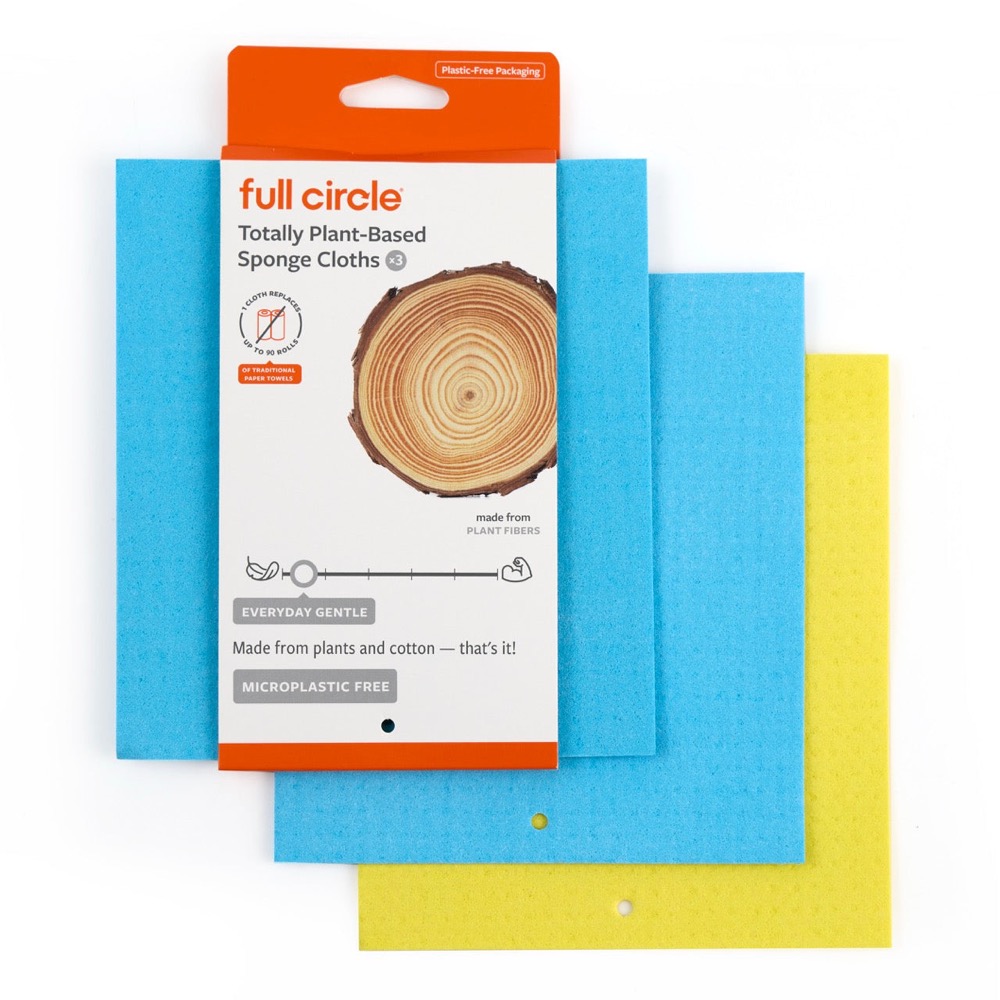 Best Sponge Replacement
The Bonn study’s clearest result was that the less plastic a sponge contained, the less microplastic it released. A cellulose cloth takes that to its end point: the pack says it is made from plants and cotton. It also fixes the sponge’s hygiene problem by design, because a thin cloth spread out to dry loses its moisture far faster than a thick foam block.
Pros
- Plant-based — no foam to wear into plastic
- Thin enough to dry between uses
- Familiar sponge-like feel when wet
Cons
- No scouring layer — pair it with a brush for pans
- Stiff when dry until you wet it
- Needs replacing periodically, like any cloth
The wiping half of a sponge-free sink.
Why it is the safer choice: Cellulose and cotton instead of polyurethane foam, and a shape that dries out rather than staying damp for days.
Check Today's Price on Amazon →Amazon prices change daily — tap to see today's price and any current discount.
- Free delivery for Prime members
- Plant-based material
- Easy 30-day returns
 Best Multipack
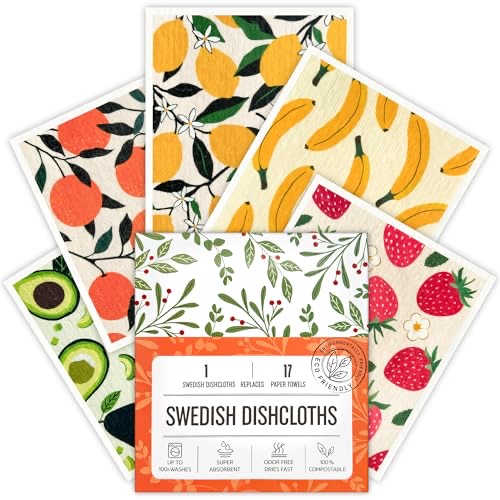
A multipack solves the problem the Nofima field study kept circling back to: a cleaning tool that never fully dries never stops growing bacteria. With five in the drawer you can use one, hang it, and pick up a fresh dry one the next day, washing the used ones in the laundry. Like the Full Circle cloths, these are cellulose and cotton, so there is no foam to shed plastic.
Pros
- Five cloths make a daily dry rotation easy
- Plant fibers only — no polyurethane
- Machine washable between uses
Cons
- Not a scrubber — keep a brush for pans
- Costs more up front than a single sponge
- Feels stiff until wetted
A dry cloth every day, without a plastic sponge in the house.
Why it is the safer choice: Plant-based fibers, and enough cloths in the pack that none has to stay damp between uses.
Check Today's Price on Amazon →Amazon prices change daily — tap to see today's price and any current discount.
- Free delivery for Prime members
- Machine washable
- Easy 30-day returns
Frequently Asked Questions
Is a dish brush more hygienic than a sponge?
Yes, on the published evidence. In a 2021 International Journal of Food Microbiology study, Nofima researchers found Campylobacter and Salmonella fell below the detection limit on dish brushes after one and three days, while Salmonella survived more than seven days in two of three sponge types. Brushes dry faster, and drying is what kills the bacteria. A 2022 follow-up on tools from real homes found lower bacterial levels in used brushes than in sponges, though the gap was modest — 1.5 log or less.
Do kitchen sponges shed microplastics?
Yes. A 2026 study in Environmental Advances by Hamann and colleagues, led by the University of Bonn, estimated that kitchen sponges release 0.682 to 4.212 grams of microplastic per person per year. A sponge declared organic, only 15.9 percent plastic by weight, released the least. Melamine magic erasers are worse per gram: a 2024 Environmental Science & Technology study measured about 6.5 million fibers per gram of sponge worn away.
Do dish brushes shed microplastics?
It depends on the bristles. A brush with nylon or polypropylene bristles and a plastic handle is plastic and frays with use, although no study has measured how much it sheds. A brush with tampico, sisal or coconut-coir bristles on a wood or bamboo handle contains no plastic, so anything it sheds as it wears is plant fiber.
Does microwaving a sponge kill the bacteria?
It kills some, but it does not reset the sponge. Nofima found chlorine, boiling and the dishwasher were effective against Salmonella in sponges and brushes. But a 2017 Scientific Reports study of used household sponges found that regular sanitizing changed which bacteria lived there rather than clearing them out, with two groups related to risk group 2 species making up a larger share in sanitized sponges. The authors advised replacing sponges regularly.
How should I store a dish brush so it stays clean?
Let it dry completely between uses — hang it or stand it bristles-up, out of standing water. In Nofima's 2022 study of tools from real kitchens, Salmonella numbers fell in used brushes left to dry overnight but not in brushes stored damp. A brush left lying wet in a soap dish loses most of its advantage over a sponge.
What should I use instead of a sponge for wiping counters?
A plant-based cellulose sponge cloth or Swedish dishcloth. They are made from cellulose and cotton rather than polyurethane foam, absorb like a sponge, and dry flat and stiff between uses, which keeps bacteria from building up. Pair one with a natural-bristle brush for dishes and pans.
Sources
- Møretrø T, Moen B, Almli VL, Teixeira P, Ferreira VB, Åsli AW, Nilsen C, Langsrud S. Dishwashing sponges and brushes: consumer practices and bacterial growth and survival. International Journal of Food Microbiology. 2021;337:108928. doi:10.1016/j.ijfoodmicro.2020.108928 · PubMed PMID 33152572
- Møretrø T, Ferreira VB, Moen B, Almli VL, Teixeira P, Kasbo IM, Langsrud S. Bacterial levels and diversity in kitchen sponges and dishwashing brushes used by consumers. Journal of Applied Microbiology. 2022;133(3):1378–1391. doi:10.1111/jam.15621 · PubMed PMID 35560961
- Cardinale M, Kaiser D, Lueders T, Schnell S, Egert M. Microbiome analysis and confocal microscopy of used kitchen sponges reveal massive colonization by Acinetobacter, Moraxella and Chryseobacterium species. Scientific Reports. 2017;7:5791. doi:10.1038/s41598-017-06055-9 · PMC5517580
- Hamann L, Galafton C, Rühr PT, Blanke A, Thonemann N. From sink to sea: microplastic release from kitchen sponges and potential environmental effects. Environmental Advances. 2026;23:100693. doi:10.1016/j.envadv.2026.100693 · University of Bonn release
- Su Y, et al. Mechanochemical formation of poly(melamine-formaldehyde) microplastic fibers during abrasion of cleaning sponges. Environmental Science & Technology. 2024. doi:10.1021/acs.est.4c00846
- Nofima. Brushes are more hygienic than sponges. nofima.com