
Hydro Flask is safe in all the ways that matter most. The 18/8 stainless steel body has no PFAS coating, no BPA, and no lead in your drink — the lead solder used to seal the vacuum is locked under the base cap and never contacts your beverage. The real, ongoing question is the polypropylene lid: every Hydro Flask lid is plastic, and plastic sheds microplastics through abrasion and heat. The fix is simple — choose a model with the Standard Flex Cap (fewest moving parts, least plastic contact) and skip the straw lid for hot drinks.
Hydro Flask has been the benchmark for premium vacuum-insulated bottles for over a decade. Its powder-coated steel body, wide-mouth openings, and lifetime warranty have made it a staple on hiking trails, in yoga studios, and on kitchen counters. But as awareness of microplastics, lead, and PFAS contamination has grown, so have the questions about whether a Hydro Flask is truly safe — or just perceived as safe because it's not a disposable plastic bottle.
The short answer is that Hydro Flask earns its reputation on the body and fails to escape the universal stainless-bottle caveat on the lid. Let's go through each concern with the actual evidence, then break down which Hydro Flask lid configuration actually minimizes your exposure.
Does Hydro Flask contain lead?
Yes — in the same place almost every other vacuum-insulated bottle does, and not where it touches your drink. Hydro Flask uses a small lead-based solder pellet to seal the evacuation hole left after the air is removed from the double wall. That pellet lives under the stainless steel base cap on the bottom exterior of the bottle, fully enclosed and inaccessible during normal use.
This manufacturing technique is an industry standard, not a Hydro Flask quirk. The 2024 Stanley lead controversy revealed the same approach across multiple major brands. Consumer testing performed during that controversy found no detectable lead leaching into the water from intact sealed bases. The lead is genuinely sealed away from your beverage; the water inside only contacts the stainless steel interior.
If the exterior base cap on your Hydro Flask chips off, cracks, or is physically peeled away, the underlying lead seal becomes exposed. Inspect the base of your bottle occasionally. If it's damaged, contact Hydro Flask warranty support rather than continuing to use it. Children who mouth the bottom of the bottle are also at higher risk if the cap is compromised — keep bottles out of reach when the base is damaged.
Under normal use — filling with water or any beverage, drinking from the top, and carrying in a bag or hand — a Hydro Flask presents no meaningful lead exposure risk. The lead never enters the drinking path.
Is Hydro Flask BPA-free, and what plastic does it use?
Yes. The Hydro Flask body is 18/8 food-grade stainless steel, which is not plastic and therefore inherently BPA-free. The powder-coat exterior finish is also BPA-free. The lids, straw accessories, and internal gaskets are made from polypropylene (PP, plastic recycling symbol #5), which is BPA-free and does not use the phthalates or hormone-disrupting additives associated with older plastics like polycarbonate (#7).
Hydro Flask publicly confirms that all consumer products are free from BPA, BPS, phthalates, and other regulated endocrine disruptors. For those concerns, Hydro Flask gets a clean bill of health.
The important distinction: BPA-free does not mean particle-free. Polypropylene is BPA-free and does not leach detectable hormone-disrupting chemicals at normal temperatures. It does, however, shed microplastic particles through friction, abrasion, and heat — which is a different type of exposure that BPA-free status says nothing about. That's the subject of the next two sections.
Does Hydro Flask have a PFAS or non-stick coating inside?
No. This is one of the cleanest answers in this entire investigation. The interior of a Hydro Flask is uncoated 18/8 stainless steel — there is no non-stick layer, no PTFE (Teflon), no PFAS chemicals, and no epoxy or resin liner on the drinking surface. The metal is bare and inert.
PFAS contamination in food and beverage containers typically comes from: non-stick cookware coatings, some food packaging liners, and certain coated outdoor gear. None of these apply to the interior of a stainless steel vacuum bottle. Hydro Flask's exterior powder coat does not contact your drink. You can set PFAS concerns entirely aside for Hydro Flask — this is not a concern, unlike for some coated can liners or some food packaging.
This is a genuine differentiator versus aluminum water bottles, which often use an epoxy-resin interior coat that may contain PFAS or BPA-based compounds. Stainless steel needs no such lining because it is already food-safe at the bare metal level.
Which Hydro Flask lid has the least plastic?
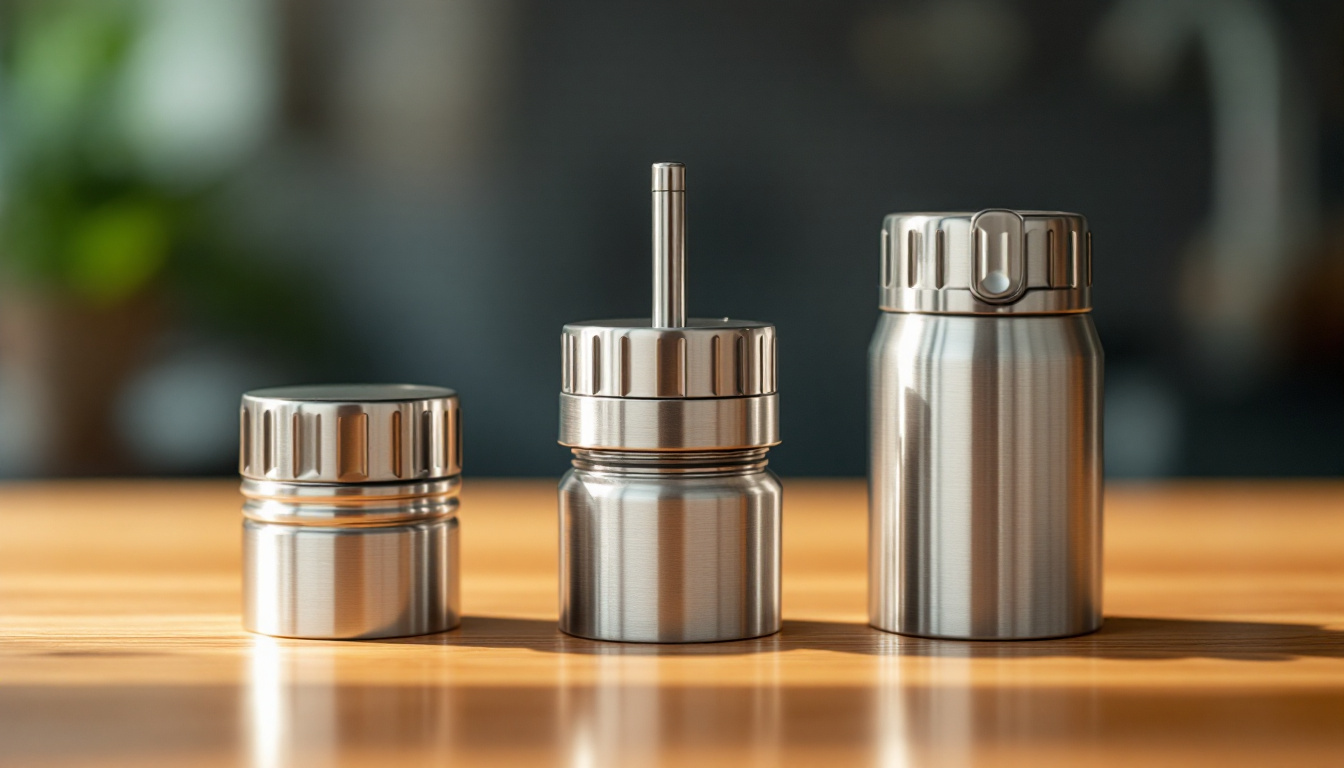
This is where Hydro Flask safety actually varies by model. All Hydro Flask lids are polypropylene, but they differ enormously in how many moving plastic parts touch your drink and how much friction they generate per use. Ranked from least to most plastic exposure:
| Lid | Moving Parts | Straw? | Plastic Exposure Level |
|---|---|---|---|
| Standard Flex Cap | None (screw-on) | No | ●○○○ Lowest |
| Flex Cap | None (screw-on with loop) | No | ●○○○ Lowest |
| Flex Sip Lid | Hinged sipper spout | No | ●●○○ Low |
| Flex Chug Cap | Push-button spout | No | ●●○○ Low |
| Flex Straw Lid | Hinged, straw slot | Yes | ●●●○ Moderate |
| Wide Mouth Straw Lid | Locking straw mechanism | Yes | ●●●● Highest |
The Standard Flex Cap and Flex Cap are mechanically simple: you unscrew, you drink, you screw back on. The only plastic-on-plastic action is threading, and the plastic in your sipping path is limited to the rim of the lid as it contacts the bottle mouth — which you don't drink against directly. This is the lowest-microplastic configuration in the Hydro Flask line.
The straw lids introduce a plastic straw into the drinking path directly. Every sip draws liquid up through polypropylene tubing, which means every sip has the potential to carry microplastic particles released by the straw material. If you use a Hydro Flask primarily for cold water with a straw lid, your exposure is higher than with a simple cap — but still far lower than drinking from a single-use plastic bottle all day.
The 7 Hydro Flask configurations and alternatives we recommend
The simplest, lowest-plastic Hydro Flask configuration. The Standard Mouth bottle pairs with the single-piece screw-on Standard Flex Cap for zero moving parts and minimal plastic in the drinking path. Ideal for daily office/desk use, hiking, or anyone prioritizing low microplastic exposure. 18/8 stainless, vacuum-insulated, lifetime warranty.
Least Plastic Lid No StrawCheck Price on Amazon →
✓ Ships free with Prime · Free returns · Amazon A-to-z purchase guarantee (on eligible items)
The most popular Hydro Flask size, paired with the Wide-Mouth Flex Cap (loop handle, screw-on, no straw). The wide mouth means you can add ice easily and clean thoroughly. Still a single-piece PP cap with minimal plastic exposure. Great balance of capacity and low-plastic lid.
Wide Mouth No StrawCheck Price on Amazon →
✓ Ships free with Prime · Free returns · Amazon A-to-z purchase guarantee (on eligible items)
The high-capacity pick for all-day hydration. The Flex Chug Cap has a push-button spout (one moving part, no straw) making it fast to drink from without introducing a straw into the path. Best for gym bags, long hikes, or travel days when you want large volume with a one-handed open mechanism.
40 oz One-Button SpoutCheck Price on Amazon →
✓ Ships free with Prime · Free returns · Amazon A-to-z purchase guarantee (on eligible items)
Hydro Flask's travel mug format with a closeable sip lid. Fits most car cup holders, double-wall insulated, and the smaller-capacity closeable lid means less plastic than the straw tumbler formats. Good for commuters who want Hydro Flask's quality in a tumbler without a built-in straw.
Tumbler Closeable LidCheck Price on Amazon →
✓ Ships free with Prime · Free returns · Amazon A-to-z purchase guarantee (on eligible items)
If you prefer straw drinking, this is the Hydro Flask straw configuration with the smallest lid footprint — the Standard Mouth size limits how wide the straw lid mechanism is. Suitable for cold beverages, not recommended for hot drinks. Hand-wash the straw and lid rather than using the dishwasher to minimize heat-induced microplastic shedding.
Straw Lid Cold Drinks OnlyCheck Price on Amazon →
✓ Ships free with Prime · Free returns · Amazon A-to-z purchase guarantee (on eligible items)
A strong alternative if you want a stainless bottle with the simplest possible lid. The S'well Original uses a wide-thread screw-on cap with no push mechanisms, no straws, and no moving parts beyond the thread itself. Triple-layer vacuum insulation (inner vacuum + ThermaS'well technology), 18/8 stainless interior, BPA-free. Narrower mouth than Hydro Flask but outstanding insulation and minimal plastic contact.
Simplest Lid Triple InsulationCheck Price on Amazon →
✓ Ships free with Prime · Free returns · Amazon A-to-z purchase guarantee (on eligible items)
The premium pick for those wanting both minimal plastic and purified water. LARQ uses a UV-C LED in the cap to neutralize bacteria and viruses in the water every two hours; the body is 18/8 stainless with no PFAS. The cap is also polypropylene, but the UV purification addresses a separate biological concern beyond microplastics. Best for travel or if tap water quality is uncertain. The price reflects the UV technology.
UV Purification TravelCheck Price on Amazon →
✓ Ships free with Prime · Free returns · Amazon A-to-z purchase guarantee (on eligible items)
Does Hydro Flask leach microplastics?
The stainless steel body: no. Steel is chemically inert at any temperature you would drink; it does not shed microplastic particles because it is not plastic. This is the single biggest advantage of a stainless bottle over any single-use plastic bottle or plastic-lined cup.
The lid: yes, to a degree. Every Hydro Flask lid is polypropylene (#5 plastic), and polypropylene sheds microplastic particles through three main mechanisms: mechanical abrasion (threading the lid on and off, straw-and-spout mechanisms cycling open and closed), physical wear (scratching on bag contents, dishwasher racks), and heat (hot dishwasher cycles that soften and degrade the plastic surface).
How much this matters in practice depends on which lid you choose. A simple screw-on cap that you open once to fill and once to drink sheds far fewer particles per day than a straw lid that activates a locking mechanism every sip. The exposure is real but manageable with lid choice. It is also vastly lower than the exposure from a single-use plastic bottle, which was recently measured at approximately 240,000 nanoplastic particles per liter in a major 2024 PNAS study.
"The steel body solved the largest microplastic exposure vector. The lid reintroduced a smaller one — and which lid you pick determines how small."
Is it safe to put hot drinks in a Hydro Flask?
The stainless steel body is completely safe for any hot beverage — coffee, tea, soup, or any other liquid you would consume. Stainless steel is inert and does not leach at any food-safe temperature. Hydro Flask markets its bottles for hot and cold use, and the body itself is sound for both.
The lid caution applies here, and it's more important than with cold water. Heat accelerates microplastic shedding from polypropylene: hotter liquid releases more particles and chemical additives from the plastic surface than cold liquid does. For a Hydro Flask straw lid with hot coffee or tea sitting against the straw and lid surface, you're combining two of the three risk factors (heat + mechanical action from sipping) in one use.
The practical guidance: for hot drinks, use the Standard Flex Cap or Flex Cap — you drink from the stainless steel bottle mouth, the hot liquid touches minimal plastic (just the internal gasket), and the exposure is dramatically reduced. Avoid the straw lid for hot drinks. Also hand-wash the lid in lukewarm water rather than running it through a hot dishwasher cycle, which degrades the plastic faster than hand washing.
Hydro Flask vs. Stanley vs. Owala vs. Klean Kanteen — which is safest?
All four brands use 18/8 stainless steel bodies, making them equivalent on the body-safety dimension. The difference is the lid. For a direct comparison of where Hydro Flask fits, see our safest water bottle brands comparison, or for deep dives into the other brands specifically see is the Stanley cup safe and is the Owala FreeSip safe.
| Brand | Lead in Drink | PFAS Interior | Simplest Available Lid | Plastic-Free Lid Option |
|---|---|---|---|---|
| Hydro Flask | None (sealed base) | No | Standard Flex Cap (no moving parts) | No |
| Stanley Quencher | None (sealed base) | No | Tumbler lid (simpler than straw lid) | No |
| Owala FreeSip | None (sealed base) | No | Owala Twist (screw-on, no straw) | No |
| Klean Kanteen | None | No | Steel Loop Cap (all-stainless) | Yes — Steel Loop Cap |
The key differentiator remains the Klean Kanteen Steel Loop Cap. Klean Kanteen is the only mainstream brand that offers a genuinely plastic-free drinking path — all-stainless cap with only a food-grade silicone gasket. If eliminating polypropylene from the drinking path entirely is the goal, Klean Kanteen is the answer. If you prefer Hydro Flask's aesthetics or already own one, the Standard Flex Cap on a Hydro Flask gets you to the lowest-plastic configuration in that ecosystem.
Within the Hydro Flask ecosystem specifically, Hydro Flask has an advantage over the Stanley Quencher in that its simplest cap (Standard Flex Cap) has no moving parts at all, whereas the Quencher's simplest non-straw lid still has a sliding lock mechanism. Owala's Twist model is comparable to Hydro Flask's Standard Flex Cap. See our full guide to microplastics in water bottles for more on how different designs compare across all major brands.
Want to cut microplastic exposure from your entire kitchen?
Your water bottle is one of many daily plastic touchpoints. The Complete Plasticproof Guide covers every room — kitchen, nursery, bathroom, bedroom — with 80+ product recommendations backed by 47+ studies.
The honest verdict
Is Hydro Flask safe? On lead: yes, definitively — the lead is sealed under the base and has never been detected leaching into the water in properly assembled bottles. On PFAS: yes, there is no coating on the interior; this concern is simply not applicable to bare stainless steel. On BPA: yes, the entire product is BPA-free. On microplastics: the body is excellent (zero shedding), but the lid is plastic and sheds particles like every other polypropylene lid in the industry.
The practical upshot: if you own a Hydro Flask, you own one of the safest mass-market bottles available. To optimize it further, choose the Standard Flex Cap instead of a straw lid, hand-wash the lid in warm (not hot) water, replace any scratched or hazy lid components, and avoid filling straw-lid models with hot beverages. If you're buying new and want to go even further, the Klean Kanteen with a Steel Loop Cap removes polypropylene from the drinking path entirely.
Compared to where most people start — single-use plastic bottles and plastic-lined coffee cups — any Hydro Flask configuration is a major upgrade. The marginal improvements are real but secondary to getting off disposable plastic in the first place. For more on what the research says about microplastics from water sources, see our guide to the best water filters for removing microplastics.
Frequently Asked Questions
Yes, but not in your drink. A small lead-based solder pellet seals the vacuum insulation under the stainless steel base cap. Under normal use, this lead never contacts your beverage. Consumer testing during the 2024 Stanley controversy found no lead leaching into water from intact sealed bases — the same design used by Hydro Flask. Only if the base cap is physically damaged does exposure become a concern.
Yes. The 18/8 stainless steel body contains no plastic and is inherently BPA-free. The polypropylene (#5) lids and accessories are also BPA-free. Hydro Flask confirms its products contain no BPA, BPS, or regulated phthalates. Being BPA-free does not mean the lid can't shed microplastic particles, however — that is a separate concern from BPA leaching.
No. The interior is bare, uncoated 18/8 stainless steel. There is no PTFE (Teflon), no PFAS, and no epoxy liner. PFAS contamination is a concern in non-stick cookware and some canned food liners, but it does not apply to the bare stainless interior of a Hydro Flask. This is one clear advantage stainless steel has over aluminum bottles, which often use an epoxy interior coat.
The Standard Flex Cap and Flex Cap are the simplest — a single-piece polypropylene screw-on cap with no moving parts and no straw. Fewest plastic-on-plastic friction points per use. The straw lids (Flex Straw Lid, Wide Mouth Straw Lid) have the most plastic contact per sip. For lowest microplastic exposure, choose the Standard Flex Cap and avoid straw configurations, especially for hot drinks.
The stainless steel body does not leach microplastics. The polypropylene lid sheds particles through mechanical use and heat — this is true of every polypropylene lid, not unique to Hydro Flask. Choosing the simplest lid (Standard Flex Cap), hand-washing in lukewarm water, and avoiding straw lids for hot drinks reduces exposure. The amount is still far lower than from single-use plastic bottles (240,000 nanoplastic particles/L per PNAS 2024).
The stainless steel body is completely safe for hot beverages. The polypropylene lid sheds more microplastics at higher temperatures. For hot coffee or tea, use the Standard Flex Cap (no straw) to minimize hot liquid contact with plastic. Avoid straw lids with hot drinks. Hand-wash the lid rather than using a hot dishwasher cycle, which degrades the lid faster.
All three share the same 18/8 stainless body, lead under the sealed base, and polypropylene lids. Hydro Flask's simplest lid (Standard Flex Cap, no moving parts) is mechanically simpler than most Stanley Quencher lids and comparable to the Owala Twist. Owala FreeSip has the most moving lid parts and highest daily plastic friction. Klean Kanteen is the safest of all four because its Steel Loop Cap removes polypropylene from the drinking path entirely.
Sources
- Hydro Flask. "Product Materials & Safety FAQ." hydro flask.com (brand safety statements on BPA, phthalates, and materials).
- Consumer Reports. "Are Stanley Cups Safe? What to Know About the Lead Concerns." 2024. (Lead-in-vacuum-bottle context applicable across the industry.)
- Winkler A, et al. "Release of microplastics from plastic bottles during everyday use." Water Research, 2019; and related literature on PP cap microplastic release.
- Qian N, et al. "Rapid single-particle chemical imaging of nanoplastics by SRS microscopy: bottled water study." Proceedings of the National Academy of Sciences, 2024.
- FDA. "Food Contact Substances: Polypropylene." Code of Federal Regulations Title 21. (Regulatory basis for PP as BPA-free, food-contact-safe.)
- Rochman CM, et al. "Microplastics as contaminants in the marine environment." Nature, 2013. (Background on PP particle shedding mechanisms.)
- Pivokonský M, et al. "Occurrence of microplastics in raw and treated drinking water." Science of the Total Environment, 2018.