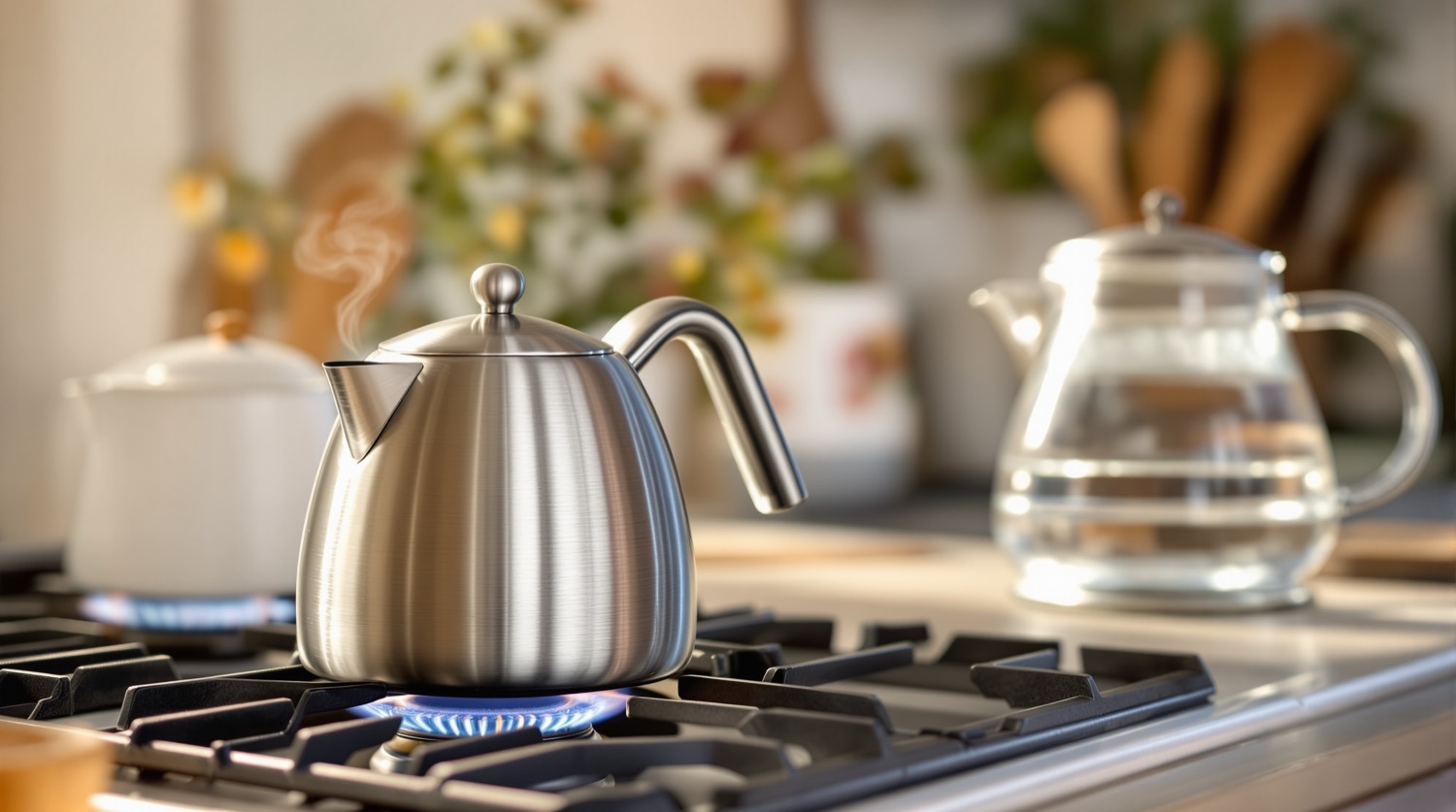
The best stovetop tea kettle in 2026 is the All-Clad Stainless Steel 2 Qt — stainless body, lid and handle, a whistle, and a base that works on gas, electric and induction, in the $110–120 range. The reason to switch from a plastic electric kettle is measured: a 2025 University of Queensland study in npj Emerging Contaminants found new polypropylene kettles released an average of 0.032 µg of microplastics and 0.011 µg of nanoplastics per square centimeter of inner wall on the first boil, falling but never reaching zero over 150 boils. Below: five stovetop kettles in stainless steel, enamel and glass, each checked for which parts actually touch the water.
We earn a commission on qualifying Amazon purchases through the buttons on this page, at no extra cost to you. The research and the rankings are our own.
A kettle is the most-used appliance in a tea or coffee household, and for most of the last twenty years the default one has been a plastic jug with a heating element in the base. It boils water every morning, sometimes several times a day, and the water inside it is as hot as anything in the kitchen ever gets.
That is exactly the condition that makes plastic shed. And unlike most plastic-in-the-kitchen questions, this one now has a direct measurement: a team that bought new plastic kettles, boiled them 150 times, and weighed what came off. The fix is old technology — a kettle that sits on the stove — but it is only a fix if the inside of the kettle is actually steel, enamel or glass. Here is what the research found, and the five that pass.
Do plastic kettles really put plastic in your water?
New polypropylene electric kettles do, and the most careful measurement so far is from late 2025. Shi, Okoffo, Fu, Bapp, Jiang, Rauert and Thomas at the University of Queensland published “Release of nanoplastic from polypropylene kettles” in npj Emerging Contaminants in 2025 (doi 10.1038/s44454-025-00018-w, full text on nature.com). They bought new 1.7-liter polypropylene kettles from two brands sold in Australia, boiled filtered laboratory water in them 150 times, and weighed and counted what came off the inside wall.
| What Shi et al. (2025) measured in new plastic kettles | Figure |
|---|---|
| Kettle plastic and size | Polypropylene, 1.7 L, two brands |
| Microplastics released, first boil (average) | 0.032 µg per cm² of inner wall |
| Nanoplastics released, first boil (average) | 0.011 µg per cm² |
| Nanoplastics, 10th boil | about 0.003 µg per cm² |
| Nanoplastics, 150th boil | 0.0004 µg per cm² (a 96.36% drop) |
| Nanoparticle count, new kettle (particle tracking) | 1.18 × 10⁷ per liter |
| Typical particle size | about 210–580 nm |
| Hard tap water (125 ppm) vs ultrapure water | Hard water released significantly fewer nanoplastics |
Read the count carefully. The paper’s results section reports about 11.8 million nanoparticles per liter from a new kettle, and notes that the particle-tracking instrument tends to overcount. The university’s press release described the figure as almost 12 million per milliliter — a unit 1,000 times larger — and that is the number most news coverage repeated as “3 billion particles in a cup of tea.” We use the paper’s own figure. Either way, the direction is not in doubt: a new plastic kettle sheds polypropylene into the water, most heavily in its first boils, and keeps shedding a smaller amount for as long as it is used.
An earlier study points the same way. Shi, Li, Xiao and colleagues at Trinity College Dublin ran a 100-day test on plastic kettles, published in the Journal of Hazardous Materials in 2022 (doi 10.1016/j.jhazmat.2021.127997, PubMed 34986566). They found that minerals in real tap water build a scale film on the plastic, and after 40 days every mineral they tested cut microplastic release by more than 89% compared with deionized water. That is why hard-water households see less, and why a freshly descaled plastic kettle is, in effect, a new one again.
Is a stovetop kettle the fix?
It removes the part that was measured. A stovetop kettle has no heating element sealed into a plastic jug and no plastic water-level window; the water sits in steel, enamel or glass from the tap to the cup. The Queensland authors make the same point from the other direction: their own suggestion to manufacturers is “alternative designs incorporating more glass or stainless-steel components.” A stovetop kettle is that design, and it has been on sale for a century.
The honest limit is that “no plastic touching the water” is a narrower claim than “no plastic anywhere.” Most stovetop kettles have a handle or lid knob in phenolic resin or silicone, because bare metal gets too hot to hold. Those parts sit outside the water. The thing to check — and the thing every pick below was checked on — is what the inside is made of, including the lid and the whistle.
Does a stainless steel kettle leach metal instead?
Very little, and the main study people cite is about electric kettles. Berg, Petersen, Pedersen, Petersen and Madsen at the Danish Veterinary and Food Administration tested 26 electric kettles on the Danish market and reported in Food Additives & Contaminants in 2000 (doi 10.1080/026520300283441, PubMed 10827900) that 10 of them released more than 50 micrograms per liter of nickel into water, while lead and chromium were not released in any significant amount. Manufacturers changed their designs; in a follow-up of 10 more kettles, two still exceeded that level and were withdrawn from sale.
Fifteen years later, Müller and colleagues at Germany’s Federal Institute for Risk Assessment (BfR) tested 11 electric kettles and 8 coffee machines, reported in Food Additives & Contaminants: Part A in 2015 (doi 10.1080/19440049.2015.1086929, PubMed 26436214), and found the kettles released only low amounts of the metals they tested for. The same study found metal release jumped after descaling in the coffee machines — so whatever kettle you own, run a fill of fresh water through it and pour it away after you descale.
What this means in practice: if you have a diagnosed nickel allergy, enamel-on-steel or borosilicate glass avoids the question entirely. For everyone else, stainless steel’s measured record in plain water is low, and it does not shed plastic, which is the thing you are trying to get away from.
Stainless, enamel or glass — which stovetop kettle material is best?
All three keep plastic out of the water. They differ on what else touches it, how they handle a drop, and whether they work on induction.
| Material | What touches the water | Induction | The honest catch |
|---|---|---|---|
| Stainless steel | Steel (iron, chromium, nickel) | Usually yes | Low measured nickel release; avoid if you have a nickel allergy |
| Enamel on steel | Fused porcelain enamel | Usually yes | Chips if dropped; a chipped interior should be retired |
| Borosilicate glass | Glass only | No | Breakable; slower to heat; handle gets hot |
| Polypropylene electric jug | Plastic wall | n/a | Measured shedding, highest when new (Shi 2025) |
Compare all 5 picks
Every pick side by side — tap a name to jump to the full review, or check today’s price.
| Pick | Water touches | Lid & stove | |
|---|---|---|---|
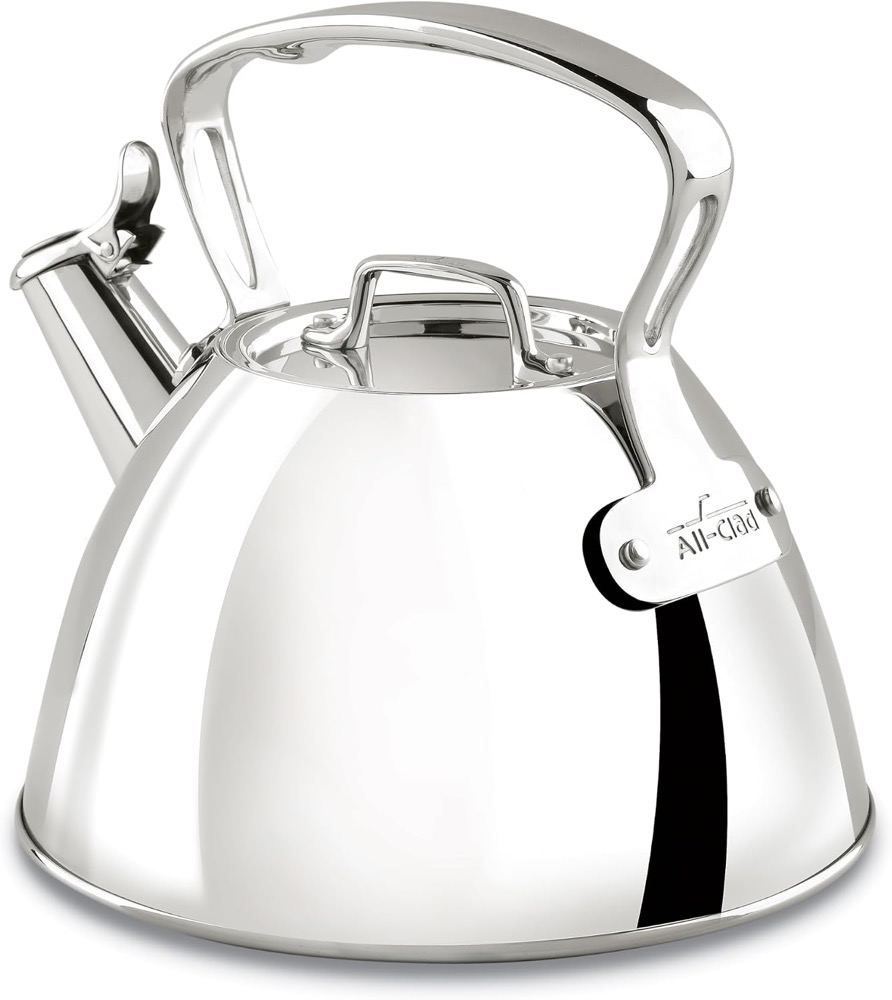 Best OverallAll-Clad 2 Qt |
Stainless steel | Steel lidInductionWhistle |
Check price → |
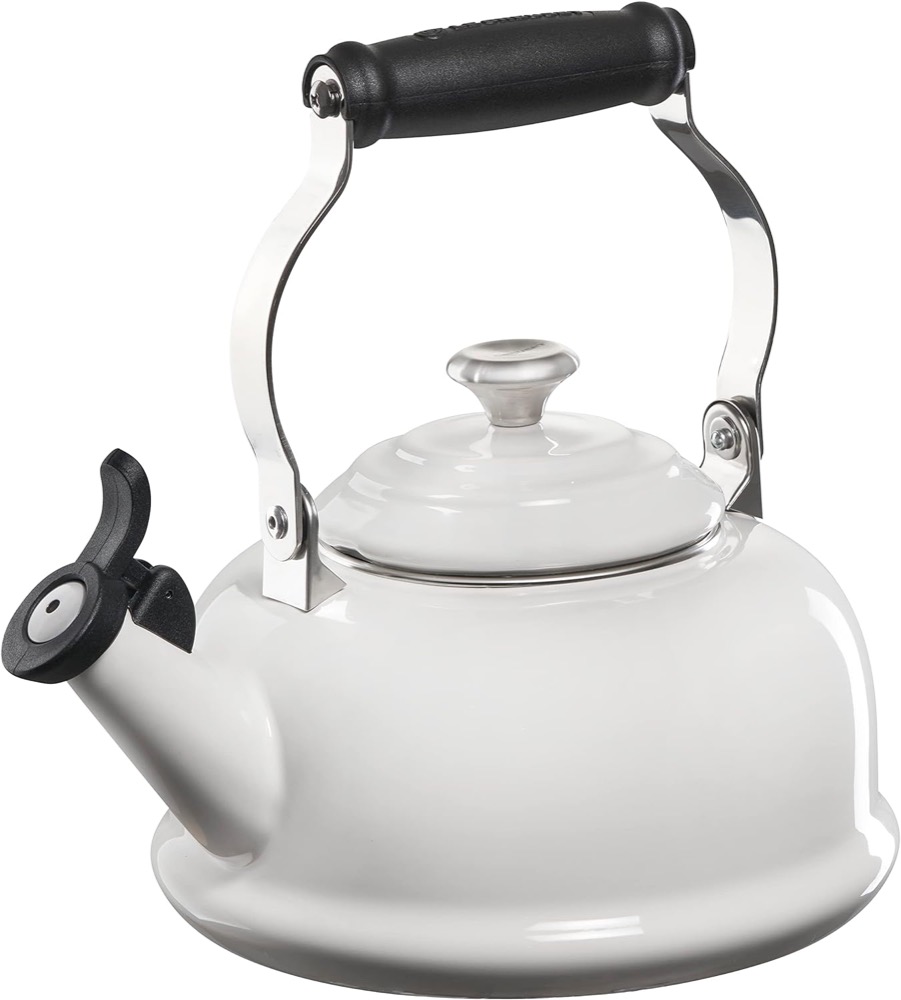 Best EnamelLe Creuset 1.7 Qt |
Enamel on carbon steel | Enamel lidInductionWhistle |
Check price → |
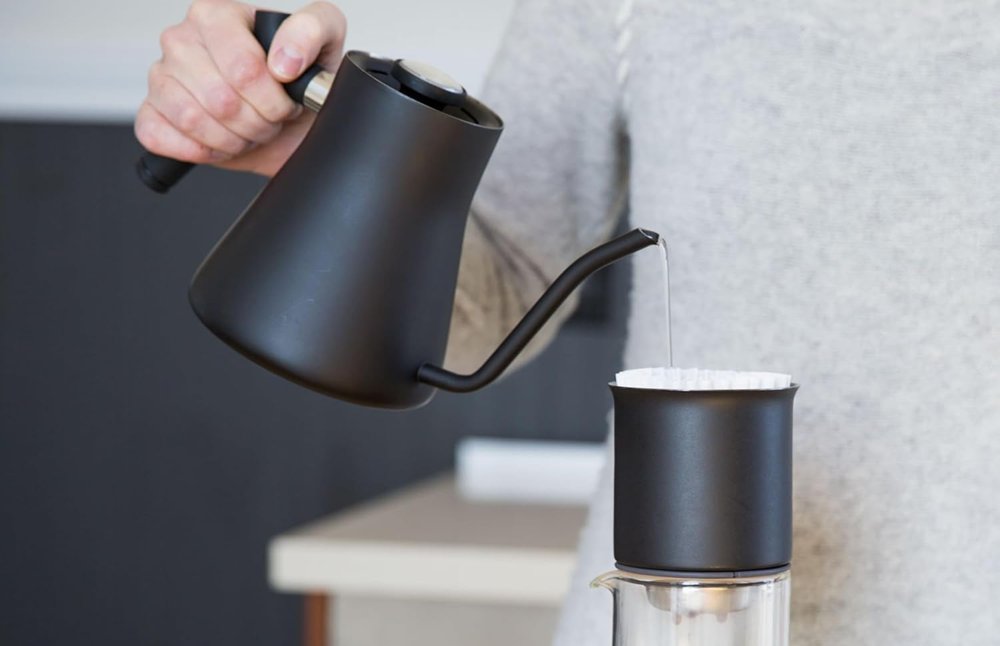 Best for Pour-OverFellow Stagg Stovetop |
18/8 stainless steel | ThermometerNo induction |
Check price → |
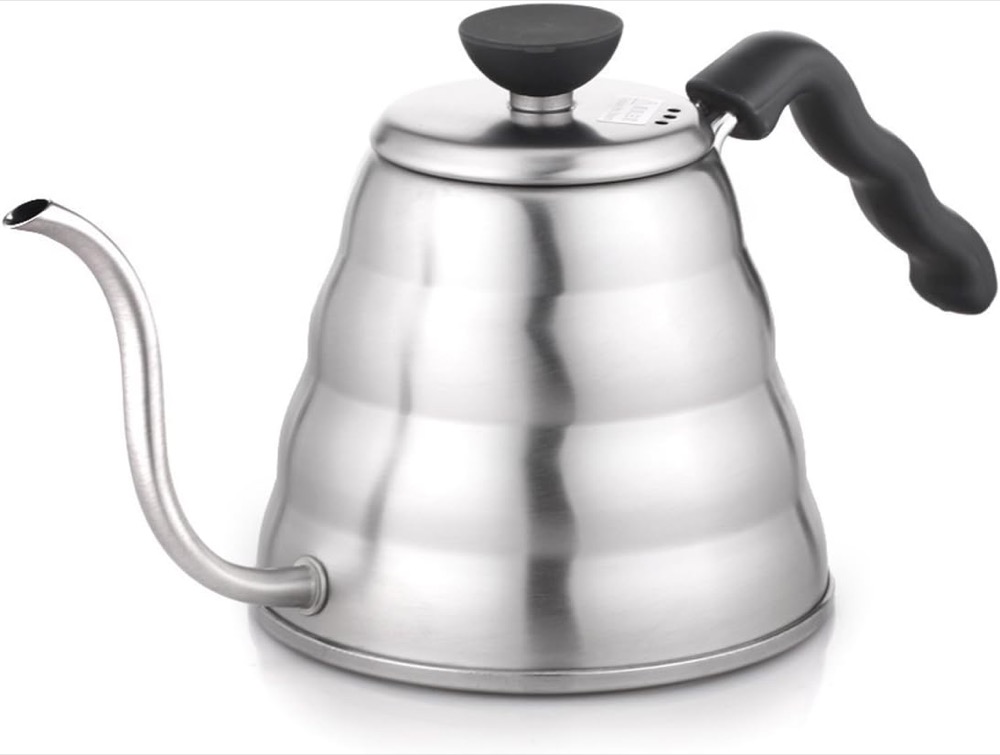 Best Value GooseneckHario V60 Buono |
Stainless steel | Steel lidInduction |
Check price → |
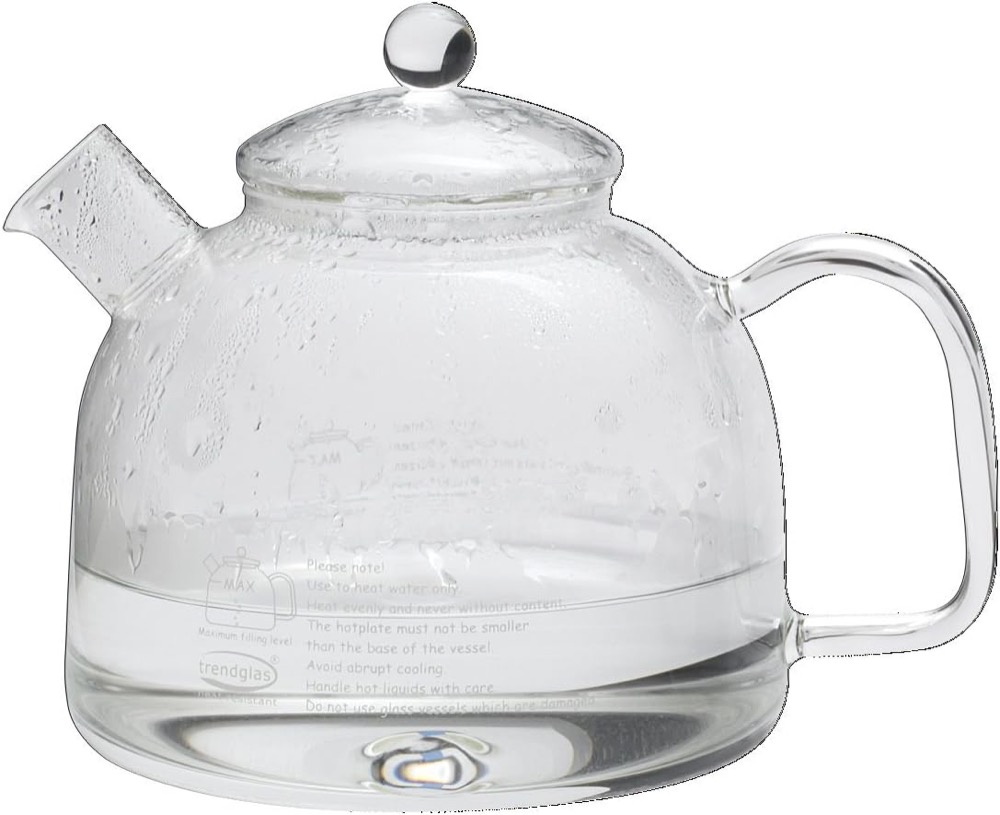 Best GlassTrendglas Jena Glass |
Borosilicate glass | Glass lidNo induction |
Check price → |
The 5 Best Stovetop Tea Kettles in 2026
#1 — All-Clad Stainless Steel 2 Qt Stovetop Tea Kettle — Best Overall
Best Overall
Fill it, set it on any burner, walk away until it whistles — and nothing in the water path is plastic.
Why it’s best for plastic exposure: The body, lid and handle are stainless steel, so boiling water never meets a polymer surface.
Check Today’s Price on Amazon →Amazon prices change daily — tap to see today's price and any active discount.
- Works on induction
- Stainless lid and handle
- 2-quart capacity
The honest trade-offs. It is the most expensive pick here, in the $110–120 range at the time of writing. A metal handle on a metal kettle gets warm, so use a towel or let the burner flame stay under the base rather than licking up the sides. And polished stainless shows water spots; a splash of white vinegar handles both spots and scale.
Best for: The household that wants one kettle, on any stove, with no plastic in the water path and no fuss.
#2 — Le Creuset Enamel on Steel Whistling Tea Kettle (1.7 Qt) — Best Enamel
Best Enamel
A kettle that looks like it belongs on the stove, with a glass-like interior that leaches neither plastic nor metal.
Why it’s best for plastic exposure: Water touches only fused porcelain enamel, which is inert in boiling water and does not shed polymer.
Check Today’s Price on Amazon →Amazon prices change daily — tap to see today's price and any active discount.
- Enamel interior
- Whistles when boiling
- 1.7-quart capacity
The honest trade-offs. Enamel chips if the kettle is dropped or knocked hard, and a chip that exposes steel will rust — retire a kettle with an interior chip. Never let it boil dry, which can crack the enamel. It costs $100–110 at the time of writing. And the materials of the black handle grip and whistle cap are not stated on the listing, so if those matter to you, the all-stainless All-Clad above is the more certain buy.
Best for: Anyone with a nickel sensitivity, or anyone who wants a kettle that never touches water with bare metal.
#3 — Fellow Stagg Pour-Over Stovetop Kettle (1.0 L) — Best for Pour-Over
Best for Pour-Over
Coffee-shop pour control and an exact water temperature, without a plastic electric base.
Why it’s best for plastic exposure: Water is held in an 18/8 stainless body; the thermometer reads through the lid rather than sitting in a plastic housing.
Check Today’s Price on Amazon →Amazon prices change daily — tap to see today's price and any active discount.
- Built-in thermometer
- Precise gooseneck pour
- 1-liter capacity
The honest trade-offs. One liter is small for a family pot of tea. There is no whistle, so it is easy to walk away and forget it. This version does not work on induction. And at $80–90 it costs more than the Hario below, which does the same pour for less without the thermometer.
Best for: The pour-over coffee drinker on a gas or electric stove who wants control over temperature and pour.
#4 — Hario V60 Buono Stovetop Gooseneck Kettle (1.2 L) — Best Value Gooseneck
Best Value Gooseneck
Precise pouring and induction compatibility for roughly the cost of a mid-range electric kettle.
Why it’s best for plastic exposure: Water sits in stainless steel; the only plastic parts, the handle and the lid knob, are outside the water.
Check Today’s Price on Amazon →Amazon prices change daily — tap to see today's price and any active discount.
- Induction compatible
- Gooseneck pour
- Phenolic parts outside the water
The honest trade-offs. The practical capacity is closer to 800 milliliters than 1.2 liters, so it suits one or two mugs at a time. There is no whistle and no thermometer. It sits in the $50–60 range at the time of writing, and the listing showed limited stock, so check availability.
Best for: Coffee and tea drinkers on a budget, including induction-stove households.
#5 — Trendglas Jena Glass Water Kettle with Glass Lid (60 oz) — Best Glass
Best Glass
Total visibility and nothing but glass from the faucet to the cup.
Why it’s best for plastic exposure: Body, lid and handle are borosilicate glass, which is inert in boiling water and has no plastic component at all.
Check Today’s Price on Amazon →Amazon prices change daily — tap to see today's price and any active discount.
- All-glass construction
- See-through water level
- 1.75-liter capacity
The honest trade-offs. It is glass, so it can break, and it does not work on induction. The glass handle gets hot, so use a cloth. It has no whistle. On an electric coil stove, a heat diffuser plate is the safer way to use any glass kettle. It costs $60–70 at the time of writing, and the listing showed limited stock.
Best for: Anyone who wants zero plastic and zero metal, on a gas or electric stove.
Where does plastic still hide on a stovetop kettle?
In three places, and only one of them matters much. The handle and lid knob are usually phenolic resin or silicone, because bare metal gets too hot to hold; they sit outside the water and are not what the kettle studies measured. The whistle cap on the spout sits in the steam path, and its material is often not listed — we have flagged it where we could not confirm it. The lid is the one to check: a plastic lid sits right above boiling water, and every pick here has a steel, enamel or glass lid.
If you are replacing an electric kettle because of plastic, the same check applies there. Our best non-toxic electric kettle guide covers glass and stainless electric models, and do electric kettles have microplastics goes deeper on the plastic kettle research. For the water going in, see whether boiling water removes microplastics, and for what you steep in it, our guide to plastic-free tea bags.
How we evaluated these
We did not run our own laboratory test and we will not imply that we did. We started from the published measurements — the University of Queensland and Trinity College Dublin plastic-kettle studies, and the Danish and German metal-release studies — to decide which materials belong on the list at all. Every pick then had to meet two requirements: the body and lid, the parts that hold and cover boiling water, are stainless steel, enamel or glass; and we name what the handle, knob and whistle are made of wherever the listing says so, and say plainly where it does not. Capacities, induction compatibility and materials come from each product’s Amazon listing, read on November 8, 2026; prices are given as ranges because they change daily. Product photos are the manufacturers’ own listing images. If you are working through the rest of the kitchen, start with our kitchen plastic detox guide and the best non-toxic cookware.
Frequently Asked Questions
The All-Clad Stainless Steel 2 Qt Stovetop Tea Kettle. The body, lid and handle are stainless steel, it whistles, and it works on gas, electric and induction, so boiling water never touches plastic. If you want to avoid bare metal too, the Le Creuset enamel-on-steel kettle puts the water against fused porcelain enamel instead, and the Trendglas Jena kettle is all borosilicate glass.
New plastic ones do. Shi and colleagues at the University of Queensland, writing in npj Emerging Contaminants in 2025, boiled water 150 times in new 1.7-liter polypropylene kettles and measured an average of 0.032 micrograms of microplastics and 0.011 micrograms of nanoplastics per square centimeter of inner wall on the first boil. Nanoplastic release fell by 96.36% by the 150th boil but never reached zero. Electric kettles with a glass or stainless interior avoid most of that plastic surface, though many still have a plastic lid or water window.
For plastic, a stovetop kettle in steel, enamel or glass removes the surface that was measured shedding particles: there is no plastic jug, no plastic water window and no element sealed into a plastic base. An electric kettle with a fully stainless or glass interior can be close, but check the lid, the filter and the water gauge, which are where plastic usually hides. Our electric picks are in the best non-toxic electric kettle guide.
Only a little, in the studies that exist. A Danish study of 26 electric kettles published in Food Additives and Contaminants in 2000 found 10 released more than 50 micrograms per liter of nickel, which led manufacturers to change designs; a 2015 German Federal Institute for Risk Assessment study of 11 electric kettles found only low release. If you have a diagnosed nickel allergy, choose enamel on steel or glass.
If you are keeping a plastic kettle for now, boil and pour away the first several fills when it is new or freshly descaled, since release is highest in the first boils. The Queensland team noted that simple rinsing does not remove as much as boiling and discarding. Hard tap water also helps: minerals form a scale film that a 2022 Trinity College Dublin study found cut microplastic release by more than 89% after 40 days.
Borosilicate glass kettles such as the Trendglas Jena are made for direct heat; the listing states it works on all kinds of stoves except induction. Keep the flame under the base, never heat it empty, and use a heat diffuser plate on an electric coil. Glass can still break if it is dropped or hit.
It is one measured source, not a proven health risk. The World Health Organization's 2022 review of nano- and microplastic exposure ended with research needs rather than a risk figure, and the kettle studies measure particles released, not health effects. Swapping to a steel, enamel or glass kettle is a one-time purchase that removes a known source, which is a reasonable step under uncertainty.
Sources cited
- Shi, K., Okoffo, E. D., Fu, H., Bapp, C., Jiang, J., Rauert, C., & Thomas, K. V. (2025). “Release of nanoplastic from polypropylene kettles.” npj Emerging Contaminants. doi 10.1038/s44454-025-00018-w.
- Shi, Y., Li, D., Xiao, L., Sheerin, E. D., Mullarkey, D., Yang, L., Bai, X., Shvets, I. V., Boland, J. J., & Wang, J. J. (2022). “The influence of drinking water constituents on the level of microplastic release from plastic kettles.” Journal of Hazardous Materials, 425, 127997. doi 10.1016/j.jhazmat.2021.127997 — PubMed 34986566.
- Berg, T., Petersen, A., Pedersen, G. A., Petersen, J., & Madsen, C. (2000). “The release of nickel and other trace elements from electric kettles and coffee machines.” Food Additives & Contaminants, 17(3), 189–196. doi 10.1080/026520300283441 — PubMed 10827900.
- Müller, F. D., Hackethal, C., Schmidt, R., Kappenstein, O., Pfaff, K., & Luch, A. (2015). “Metal release from coffee machines and electric kettles.” Food Additives & Contaminants: Part A, 32(11), 1959–1964. doi 10.1080/19440049.2015.1086929 — PubMed 26436214.
- World Health Organization (2022). Dietary and inhalation exposure to nano- and microplastic particles and potential implications for human health. WHO publication 9789240054608.
- Materials, capacities, induction compatibility and prices: each product’s Amazon listing, read November 8, 2026.
Protect Every Room in Your Home
From the kitchen to the nursery to the bathroom — the Complete Plasticproof Guide covers every swap that matters, backed by 47+ studies.