Yes — reverse osmosis is the most thorough household way to remove microplastics. An RO membrane's pores are about 0.0001 microns (0.1 nanometer) wide — roughly 10,000 times smaller than the 1-micron mark where most microplastics are counted — so the particles simply can't pass through. Peer-reviewed studies of RO drinking-water systems report around 99.9% microplastic removal, and RO is one of the few methods that also captures the much smaller nanoplastics. The honest caveats: no filter is a perfect 100% at the nano scale, RO wastes some water and strips out minerals, and only a certified system is worth trusting.
If you've started reading about microplastics in water, you've probably run into reverse osmosis — usually described as the "gold standard." That reputation is earned, but the marketing around it is a mess: every filter company now slaps "removes microplastics" on the box, whether it's a true RO membrane or a basic carbon cartridge that behaves nothing like one. It's worth knowing exactly what RO does, and where the claim quietly breaks down.
The short version is that reverse osmosis works on microplastics for a simple physical reason, and the evidence backs it up. But "it works" isn't the whole story. RO also comes with real trade-offs, it isn't always necessary, and a cheaper filter is sometimes enough. This guide walks through how RO actually blocks microplastics, whether it catches nanoplastics too, the honest downsides, and which systems are genuinely worth buying in 2026.
The bottom line up front: reverse osmosis removes essentially all microplastics and most nanoplastics — more than any pitcher or countertop carbon filter. If you want the full picture, compare it against other methods in our Brita vs. Berkey vs. reverse osmosis breakdown, see the best reverse osmosis systems for 2026, or start cheaper with a certified water filter pitcher.
Does reverse osmosis remove microplastics?
Yes — and it's not close. Reverse osmosis pushes water through a semipermeable membrane whose effective pore size is roughly 0.0001 microns (0.1 nanometer). Microplastics are defined as plastic pieces smaller than 5 millimeters, and the smallest fragments typically measured in drinking water sit around 1 micron. That makes the membrane's openings about 10,000 times smaller than the particles trying to get through. There's no clever chemistry here — the plastic is simply too big to fit.
The measured results match the physics. In a 2025 study of two large seawater reverse osmosis plants supplying the Barcelona metropolitan area, the RO stage removed microplastics with efficiencies of 99.9% and 97.8%. Reviews of household and municipal RO consistently land in the same range: about 90–99.9% removal when the membrane is intact and the system is working properly. Compared with the microplastics already present in a lot of tap water, that's a dramatic cut.
How reverse osmosis actually blocks microplastics
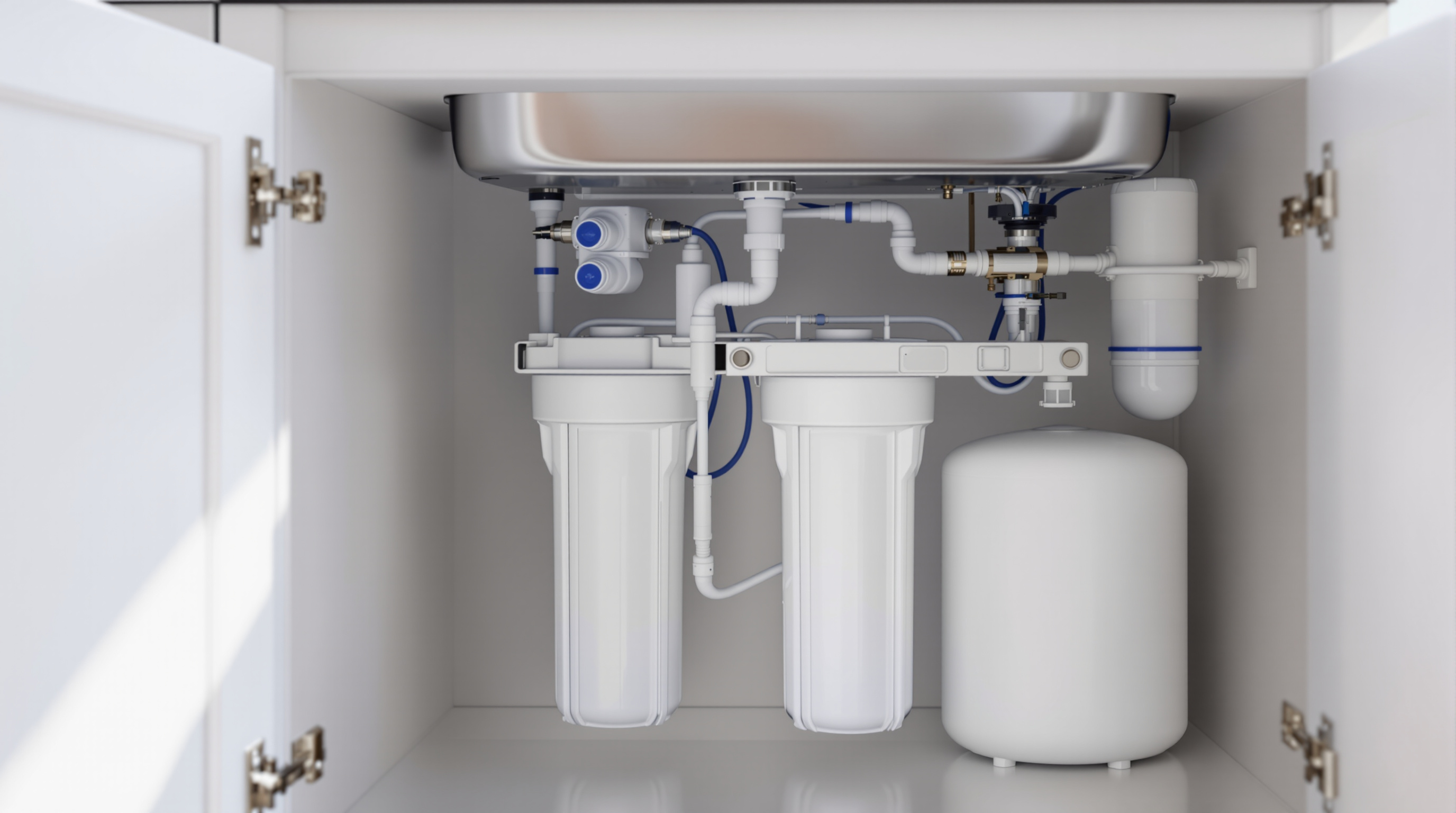
An RO system is really a series of filters ending in the membrane that does the heavy lifting. Water first passes a sediment pre-filter (grit and rust) and a carbon pre-filter (chlorine, which would otherwise damage the membrane). Then household water pressure forces it against the reverse osmosis membrane. Water molecules squeeze through the microscopic pores; microplastics, dissolved salts, lead, fluoride, nitrates, and PFAS are too large and get flushed away down the drain line. A final carbon post-filter polishes the taste before the water reaches your glass.
That membrane is the whole reason RO outperforms a standard carbon pitcher. A carbon cartridge works by adsorption — contaminants stick to the carbon — which is great for chlorine and taste but inconsistent for physical particles. A membrane works by exclusion: if the particle is bigger than the pore, it cannot pass, full stop. That's why "removes microplastics" means something very different on an RO box than on a basic filter.
How RO compares to other ways of removing microplastics
Not every filter that mentions microplastics performs like reverse osmosis. What matters is the pore size and whether the product is actually certified for the job. A 2023 study in the journal Polymers tested ordinary point-of-use carbon devices and found microplastic removal ranging from below 50% to nearly 100% — the best performer was the one with the smallest pore size (0.2 microns), while a plain carbon-and-ion-exchange unit sometimes let more particles out than went in. Pore size is the whole game, and RO's is in a different league.
| Method | Typical Microplastic Removal | Notes |
|---|---|---|
| Reverse osmosis | ~99.9% | Membrane pores ~0.0001µm block microplastics and most nanoplastics; also removes lead, fluoride, PFAS |
| Certified hollow-fiber / P473 pitcher | High (when certified) | Good for microplastics at low cost, no water waste — but check the certification, not the slogan |
| Basic carbon pitcher | Inconsistent (<50–100%) | Not designed or certified for microplastics; performance depends entirely on pore size |
| Standard fridge / faucet filter | Variable, usually low | Built for chlorine and taste; rarely certified for microplastics |
| Boiling | Limited / unreliable | Can clump some particles in hard water but does not filter them out |
If a certified pitcher is all you need, that's a legitimate, cheaper choice — see our guide to the best water filter pitchers for microplastics, and why a plain Brita only partly removes microplastics. RO simply goes further, and reaches smaller particles.
"A carbon filter asks microplastics to stick to it. A reverse osmosis membrane doesn't ask — the particle is bigger than the door, so it isn't getting in."
Does reverse osmosis remove nanoplastics too?
This is where RO really separates from everything else. Nanoplastics are the fragments smaller than 1 micron — often below 100 nanometers — and they matter because there are so many of them. A 2024 study from Columbia University, published in PNAS, used a new imaging technique to count the particles in bottled water and found an average of about 240,000 plastic particles per liter, roughly 90% of them nanoplastics. Most filters never see particles that small.
Because an RO membrane's pores are around 0.1 nanometer, it blocks the large majority of nanoplastics as well, with studies reporting rejection well above 90%. It isn't a perfect 100% — a small fraction of the very smallest particles can slip through, and no household system should be sold as flawless — but reverse osmosis removes far more of the nano-scale plastic than a carbon pitcher, a fridge filter, or boiling ever could. If nanoplastics are what worry you, RO is the most complete answer currently available for the home. It's also a strong argument for filtering tap water instead of buying bottled water, which the same research shows is a heavy source of nanoplastics.
The honest catch: what reverse osmosis costs you
RO is the most thorough option, not the free one. Before you buy, weigh the real trade-offs — none of them are dealbreakers for most people, but you should know them going in.
It wastes some water. The membrane flushes rejected contaminants down the drain, so RO produces "reject" water. Older tank systems can send 3–4 gallons to the drain per gallon purified; modern tankless systems are far better, often around 1.5–2 to 1. It strips minerals. RO removes beneficial calcium and magnesium along with the bad stuff, which flattens the taste — systems with a remineralization ("alkaline") stage add them back. It needs installation and maintenance. Under-sink units require plumbing and a faucet; countertop units don't, but all of them need periodic filter and membrane changes.
"Reverse osmosis" only helps if the system actually performs. Look for independent certification — NSF/ANSI Standard 58 is the reverse osmosis standard, and marks like the WQA Gold Seal or IAPMO testing confirm the claims. Even at municipal RO plants, researchers have found microplastics can be reincorporated at later treatment stages, which is exactly why the quality of the whole system — not just the membrane — matters. Skip any product that promises microplastic removal without a certification to back it.
Is reverse osmosis worth it — or is it overkill?
Here's the honest proportion. The World Health Organization's 2019 review concluded that microplastics in drinking water "don't appear to pose a health risk at current levels," while stressing that the data are limited and more research is needed. So reverse osmosis is a sensible precaution, not an emergency purchase — and whether it's the right call depends on your water.
Reverse osmosis makes the most sense if you're on well water, have high total dissolved solids (TDS), or are dealing with lead, fluoride, nitrates, arsenic, or PFAS on top of microplastics — RO handles all of them at once. A certified pitcher or countertop filter is often enough if microplastics and taste are your only concern and your municipal water is otherwise good. Either way, filtering your own tap water beats buying bottled, which carries its own heavy plastic load.
Not sure how far to go? Start with the fundamentals
Whether you land on reverse osmosis or a simple certified pitcher, the goal is the same: cut the microplastics in the water you drink most. Compare your options first.
The best reverse osmosis systems for microplastics (2026)
These are established RO systems with strong independent certifications and thousands of owners. They span the two real choices: countertop units that need no plumbing, and under-sink units that install permanently and deliver water from a dedicated faucet. Prices and availability change constantly, so check the current listing.
1. AquaTru Classic — Best Overall (No Installation)
 Best Overall
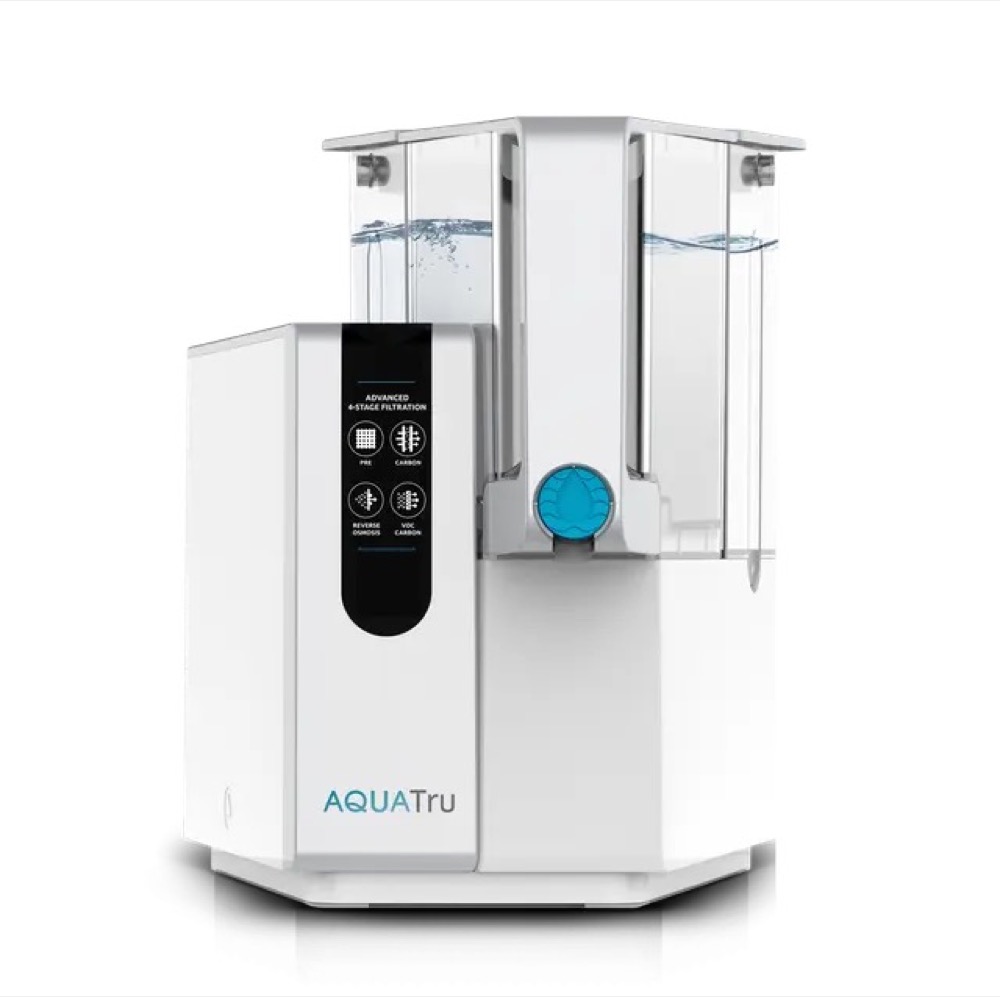
True reverse osmosis with zero installation — fill the back tank, press a button, and purified water collects in the front. Ideal for renters or anyone who doesn't want to touch the plumbing.
Why it's thorough: The RO membrane physically blocks microplastics and nanoplastics, and its NSF/ANSI 58 + P473 certifications confirm reduction of dissolved contaminants like PFAS, lead, and fluoride too.
Check Today's Price on Amazon →Amazon prices change daily — tap to see today's price and any active discount.
- Free delivery & returns for Prime members
- Sold & shipped by Amazon
- Thousands of verified reviews
If you want reverse osmosis without cutting into your cabinet or hiring a plumber, the AquaTru Classic is the clearest pick. It's one of the very few countertop systems carrying formal NSF/ANSI certifications for microplastics, PFAS, lead, and fluoride, so the "removes microplastics" claim is backed by testing rather than marketing.
2. Waterdrop G3P600 — Best Under-Sink (Tankless)
 Best Under-Sink
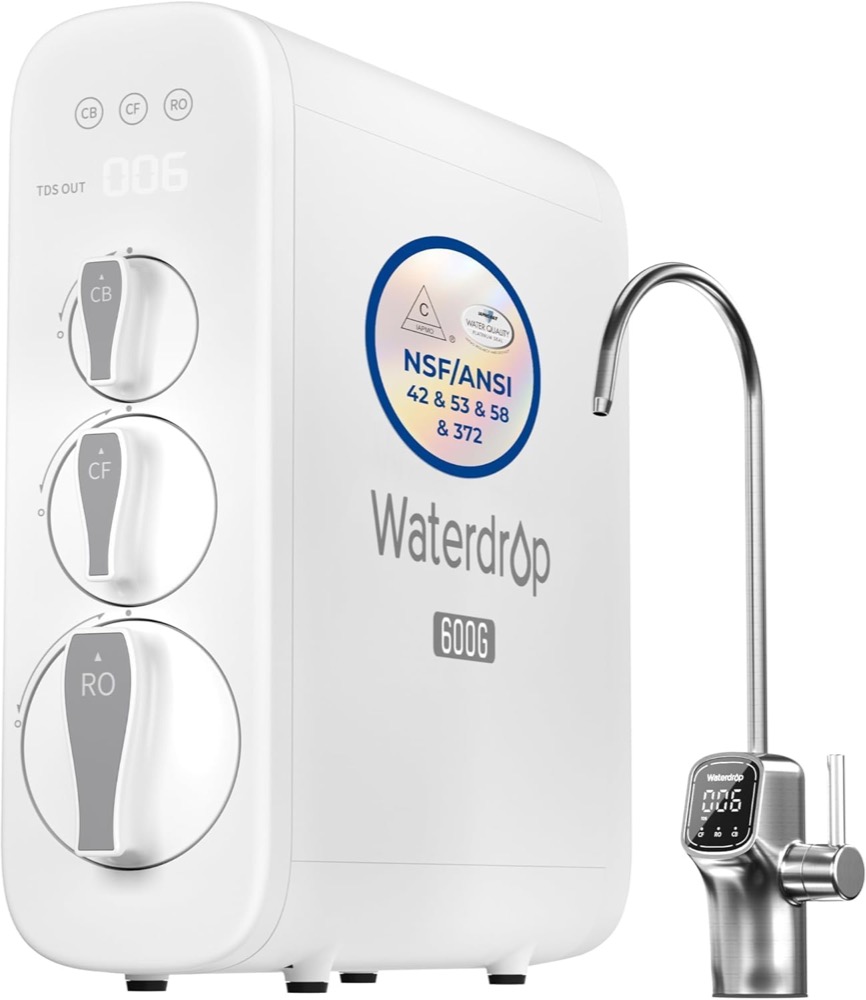
No storage tank means no standing water and a smaller footprint under the sink, plus enough flow (600 GPD) to fill a glass without waiting.
Why it's thorough: A true RO membrane blocks microplastics and nanoplastics, while the NSF/ANSI 58 certification verifies dissolved-solids reduction and 372 confirms lead-free contact materials.
Check Today's Price on Amazon →Amazon prices change daily — tap to see today's price and any active discount.
- Free delivery & returns for Prime members
- Sold & shipped by Amazon
- Thousands of verified reviews
For a permanent kitchen setup, the tankless Waterdrop G3P600 is the modern default. The lack of a storage tank means no pool of standing water and more room under the sink, and its 2:1 efficiency wastes far less than the older 3–4:1 tank designs. The NSF/ANSI 58 certification is the credential that matters for an RO system.
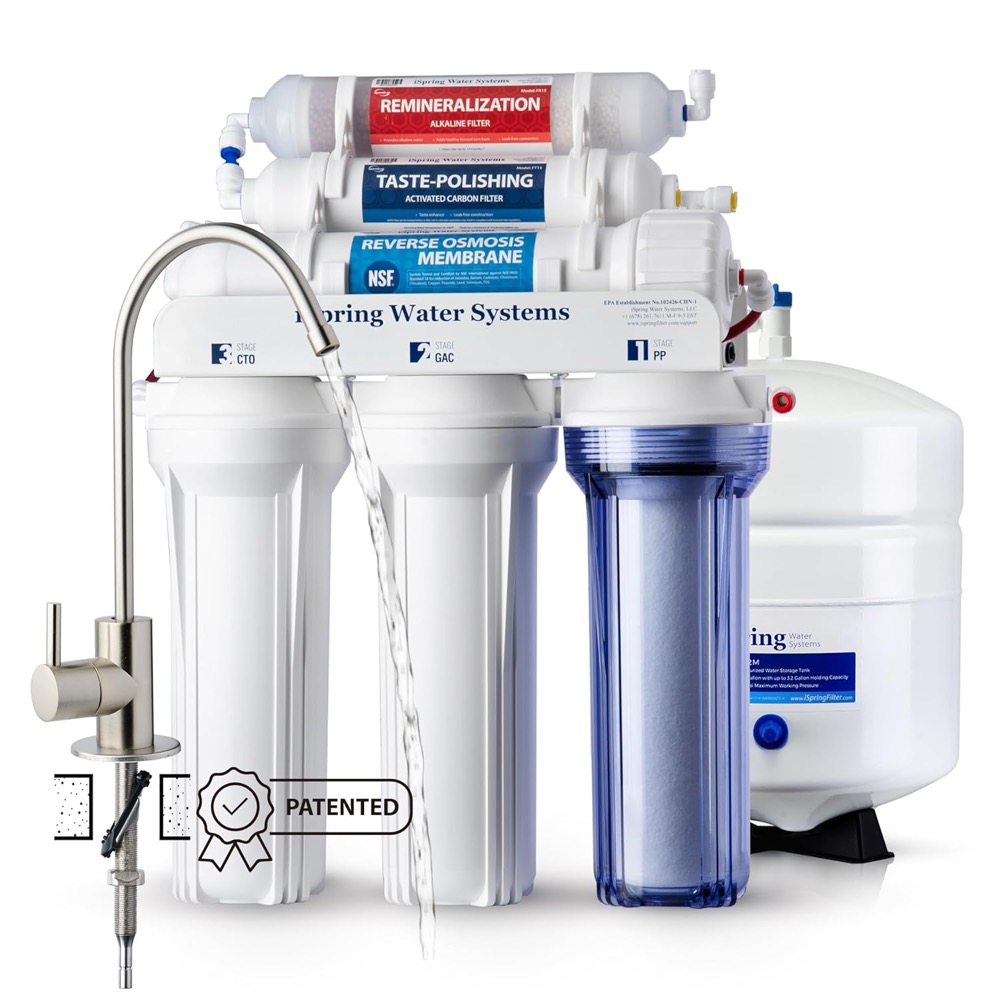
3. iSpring RCC7AK — Best Remineralizing
 Best Remineralizing
Gets the thoroughness of reverse osmosis without the flat, stripped taste — the alkaline stage remineralizes the water on its way to your glass.
Why it's thorough: The RO membrane blocks microplastics, nanoplastics, and dissolved contaminants; the extra stages simply improve taste and mineral content afterward.
Check Today's Price on Amazon →Amazon prices change daily — tap to see today's price and any active discount.
- Free delivery & returns for Prime members
- Sold & shipped by Amazon
- Thousands of verified reviews
The most common complaint about RO water is that it tastes flat, because the membrane removes minerals along with everything else. The iSpring RCC7AK solves that with a sixth alkaline remineralization stage that adds calcium and magnesium back after filtration — the same purity, a rounder taste.
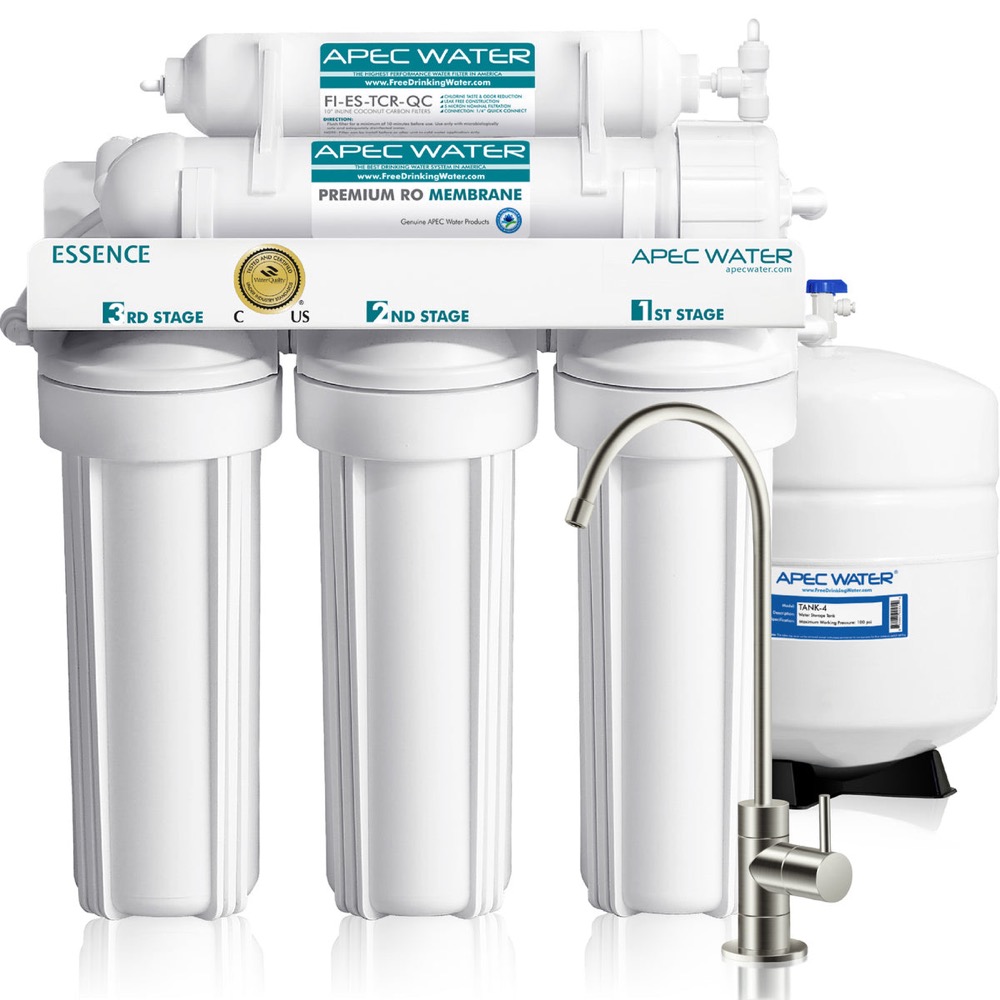
4. APEC ROES-50 Essence — Best Classic 5-Stage (USA-Made)
 Best Classic 5-Stage
A proven, heavily reviewed system that just works — quality membrane, easy filter changes, and responsive US-based support for the long haul.
Why it's thorough: The high-rejection FILMTEC RO membrane blocks microplastics and dissolved contaminants alike, and the WQA Gold Seal certification independently backs the removal claims.
Check Today's Price on Amazon →Amazon prices change daily — tap to see today's price and any active discount.
- Free delivery & returns for Prime members
- Sold & shipped by Amazon
- Thousands of verified reviews
If you want a conventional tank-based RO with a long track record, the APEC ROES-50 is the enthusiast favorite. It's WQA Gold Seal certified, built around a genuine FILMTEC membrane, and assembled in the USA — unglamorous, but exactly what you want from a system you'll keep for a decade.
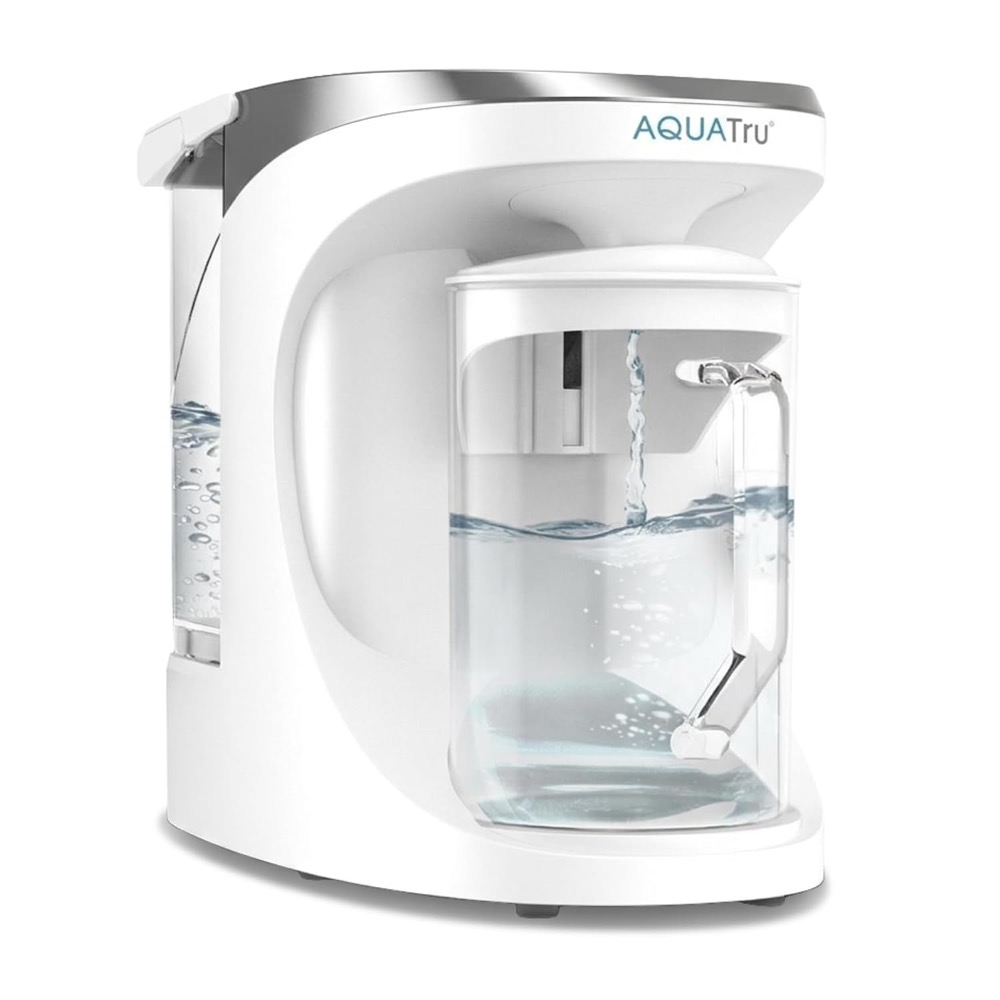
5. AquaTru Carafe — Best Compact Countertop
 Best Compact
The smallest way to get genuine reverse osmosis: no plumbing, no big machine, just a carafe you fill — perfect for renters and compact kitchens.
Why it's thorough: It uses a real RO membrane rather than a simple carbon cartridge, so it physically blocks microplastics instead of merely adsorbing chlorine and taste.
Check Today's Price on Amazon →Amazon prices change daily — tap to see today's price and any active discount.
- Free delivery & returns for Prime members
- Sold & shipped by Amazon
Want the Full Home Protection Guide?
Your drinking water is the highest-volume thing you put in your body — but it's one of dozens of plastic touchpoints at home. The Complete Plasticproof Guide covers every room, with 80+ product recommendations backed by 47+ studies.
The honest verdict
Does reverse osmosis remove microplastics? Yes — more completely than any other method you can install at home. The membrane's pores are about 10,000 times smaller than the smallest microplastics, studies of RO drinking-water systems report removal around 99.9%, and it's one of the only household technologies that also captures the far smaller nanoplastics. That part isn't marketing; it's physics plus measurement.
The honest framing is just as important. Microplastics in tap water don't appear to pose a proven health risk at current levels, so RO is a reasonable precaution rather than an emergency. It costs some wasted water and stripped minerals, it needs a certified system to live up to the claim, and for many people a certified pitcher covers microplastics at a fraction of the price. Buy reverse osmosis if you want the most thorough water in the house — especially on well water or with multiple contaminants — and buy it on its certification, not its slogan.
Ready to pick a system?
See how the top reverse osmosis systems stack up, or compare RO against the simpler filters if you're not sure you need it.
Frequently Asked Questions
Yes. Reverse osmosis is the most thorough household method for removing microplastics. An RO membrane's effective pore size is about 0.0001 microns (0.1 nanometer), roughly 10,000 times smaller than the 1-micron threshold at which most microplastics are counted, so the particles physically cannot pass through. Peer-reviewed studies of RO drinking-water systems have reported microplastic removal of around 99.9%.
Mostly, yes. Nanoplastics are far smaller than microplastics (below 1 micron, often below 100 nanometers), and RO is one of the few household technologies that removes the large majority of them, with studies reporting rejection well above 90%. No filter is a perfect 100% at that scale — a small fraction of the very smallest nanoplastics can slip through — but RO removes far more than a carbon pitcher, boiling, or a basic fridge filter.
A reverse osmosis membrane has an effective pore size of about 0.0001 microns (0.1 nanometer). Microplastics are defined as plastic pieces under 5 millimeters, and the smallest ones typically measured in water are around 1 micron — roughly 10,000 times larger than the pores. Because the openings are so much smaller than the particles, microplastics are blocked by simple physical exclusion, and dissolved contaminants like lead, fluoride, and PFAS are rejected too.
Yes. RO strips out beneficial minerals like calcium and magnesium along with the contaminants, but the amount you get from water is small compared with food, and RO water is safe to drink. If you prefer the taste and minerals of harder water, choose a system with a remineralization stage (often labeled "alkaline" or "mineralizing"), which adds minerals back after the membrane.
For microplastics specifically, a filter certified for them — such as a hollow-fiber pitcher with NSF/ANSI P473 or a documented microplastics claim — can remove the large majority at a far lower cost, with no water waste and no plumbing. Reverse osmosis goes further: it also removes dissolved contaminants (lead, fluoride, PFAS, nitrates) and the smallest nanoplastics. Choose RO if you have well water, high TDS, or multiple contaminants; a certified pitcher is often enough if microplastics are your main concern.
It produces some reject (drain) water because the membrane flushes rejected contaminants away. Older tank systems can waste roughly 3 to 4 gallons per gallon of purified water, while modern tankless systems are far more efficient — often around 1.5 to 2 gallons drained per gallon produced. It is a real trade-off, but for most households the volume is modest, and newer systems have improved substantially.
Sources
- Sol D, et al. "Removal and reincorporation of microplastics at several stages of two seawater reverse osmosis plants that provide drinking water to the Barcelona metropolitan area." Desalination, 2025. (RO stage microplastic removal of 99.9% and 97.8%.)
- Qian N, et al. "Rapid single-particle chemical imaging of nanoplastics by SRS microscopy." Proceedings of the National Academy of Sciences (PNAS), January 2024. (Bottled water averaged ~240,000 particles/L, ~90% nanoplastics.)
- Cherian AG, Liu Z, McKie MJ, Almuhtaram H, Andrews RC. "Microplastic Removal from Drinking Water Using Point-of-Use Devices." Polymers, 2023;15(6):1331. (Carbon POU removal ranged below 50% to nearly 100%, driven by pore size.)
- World Health Organization. "Microplastics in Drinking-water." 2019. (Microplastics don't appear to pose a health risk at current levels; data limited; conventional treatment removes >90%.)
- NSF International / IAPMO R&T. NSF/ANSI Standard 58 (Reverse Osmosis Drinking Water Treatment Systems); manufacturer certification listings for AquaTru, Waterdrop G3P600, iSpring, and APEC.