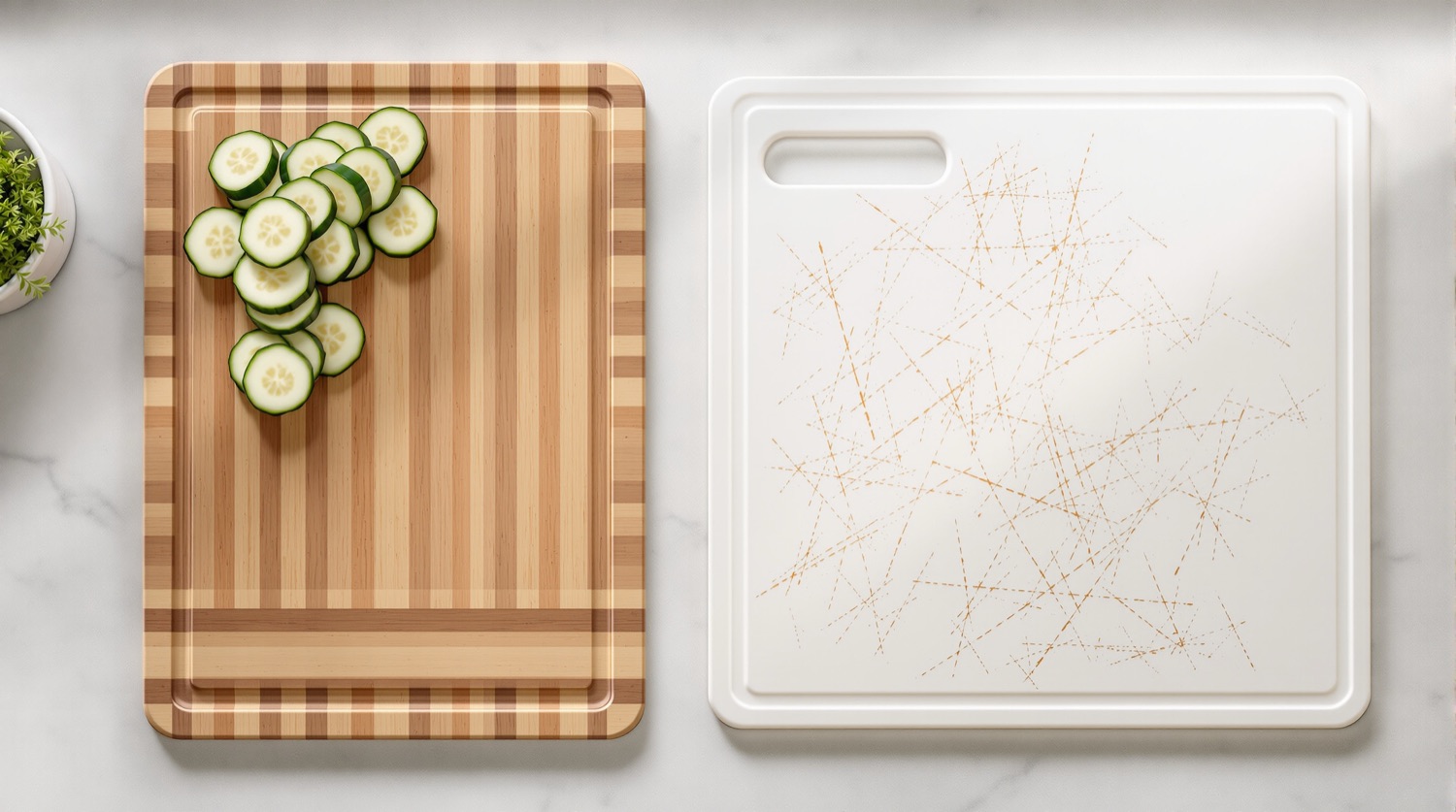
Solid bamboo beats plastic on the one number that matters most here: it puts no plastic into your food, while a plastic board sheds an estimated 14.5 to 79.4 million microplastic particles a year (Yadav et al., Environmental Science & Technology, 2023). Buy a striped, solid-strip bamboo board such as the Totally Bamboo Kauai, skip anything sold as “bamboo fiber” or “bamboo composite” (that is melamine plastic), hand wash it, and expect it to be harder on knives than plastic.
Bamboo is usually sold as the “eco” cutting board, and plastic as the practical one. Neither label answers the question most people are actually asking, which is what each board puts into the food you eat. That question now has real numbers behind it on the plastic side, and a real trap on the bamboo side that almost no product listing explains: the word “bamboo” is printed on two very different things, one of which is a plastic.
This guide compares bamboo and plastic cutting boards on five things, each tied to a named study or official guidance: microplastic release, glue and formaldehyde, bacteria, knife wear, and care. Our sister guide, wood vs plastic cutting board, covers hardwoods like maple and walnut; this page is about bamboo specifically.
Does a plastic cutting board put microplastics in your food?
Yes, and by the only published yearly estimate, it is tens of millions of particles. The North Dakota State University team behind “Cutting Boards: An Overlooked Source of Microplastics in Human Food?” (Yadav et al., Environmental Science & Technology, 2023, vol. 57, pp. 8225–8235) had people chop on polyethylene and polypropylene boards, the two plastics nearly every store board is made from, and measured what came off.
Their estimate: 7.4 to 50.7 grams of plastic a year from a polyethylene board, or 14.5 to 71.9 million particles, and 49.5 grams, or 79.4 million particles, from a polypropylene board. Polypropylene shed 14 to 71% more particles than polyethylene. Chopping carrots on polyethylene released more than chopping with no food on the board, so real cooking is the worse case, not the better one. Most particles were under 100 microns, far too small to see on a slice of vegetable.
A follow-up feeding study, Gan et al., Environmental Health Perspectives, 2025, measured release per cut: about 0.078 mg from a new polyethylene board and 0.106 mg from a new polypropylene board, rising to 0.277 and 0.249 mg per cut by the twelfth cutting cycle as the surface wore. A scarred plastic board sheds two to three times what a new one does. The 2023 team’s own preliminary toxicity test found no effect of polyethylene particles on mouse cells over 72 hours, so the honest summary is: the exposure is measured, the long-term human effect is not yet known.
Does a bamboo cutting board shed microplastics?
A solid bamboo board does not, because there is no plastic in the cutting surface. Bamboo is a grass, and a solid board is made of flat strips of the stalk glued side by side, which is why most bamboo boards have that striped look. Cutting on it releases bamboo fiber, the same kind of plant material as the cellulose in vegetables, not a synthetic polymer that the body cannot break down.
The thin glue lines between strips are the only non-bamboo material in the cutting surface. No published study has measured particle release from bamboo glue lines specifically, so we will not invent a number. What we can say is that the glue is a tiny fraction of the surface, and that the much bigger question about glue is not particles but formaldehyde.
Do bamboo cutting boards have formaldehyde in the glue?
Some bamboo products do, and the best government data comes from one specific kind: molded bamboo-fiber items. These are made by mixing bamboo powder into melamine-formaldehyde resin and pressing it into shape. They are marketed as natural and biodegradable, but they are a plastic with bamboo filler. In 2019 the Netherlands Food and Consumer Product Safety Authority (NVWA) tested 46 of these bamboo/melamine cups, published as Bouma et al., Chemosphere, 2022 (vol. 292, 133439).
The results: 88% stayed within the EU formaldehyde migration limit of 15 mg per kg of food, which means about 12% did not, and some released more than 200 mg/kg. The authors calculated that someone drinking 0.4 liters a day from a cup would exceed the health-based guidance value at a migration of just 19 mg/kg, and that the legal limit does not adequately protect babies and young children. Bamboo is not an authorized additive in plastic food-contact materials in the EU, and the Netherlands, Belgium, Luxembourg and other member states have pulled these products from shelves.
A solid-strip bamboo cutting board is a different object: the bamboo is the board, and glue only holds the strips together. Brands rarely publish exactly which adhesive they use, and we could not find a published migration study on solid bamboo cutting boards. So the practical rule is simple. Buy striped, solid-strip bamboo from a brand that names its glue as food-safe and formaldehyde-free, and never buy a “bamboo fiber,” “bamboo powder” or dishwasher-safe molded bamboo board.
How to spot a bamboo-fiber (melamine) board: it looks smooth and uniform rather than striped, it is often thin and colorful, and the listing says “dishwasher safe,” “bamboo fiber,” “eco composite” or “biodegradable.” Solid bamboo shows visible strips and growth nodes and is always hand-wash only.
Bamboo vs Plastic Cutting Board: Side by Side
Every row is tied to a named source below, or marked — where no measurement exists.
| Feature | Plastic (PE / PP) | Solid bamboo | “Bamboo fiber” composite |
|---|---|---|---|
| What it is | Molded polyethylene or polypropylene slab | Strips of bamboo glued side by side | Bamboo powder in melamine-formaldehyde resin |
| Plastic shed per year | 14.5–71.9 million (PE), 79.4 million (PP) | None from the bamboo; glue lines unmeasured | It is a plastic; release not measured for boards |
| Release per cut (new → worn) | 0.078–0.106 mg → 0.249–0.277 mg | — | — |
| Formaldehyde risk | Not a formaldehyde resin | Depends on glue; choose a brand that names it | 12% of tested bamboo/melamine cups over the EU limit |
| Bacteria | Bacteria recoverable for hours (1994 study); grooves hard to clean | Less porous than most woods; strongest antibacterial result of 5 woods (2012) | — |
| Knife edges | Gentle | Hard; dulls knives faster | Hard |
| Dishwasher | Yes | No, hand wash | Usually labeled yes |
| When to replace | As soon as it has deep grooves | When deeply grooved or cracked; can be oiled to slow wear | Avoid buying |
| Our verdict | Retire it, or keep it only for raw meat and replace often | Recommended | Avoid |
Is bamboo or plastic more sanitary for raw meat?
Neither material is a free pass, but the evidence does not favor plastic the way the old kitchen advice claimed. In the classic University of Wisconsin–Madison study, Ak, Cliver and Kaspar, Journal of Food Protection, 1994, bacteria such as E. coli O157:H7, Listeria and Salmonella were readily recovered from plastic for minutes to hours and multiplied if left overnight, while on clean hardwood they were absorbed and generally could not be recovered at raw-meat doses. The authors wrote that their results “do not support the often-heard assertion that plastic cutting boards are more sanitary than wood.”
That study did not include bamboo. A 2012 study in the Korean Journal of Food Science and Technology (record in the UN FAO AGRIS database) did, testing three antibacterial plastics, a regular plastic, and five woods: red pine, rubber tree, cypress, birch and bamboo. Bamboo showed the highest antibacterial activity of the woods against five foodborne bacteria, including E. coli O157:H7 and Salmonella Typhimurium. To be fair to plastic, the plastic boards also showed strong activity against E. coli O157:H7, Salmonella and Staphylococcus aureus. The honest reading is that bamboo holds its own; it is not a reason to skip washing.
Official guidance points the same way. NC State Extension, summarizing USDA advice, says bamboo boards “are harder, resist scarring from knives and less porous so they are less absorbent and more resistant to bacteria than other woods,” and that any board with hard-to-clean grooves should be replaced. That last point matters most for plastic: grooves are where bacteria hide and, per the 2025 study, where microplastic release doubles.
Do bamboo cutting boards ruin knives?
They wear an edge faster than plastic, and this is bamboo’s real downside. The same NC State Extension guidance notes that “bamboo is a hard material and can dull knives faster than softer wood or plastic cutting boards,” and recommends maple and beech as gentler hardwoods. If you hone your knives regularly, the difference is easy to live with. If you own expensive Japanese knives, a hard maple board gives you the same zero-plastic result with less edge wear; that is why our second pick below is not bamboo.
Which should you buy: bamboo or plastic?
Choose solid bamboo if:
- You want plastic out of your food for the lowest price
- You want a light board that is easy to lift and rinse
- You are fine hand washing and oiling it now and then
- Your knives are everyday knives you hone or sharpen
Choose something else if:
- You prize your knife edges: pick hard maple instead
- You need a dishwasher board for raw meat: pick a wood-fiber composite, not plastic
- You keep a plastic board anyway: use it only for raw meat and replace it at the first deep grooves
For the full ranked lineup across wood, bamboo and composite, see our best non-toxic cutting boards guide. For the plastic-board study on its own, read do plastic cutting boards release microplastics. And since the board is only one of several plastic contact points in a kitchen, our list of kitchen mistakes that put microplastics in your food covers the rest.
The Three Boards We Recommend
One solid bamboo board, one hardwood upgrade for people who care about their knives, and one dishwasher-safe board that is not polyethylene or polypropylene.
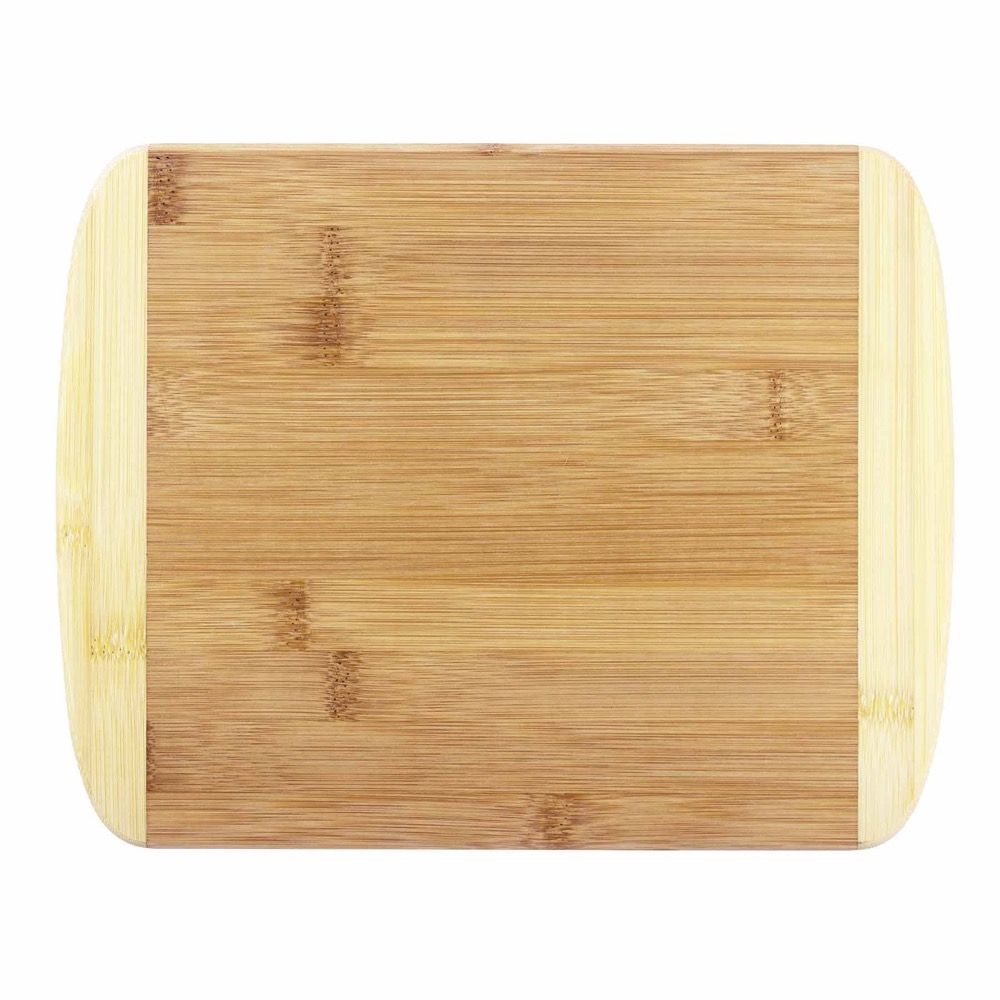 Best Bamboo
Pros
- Solid bamboo surface: no polyethylene or polypropylene to shed
- Light enough to rinse and flip one-handed
- Less porous than most woods, per NC State Extension
- Low price for a plastic-free board
Cons
- Harder on knife edges than maple or plastic
- Not dishwasher-safe; soaking can warp or split it
- Glue chemistry is not published
The low-cost switch from a plastic board to a surface that sheds plant fiber, not plastic.
Why it matters: a polypropylene board was estimated to put 79.4 million microplastic particles a year into one person’s food (Environmental Science & Technology, 2023). A solid bamboo surface takes that source to zero.
Check Today’s Price on Amazon →Amazon prices change daily — tap to see today’s price and any current discount.
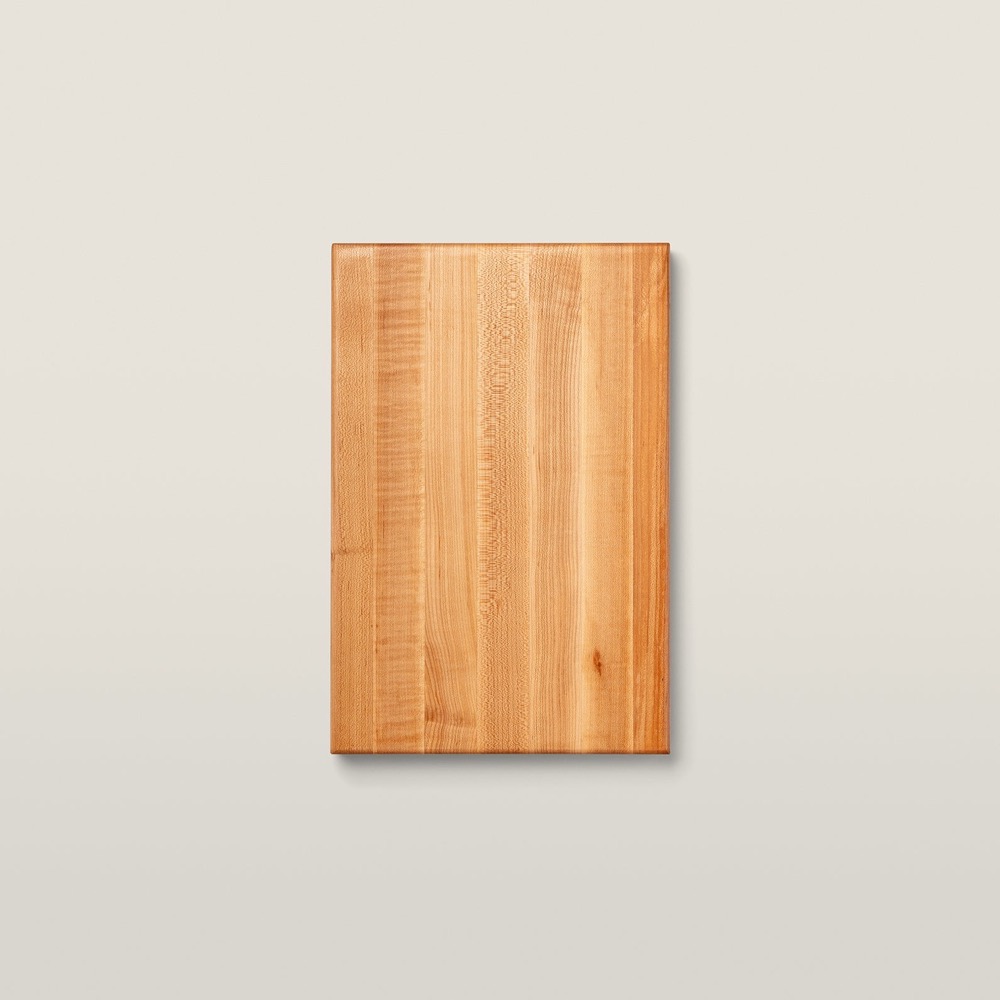 Best for Knife Lovers
Pros
- No plastic surface, no plastic particles
- Gentler on knives than bamboo
- Reversible: keep one face for raw meat
- Refinishable instead of disposable
Cons
- Costs several times more than bamboo
- Heavy
- Needs regular oiling; never the dishwasher
Zero plastic, kinder to your knives, and built to be sanded back to new for decades.
Check Today’s Price on Amazon →Amazon prices change daily — tap to see today’s price and any current discount.
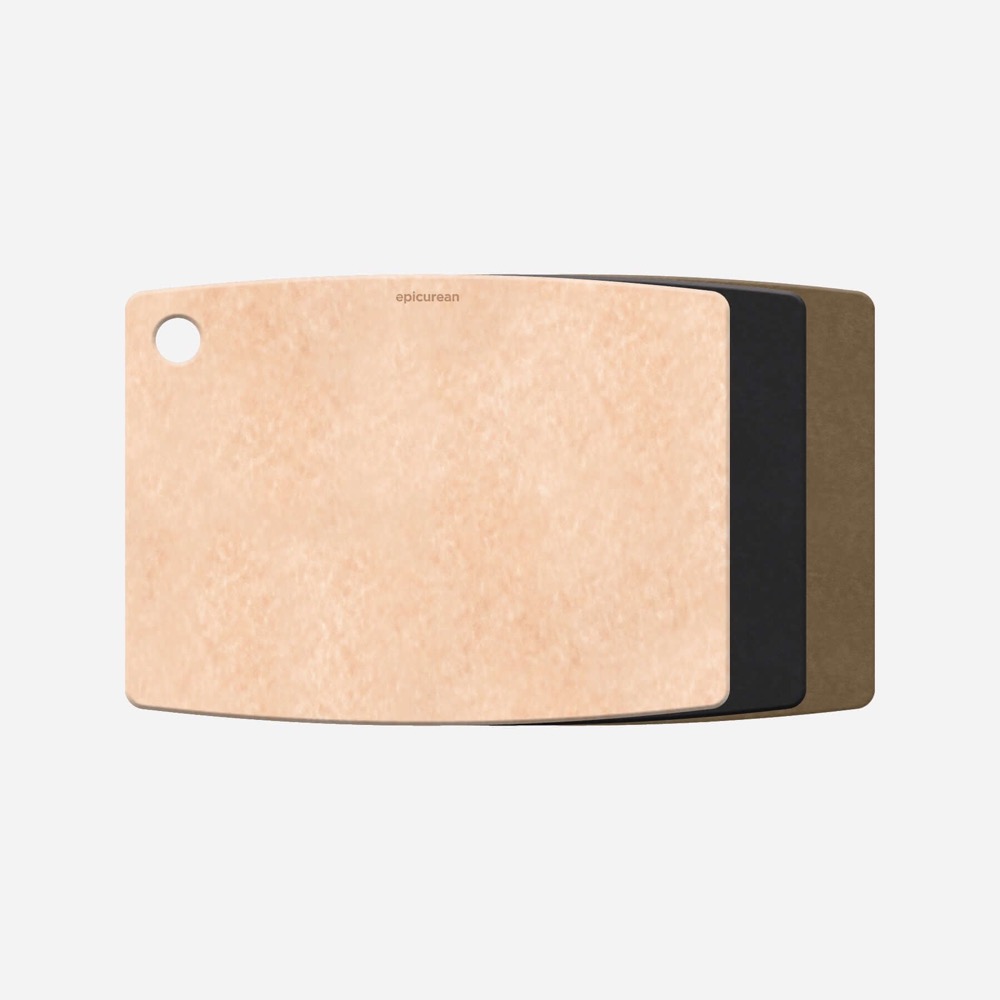 Best Dishwasher-Safe
Pros
- Not polyethylene or polypropylene
- Dishwasher-safe for raw-meat sanitizing
- Thin and light; dries fast
Cons
- A resin-bonded composite, not solid wood
- Hard surface is tough on knife edges
- Louder to chop on
The dishwasher-safe raw-meat board that is not a plastic slab.
Check Today’s Price on Amazon →Amazon prices change daily — tap to see today’s price and any current discount.
How do you clean a bamboo cutting board after raw meat?
Wash it with hot soapy water, then sanitize it with dilute bleach and let it air dry. University of Illinois Extension recommends 1/2 tablespoon of unscented bleach in 1 quart of water for boards that touched raw meat, left for several minutes, then air dried; NC State Extension gives an equivalent 1 tablespoon per gallon. For a solid bamboo board, flood the surface with the solution rather than soaking the board, because long soaks loosen glue lines.
- Dry it standing on edge so both faces get air; trapped moisture warps glued strips.
- Oil it with food-grade mineral oil when the surface looks pale or dry, to slow cracking.
- Replace it when it has deep grooves or a split seam, the same rule extension services give for every board material.
- Never put it in the dishwasher. A bamboo board that survives the dishwasher is a sign it may be a melamine composite.
Frequently Asked Questions
Is bamboo or plastic better for a cutting board?
For avoiding microplastics, solid bamboo. Yadav et al. (Environmental Science & Technology, 2023) estimated 14.5 to 71.9 million microplastic particles a year from a polyethylene board and 79.4 million from polypropylene. Solid bamboo sheds plant fiber instead. Avoid molded bamboo-fiber boards, which are melamine plastic.
Do bamboo cutting boards have formaldehyde?
It depends on the glue and construction. The strongest data is on molded bamboo-fiber products: a Dutch government survey of 46 bamboo/melamine cups (Bouma et al., Chemosphere, 2022) found about 12% released formaldehyde above the EU limit of 15 mg/kg, some above 200 mg/kg. Choose solid-strip bamboo from a brand that names its glue.
Are bamboo cutting boards sanitary for raw meat?
Yes, with normal washing and sanitizing. NC State Extension notes bamboo is less porous than most woods, and a 2012 Korean study found bamboo had the strongest antibacterial activity of five woods tested. Wash with hot soapy water and sanitize with dilute bleach after raw meat.
Do bamboo cutting boards dull knives?
Faster than plastic or softer hardwoods, according to NC State Extension. If knife edges matter most to you, hard maple gives the same zero-plastic benefit with less wear.
Can bamboo cutting boards go in the dishwasher?
Solid bamboo should not; heat and soaking warp and split the glued strips. A “bamboo” board labeled dishwasher-safe that looks molded rather than striped is likely a bamboo-fiber and melamine composite. For a dishwasher board, a wood-fiber composite such as Epicurean is the safer choice.
Sources
- Yadav H, Khan MRH, Quadir M, Rusch KA, Mondal PP, Orr M, Xu EG, Iskander SM. “Cutting Boards: An Overlooked Source of Microplastics in Human Food?” Environmental Science & Technology 2023; 57(22):8225–8235. https://doi.org/10.1021/acs.est.3c00924 (PubMed 37220346)
- Gan HJ, et al. “Simulated Microplastic Release from Cutting Boards and Evaluation of Intestinal Inflammation and Gut Microbiota in Mice.” Environmental Health Perspectives 2025; 133(4):047004. https://doi.org/10.1289/EHP15472
- Bouma K, Kalsbeek-van Wijk DK, Sijm DTHM. “Migration of formaldehyde from ‘biobased’ bamboo/melamine cups: A Dutch retail survey.” Chemosphere 2022; 292:133439. PubMed 34968515
- Ak NO, Cliver DO, Kaspar CW. “Cutting Boards of Plastic and Wood Contaminated Experimentally with Bacteria.” Journal of Food Protection 1994; 57(1):16–22. PubMed 31113021
- “Antimicrobial Effect of Various Chopping Boards against Food-borne Bacteria.” Korean Journal of Food Science and Technology, 2012. FAO AGRIS record
- NC State Extension, Brunswick County Center. “Cutting Boards That Make the Cut.” brunswick.ces.ncsu.edu
- University of Illinois Extension. “Cutting Boards” (Meat Safety). extension.illinois.edu