Waterdrop

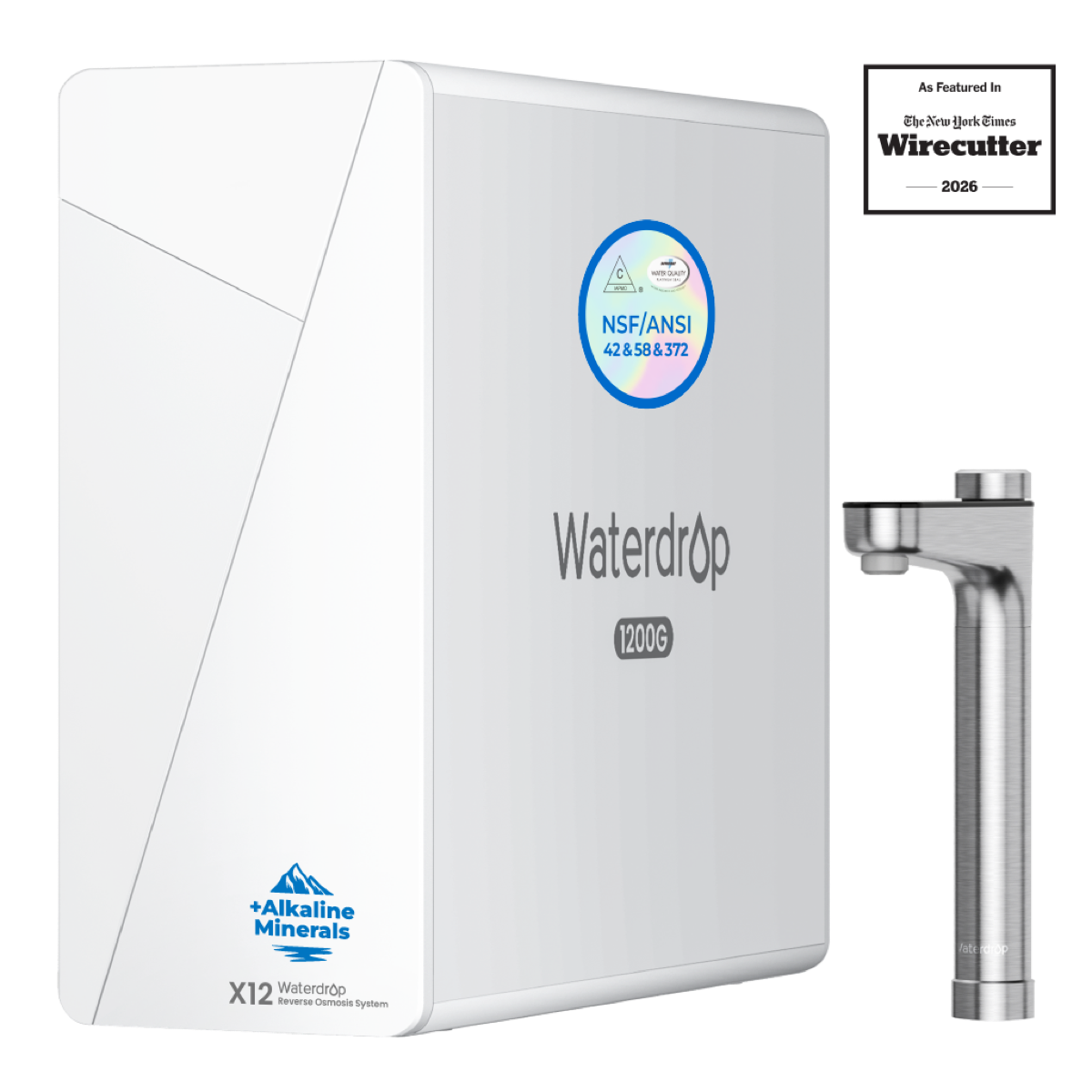
Waterdrop X12 Tankless Reverse Osmosis System

Plasticproof Excellent $$$Our price tier

Tankless under-sink reverse osmosis that Waterdrop states is certified to NSF/ANSI 42, 58 and 372, with an 0.0001 micron membrane, a three-to-one pure-to-drain ratio and minerals added back after filtering.

Check price on Amazon
0.0001 micron membraneFiner than any particle claim.
Certified to Standard 58The RO performance standard.
Tankless, 3 to 1Less drain water, less cabinet space.
See exactly how we verify this

As an Amazon Associate I earn from qualifying purchases — at no extra cost to you. We show a "Check price on Amazon" link rather than a number because Amazon prices change often.

Why it's safe for your family

  • The membrane is rated at 0.0001 micron. That is the number that matters in this whole category: it is a physical pore size, thousands of times smaller than a microplastic particle, and it is what separates reverse osmosis from every carbon filter.
  • Waterdrop states the system is certified to NSF/ANSI 42, 58 and 372 — Standard 58 being the reverse osmosis performance standard, which is the one that actually tests the membrane rather than the housing.
  • Tankless design removes the pressurized tank from the cabinet, which is both the bulk and the part that can sit stagnant. Waterdrop states a three-to-one pure-to-drain ratio, considerably better than older tank systems.
  • A remineralization stage puts calcium and magnesium back after the membrane, which fixes the flat taste that puts people off reverse osmosis, and the faucet displays the dissolved-solids reading so performance is visible rather than assumed.

Quick specs

Method
Multi-stage tankless reverse osmosis
Membrane
0.0001 micron
Certified
NSF/ANSI 42, 58 and 372 (Waterdrop’s stated certifications)
Output
1200 gallons per day
Pure to drain
3 to 1
Power
Under-sink outlet required

What to avoid instead

Avoid a tank-style reverse osmosis system if cabinet space is tight or your drain-water ratio matters to you — that is the specific problem this design solves. What you must have instead is an electrical outlet under the sink, which older systems do not need at all.

How we verify — and what we don't

Straight answer: we're a research team, not a testing lab. Here's exactly what our rating is based on — and what it isn't — so you can weigh it honestly.

What we check

  • What the product is made of, from the maker's own specs and product listing.
  • Whether any part that touches you or your food uses PTFE, PFAS, plastic, or a coating that can degrade.
  • Peer-reviewed research on how that material behaves when heated, scratched, washed, or worn.
  • Known failure modes — how the product actually breaks down in a real home.

What we don't do

  • We have not chemically tested this specific unit in a lab.
  • We don't take payment to rate a product higher — there is no sponsored placement.
  • We don't show star ratings or "trusted by thousands" counts we can't stand behind.
What gets a product rejected

Anything that adds a known microplastic, PFAS, or off-gassing source — a non-stick coating, a plastic surface against food or skin, vinyl/PVC — is downgraded or cut. We only list what clears that bar.

Don't take our word for it — check the sources yourself Waterdrop's product details

Common questions

What does tankless actually change?
Three things: the bulky pressurized tank leaves the cabinet, water is made on demand rather than stored, and the drain ratio improves markedly. The cost is that the system needs mains power, so an outlet has to exist under the sink or be added.
Does it remove PFAS and microplastics?
Reverse osmosis at 0.0001 micron is the most thorough home filtration available and is the standard answer for both. Waterdrop’s certifications name Standards 42, 58 and 372 rather than a separate PFAS protocol, so the honest framing is: the mechanism is the strongest available, and the specific certified claims are the ones listed.
Is the water flat-tasting like other RO?
Less so — this version adds calcium and magnesium back after the membrane, which is what most people are reacting to when they say RO water tastes empty. If you dislike mineral taste entirely, the basic version without remineralization exists.
Related reading
Best Reverse Osmosis Systems
Related reading
Best Under-Sink Water Filter

More safe picks

Affiliate disclosure: some links on this page are affiliate links. As an Amazon Associate I earn from qualifying purchases. We earn a small commission from qualifying purchases at no extra cost to you. This does not influence our recommendations — every product is selected based on peer-reviewed research.