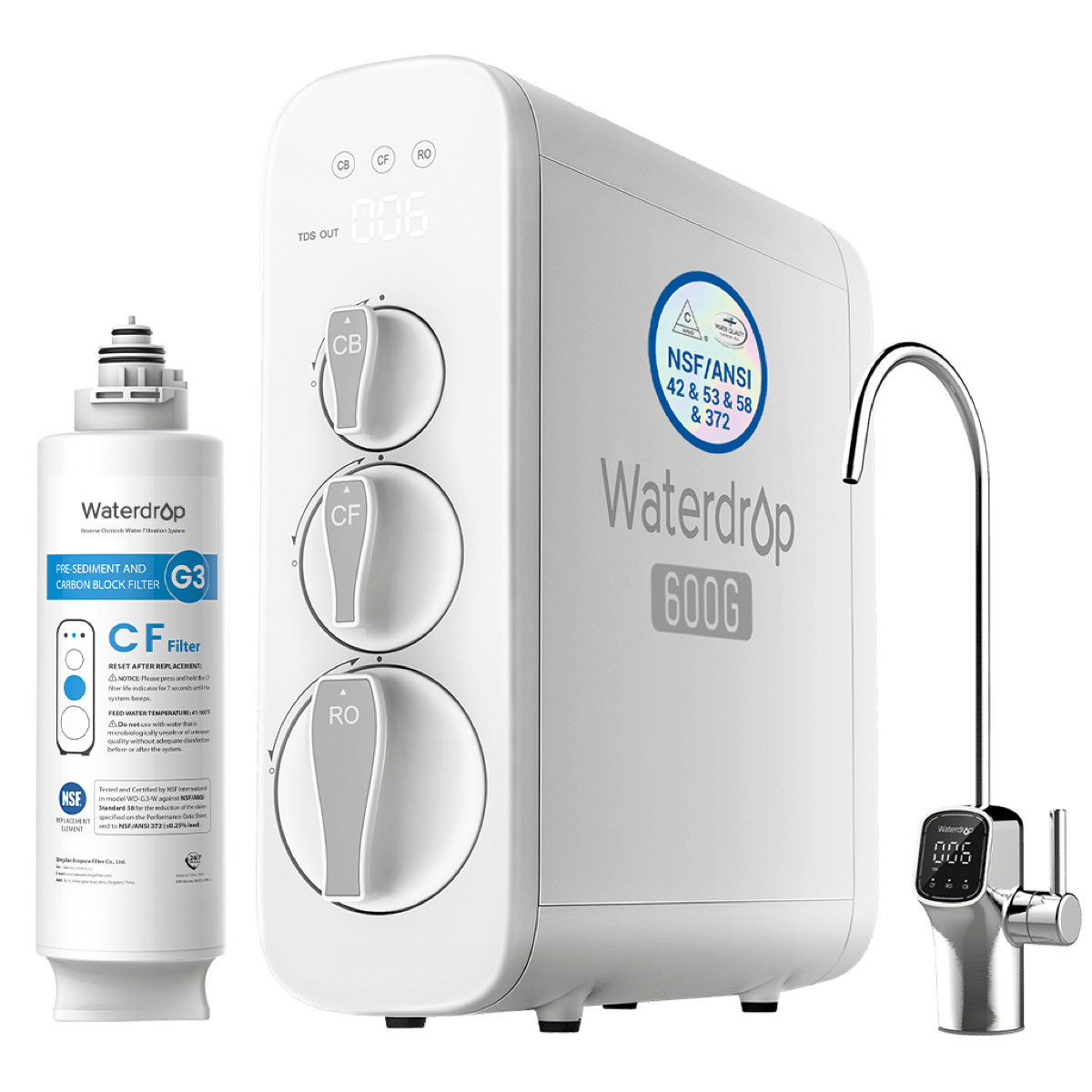
Waterdrop G3P600 Tankless RO
Tankless reverse osmosis system with 600 GPD throughput. NSF 58 and 372 certified. No storage tank means no bacterial buildup over time. Smart faucet shows TDS reduction in real time.
As an Amazon Associate I earn from qualifying purchases — at no extra cost to you. We show a "Check price on Amazon" link rather than a number because Amazon prices change often.
Why it's safe for your family
- Tankless reverse osmosis means filtered water is produced on demand rather than stored, so there is no pressure tank sitting under the sink holding standing water.
- Waterdrop states the G3P600 is certified to NSF/ANSI 58 for reverse osmosis performance and NSF/ANSI 372 for lead-free materials.
- At 600 gallons per day the membrane keeps up with normal kitchen use without a storage tank buffering it.
- The faucet displays a live total-dissolved-solids reading, so you can see the filtration working and tell when performance drops rather than guessing at the filter schedule.
Quick specs
What to avoid instead
The alternative is unfiltered tap water or a carbon pitcher, neither of which is a barrier to the dissolved contaminants a reverse osmosis membrane rejects.
How we verify — and what we don't
Straight answer: we're a research team, not a testing lab. Here's exactly what our rating is based on — and what it isn't — so you can weigh it honestly.
What we check
- What the product is made of, from the maker's own specs and product listing.
- Whether any part that touches you or your food uses PTFE, PFAS, plastic, or a coating that can degrade.
- Peer-reviewed research on how that material behaves when heated, scratched, washed, or worn.
- Known failure modes — how the product actually breaks down in a real home.
What we don't do
- We have not chemically tested this specific unit in a lab.
- We don't take payment to rate a product higher — there is no sponsored placement.
- We don't show star ratings or "trusted by thousands" counts we can't stand behind.
Anything that adds a known microplastic, PFAS, or off-gassing source — a non-stick coating, a plastic surface against food or skin, vinyl/PVC — is downgraded or cut. We only list what clears that bar.