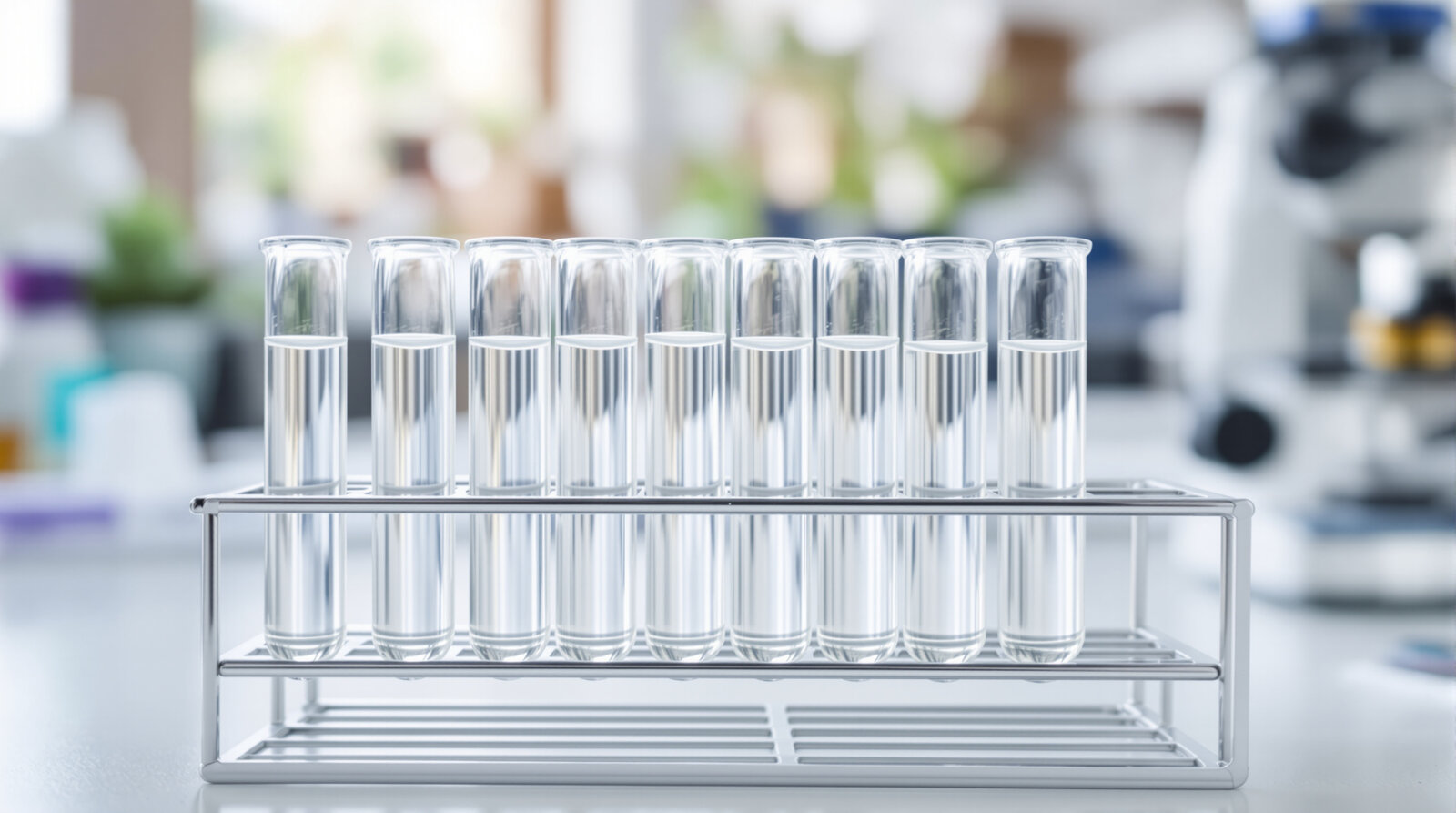
There is no FDA-cleared clinical test and no validated at-home kit that can measure microplastics in a living person's body. Researchers have detected plastic particles in human blood, stool, placenta and arterial plaque — but only in contamination-controlled labs using instruments like pyrolysis gas chromatography-mass spectrometry, FTIR and Raman spectroscopy, and only to study groups of people, not to screen one individual. No doctor can order a routine microplastics panel, and the direct-to-consumer tests sold online are not standardized or clinically meaningful. Since there's no test to act on and no treatment to remove particles, the useful move is reducing your exposure.
“How do I get tested for microplastics?” is one of the most natural questions to ask once you learn the particles are turning up in human tissue. If plastic is in our blood and organs, surely there's a blood test, a urine panel, something a lab can run? It's the same instinct that drives people to check their cholesterol or their vitamin D. Unfortunately, the honest answer is that the tools to measure your personal microplastic load do not exist outside a research laboratory — and even there, they're built to study populations, not to hand you a number.
This guide explains what's real and what isn't: how scientists actually detect microplastics in the body, why there's no clinical test your doctor can order, whether the at-home kits are worth your money, and — most importantly — what you can do that genuinely matters while the science catches up. It takes the same evidence-first approach as how dangerous are microplastics: real concern, honestly bounded by what the data can support.
The short version: you can't put a trustworthy number on the microplastics in your body today, so don't spend money trying. Spend it on the things that lower your intake — filtering your water and getting plastic out of your kitchen — which help whether or not a test ever exists.
Can you actually test your body for microplastics?
Not in any way that gives you a trustworthy result. As of 2026 there is no test — in a clinic or through the mail — that has been validated to measure how many microplastics are in your body. The detections you read about in the news are real, but they come from research labs analyzing donated samples under conditions a routine lab simply cannot reproduce, and they were never designed to profile a single person.
That gap matters because the demand is real: searches for microplastic testing have climbed alongside headlines about particles in blood and the brain. A market has started to fill the vacuum, which is exactly why it helps to understand what a “microplastic test” can and can't actually tell you before you pay for one.
How do researchers detect microplastics in the human body?
Scientists take a physical sample — blood, stool, lung tissue, placenta — and chemically digest the organic material away, leaving any plastic behind to be identified. The particles are then analyzed with instruments such as pyrolysis gas chromatography-mass spectrometry (which burns the particle and reads its chemical signature), or FTIR and Raman spectroscopy (which identify polymers by how they scatter light). None of this happens at a walk-in lab.

The landmark studies show what's possible — and how specialized it is. In 2022, researchers in the Netherlands reported finding plastic particles in the blood of 17 of 22 healthy donors, the first solid evidence that microplastics circulate in human blood (Leslie et al., Environment International, 2022). A 2019 pilot study detected microplastics in the stool of all eight participants tested across several countries (Schwabl et al., Annals of Internal Medicine, 2019). Particles have since been documented in the placenta (Ragusa et al., 2021), in arterial plaque linked to cardiovascular events (Marfella et al., New England Journal of Medicine, 2024), and even accumulating in brain tissue (Nihart et al., Nature Medicine, 2025). Every one of these is a population study, not a service you can book.
Can a doctor test me for microplastics?
No. There is no clinical microplastics test a physician can order, because none has been standardized, validated or approved, and — just as importantly — there is no treatment that would change based on the result. A doctor can run blood work for cholesterol or iron because those numbers guide a decision; a microplastic count currently guides nothing, so it isn't part of medicine.
What a doctor can do is take your actual symptoms seriously and investigate them on their own terms. If you're worried because of fatigue, gut issues or other complaints you suspect are plastic-related, it's worth reading symptoms of microplastics in the body for the honest state of that evidence — and then seeing a clinician about the symptoms themselves, which may have a treatable cause that has nothing to do with plastic.
Are the at-home microplastic test kits legit?
Treat them with heavy skepticism. A small number of companies now sell mail-in blood or stool “microplastic tests,” usually marketed as wellness or longevity products rather than medical diagnostics. The problem isn't that they're necessarily scams — it's that the science to make the result meaningful doesn't exist yet.
Three issues sink the usefulness of these kits:
- Contamination is nearly impossible to rule out. Plastic is in the air, the collection tube, the packaging and the shipping. A particle found in your sample may have come from the kit, not from you — and the strict “blank” controls research labs use to catch this are hard to replicate in a mail-in workflow.
- There are no reference ranges. Even with a clean number, there is no established “normal” or “high” level for microplastics in a person, so the result can't be interpreted as healthy or concerning.
- Nothing changes based on the result. There's no medical intervention to lower a microplastic count, so a number can't guide treatment — it can only generate anxiety or a false sense of a “clean” result.
Paying for an at-home microplastic test today buys you a figure with no validated meaning, no reference range to compare it against, and no action attached to it. The money is far better spent on the swaps that actually reduce your exposure.
Why isn't there a reliable microplastics test yet?
The obstacles are technical, not just commercial. Building a test an individual could trust runs into four hard problems at once, and until they're solved, measuring your personal plastic load stays a research project rather than a product.
- Contamination control. Because plastic is everywhere, keeping it out of the sample and the lab is the single biggest challenge — and the easiest way for a sloppy test to produce a falsely high number.
- No agreed standards. Different labs use different methods, particle-size cutoffs and units, so results aren't comparable, and there are no reference values for what a given level means.
- Uneven distribution. Particles spread unevenly through the body and across tissues, so a single blood or stool sample may not represent your overall burden.
- No treatment to act on. Medicine generally doesn't test for things it can't treat, and there is currently no way to clear microplastics from the body, so there's little clinical reason to measure them.
This is also why the related question — how long do microplastics stay in your body — still has only partial answers. The field is young, and honest reporting means saying so rather than selling certainty that doesn't exist.
What to do instead of testing
Here's the reassuring part: you don't need a test to take meaningful action, because the fix doesn't depend on knowing your personal number. The levers that lower microplastic intake are the same for everyone, and they work whether your baseline is high or low. Think of it the way you'd think about reducing junk food — you don't need a lab to tell you it's worth doing.

- Filter your drinking water. Water is a concentrated, controllable source. A reverse-osmosis system or a quality carbon-block filter removes most microplastics — start with the best water filters for microplastics.
- Stop heating food in plastic. Heat drives shedding, so never microwave food in plastic containers or pour hot liquids into them — use glass or ceramic instead.
- Cut plastic-packaged and ultra-processed food. Packaging and processing both add particles; fresh, minimally packaged food lowers the load.
- Swap plastic storage and utensils. Move to glass and stainless steel for food storage, and replace worn plastic cutting boards and utensils, which shed as they wear.
- Vacuum and dust regularly. A large share of everyday exposure is inhaled household dust, so a vacuum with a HEPA filter and regular damp dusting cut what you breathe.
For the full room-by-room version of this, how to reduce microplastics in your body walks through the highest-impact changes in order. None of them requires a lab result to be worth doing today.
The bottom line on testing for microplastics in your body
Can you test for microplastics in your body? Not reliably, and not yet. The particles are genuinely there — science has found them in blood, stool, the placenta, arteries and the brain — but detecting them takes contamination-controlled labs and specialized instruments, and the results describe groups of people, not individuals. No doctor can order a microplastics panel, the at-home kits can't be meaningfully interpreted, and there's no treatment a result would guide.
That sounds like bad news, but it points to a genuinely good one: your energy is better spent on exposure than on measurement. Filter your water, keep heat away from plastic, and move your kitchen toward glass and steel. Start with how to reduce microplastics in your body and the best water filters for microplastics — the actions that matter don't depend on a test that doesn't exist.
You can't test it — but you can lower it
Skip the unprovable kits. Put the same effort into the swaps that actually cut your microplastic intake, starting with your water.
Frequently Asked Questions
Not with any approved or reliable test yet. Scientists have measured microplastics in human blood, stool, placenta and arterial plaque, but only in research labs using specialized instruments and strict contamination controls. There is no FDA-cleared clinical test and no validated at-home kit that can tell an individual how many microplastics are in their body.
No. There is no routine clinical test a physician can order for microplastics, because no standardized, validated assay exists and there is no treatment to act on a result. Doctors can investigate specific symptoms you report, but they cannot measure your personal microplastic burden or interpret what a number would mean for your health.
Be skeptical. A handful of companies sell mail-in blood or stool "microplastic tests," but none is clinically validated, there are no agreed reference ranges, and plastic contamination during collection and shipping is extremely hard to rule out. A number from one of these kits cannot currently be interpreted as a meaningful measure of your health or exposure.
They collect a tissue or fluid sample — blood, stool, lung tissue, placenta — chemically digest the organic material, then identify the plastic that remains using methods such as pyrolysis gas chromatography-mass spectrometry, Fourier-transform infrared (FTIR) spectroscopy or Raman spectroscopy. The work is done in contamination-controlled labs and is designed to study populations, not to screen an individual.
Several reasons: plastic is everywhere, so keeping it out of the sample is a major challenge; there are no established "normal" levels to compare against; particles spread unevenly through the body, so one sample may not reflect the whole; and there is no medical treatment to remove microplastics, so a result would not change your care. Until those are solved, testing stays a research tool.
Focus on the exposure you can control. Filter your tap water, stop heating food in plastic, cut back on ultra-processed and plastic-packaged food, swap plastic storage and utensils for glass and stainless steel, and vacuum and dust regularly to reduce the particles you breathe. These steps lower your intake whether or not you could ever put a number on it.
Sources
- Leslie HA, van Velzen MJM, Brandsma SH, et al. "Discovery and quantification of plastic particle pollution in human blood." Environment International, 2022;163:107199, doi.org/10.1016/j.envint.2022.107199. Found plastic particles in the blood of 17 of 22 healthy adult donors, the first measurement of microplastics in human blood.
- Schwabl P, Köppel S, Königshofer P, et al. "Detection of Various Microplastics in Human Stool: A Prospective Case Series." Annals of Internal Medicine, 2019;171(7):453-457, doi.org/10.7326/M19-0618. Detected microplastics in the stool of all eight participants across several countries.
- Ragusa A, Svelato A, Santacroce C, et al. "Plasticenta: First evidence of microplastics in human placenta." Environment International, 2021;146:106274, doi.org/10.1016/j.envint.2020.106274. Identified microplastic particles in human placental tissue.
- Marfella R, Prattichizzo F, Sardu C, et al. "Microplastics and Nanoplastics in Atheromas and Cardiovascular Events." New England Journal of Medicine, 2024;390:900-910, doi.org/10.1056/NEJMoa2309822. Linked microplastics found in carotid-artery plaque to a higher risk of heart attack, stroke and death.
- Nihart AJ, Garcia MA, El Hayek E, et al. "Bioaccumulation of microplastics in decedent human brains." Nature Medicine, 2025, nature.com/articles/s41591-024-03453-1. Measured microplastic concentrations in human brain, liver and kidney tissue from autopsy samples.