
Most tampons contain plastic — in the applicator, the pull string, the wrapper, and often a thin synthetic veil over a core of cotton and rayon, which is itself a semi-synthetic fiber. No study has yet directly measured microplastics shedding from a tampon into the body, so an exact particle count would be dishonest. But the building blocks are there: lab tests show synthetic period-product fibers can fragment into micro- and nanoplastics, a 2025 analysis found plastic additives in all 41 menstrual products tested, and a landmark 2024 University of California, Berkeley and Columbia study detected toxic metals — including lead in every one of 30 tampons — though whether those metals leach into the body is not yet known. The low-cost response is to favor 100% organic cotton tampons with a cardboard or no applicator, or a reusable plastic-free period product like a silicone menstrual cup. For the wider picture, see how dangerous microplastics really are and how plastics interact with hormones.
“Do tampons have microplastics?” has become one of the most-searched questions about period products, and for a good reason: a person who menstruates may use somewhere around 10,000 to 15,000 tampons or pads in a lifetime, each one in prolonged contact with mucosal tissue that absorbs chemicals far more readily than skin does. If plastic is part of the product, that is a lot of repeated, intimate exposure.
The honest answer is more nuanced than a headline. Tampons are not “made of plastic” the way a water bottle is, but they are rarely plastic-free either — and the direct, in-body measurement everyone wants simply has not been done yet. This guide walks through what tampons are actually made of, what the research has and has not shown about microplastics and metals, whether organic cotton really solves it, and which alternatives cut the plastic the most. It takes the same evidence-first approach as our look at PFAS in makeup and how dangerous microplastics are: a real exposure, honestly bounded by what the data supports.
The short version: the applicator, string and wrapper are usually plastic, and the absorbent core often blends cotton with rayon plus a thin synthetic cover. Microplastic shedding into the body has not been measured, but the materials and a 2024 toxic-metals study are reason enough to prefer 100% organic cotton, applicator-free tampons — or a reusable cup.
What are tampons actually made of?
A tampon looks like a simple plug of cotton, but a conventional one is a small assembly of several materials, and most of them are where the plastic hides. Knowing the parts is the fastest way to judge any specific box on the shelf.
The absorbent core is usually a blend of cotton and rayon. Rayon — also called viscose — is a semi-synthetic fiber: it is made from wood pulp cellulose but heavily chemically processed, so it behaves more like a manufactured fiber than natural cotton. Many conventional cores also carry a thin synthetic overwrap, a fine veil of polyethylene or polypropylene that holds the fibers together and helps with smooth insertion.
Then come the obvious plastic parts. The applicator, when there is one, is most often polyethylene or polypropylene plastic (some brands use cardboard instead). The pull string is frequently cotton but is often polyester or polypropylene, or a blend. And every tampon arrives sealed in a plastic wrapper. Add it up and a single conventional applicator tampon can involve four or five distinct plastic or semi-synthetic components before you even reach the cotton.

Do tampons actually contain microplastics?
Here is where honesty matters. No peer-reviewed study has yet directly measured microplastics shedding from a tampon into vaginal tissue or blood, so anyone quoting a precise particle count is inventing it. What the evidence does show is that the ingredients for microplastic exposure are present, and that closely related products have been measured.
Tampons contain plastic components and semi-synthetic fibers, and plastics shed particles when they are abraded, stretched or broken — exactly the mechanical stresses a tampon and its applicator undergo. Laboratory work on synthetic period-product fibers has shown they can fragment into micro- and nanoscale pieces under simulated use conditions. And in the most direct adjacent evidence, a 2025 South Korean study found polypropylene-based microplastics in every sanitary pad it analyzed — pads, not tampons, but made from the same family of synthetic materials.
On the chemical side, a 2025 study in Environmental Science & Technology, summarized by the research institute IDAEA-CSIC, found plastic additives in all 41 menstrual products it tested. Encouragingly, the lowest concentrations turned up in menstrual cups and tampons, and the highest in other product types — but “lowest” is not “none,” and the authors flagged skin and mucosal contact as an exposure route that deserves more study.
So the fair statement is this: tampons almost certainly can shed small amounts of plastic, the materials and the pad data make that very plausible, but the exact in-body dose is unmeasured. That is a reason for sensible precaution, not panic — the same posture we take toward microplastics in food packaging, where exposure is real but the numbers are still being pinned down.
What did the 2024 study find about metals in tampons?
The single most important piece of hard data here is not actually about plastic — it is about metals, and it is unusually solid. In 2024, researchers led by Jenni Shearston at the University of California, Berkeley and Columbia University’s Mailman School of Public Health published the first study ever to measure toxic metals in tampons.
They tested 30 tampons from 14 brands for 16 different metals, and the results were striking: measurable concentrations of every one of the 16 metals turned up across the products, and lead was detected in every single sample, with no level of lead considered safe. The pattern split by product type — lead tended to run higher in non-organic tampons, while arsenic tended to run higher in organic ones, likely reflecting how cotton plants take up metals from soil and water.
The crucial caveat, which the researchers themselves stressed, is that detecting a metal in a tampon is not the same as showing it enters the body. The study did not measure whether these metals actually leach out during use or get absorbed, and it did not link them to any health outcome. It is a “this is present, and we urgently need follow-up” finding, not a “this is harming you” one. In fact, the U.S. Food & Drug Administration later conducted its own research on metals in tampons and concluded that the amount of metals released during normal use is too small to cause harm. Still, given how absorptive the tissue is, the detection is a strong argument for more testing and better labeling — and the arsenic result is a useful reminder that “organic” is not automatically “pure.”
None of this is a reason to stop managing your period, and the studies here show presence, not proven harm. Tampons remain regulated medical devices. The reasonable move is not fear — it is choosing lower-plastic, well-made products where you easily can, and pushing for the absorption research that still has not been done. If you are weighing exposures across your whole routine, start with how to reduce microplastics in your body.
Can microplastics or chemicals from a tampon get into your body?
This is the question that makes period products different from, say, a plastic food container. The vaginal lining is thin, richly supplied with blood vessels, and highly permeable — it is why some medications are delivered that way. In principle, that makes it a plausible route for small particles or leached chemicals to enter circulation, which is exactly why the 2025 additives study singled out dermal and mucosal contact as a pathway worth investigating.
“Plausible route,” though, is not “measured fact.” No study has yet tracked microplastics or metals crossing from a tampon into a person’s bloodstream. We do know microplastics reach deep into the body in general — they have been detected in human blood and even in the placenta — but those particles arrive from food, water and air, and no one has traced a specific tampon to a specific particle. The intellectually honest position is: the tissue makes absorption believable, the measurement to confirm it is missing, and that gap is itself a reason the precaution is cheap and sensible.
Are organic cotton tampons safer?
Switching to 100% organic cotton helps with the plastic-fiber question, but it is not a complete fix, and it is worth being precise about what it does and does not solve.
What organic cotton does do: a genuine 100% organic cotton core contains no rayon and no synthetic overwrap, so you remove the main manufactured fibers from the part of the tampon in longest contact with the body. Certified organic cotton is also grown without synthetic pesticides. What it does not automatically do: the applicator can still be plastic, the string can still be synthetic, and the wrapper is usually plastic film unless the packaging specifically promises a cardboard applicator, applicator-free design, or plastic-free wrapping. And as the 2024 metals study showed, organic cotton can actually carry more arsenic, because the plant pulls metals from its environment regardless of farming method.
So “organic” on the front of the box is a real improvement for synthetic fibers, but read the full materials list. The cleanest conventional-format choice is 100% organic cotton, applicator-free (or cardboard applicator), in plastic-free packaging. This is the same lesson as our guide to why “BPA-free” doesn’t mean safe: one reassuring word on the label rarely covers the whole product.
How can you reduce plastic exposure from period products?
You have more good options now than at any point in the past, and they range from a simple swap at the same shelf to a one-time purchase that lasts years. Here is how they stack up, roughly from easiest to most plastic-reducing.
- Choose 100% organic cotton, applicator-free tampons. The lowest-friction change: same insertion habit, but you drop the rayon, the synthetic veil and the plastic applicator in one move. Look for “plastic-free wrapper” too.
- If you want an applicator, pick cardboard over plastic. Cardboard applicators do the same job and skip the molded-plastic tube that is pure single-use plastic.
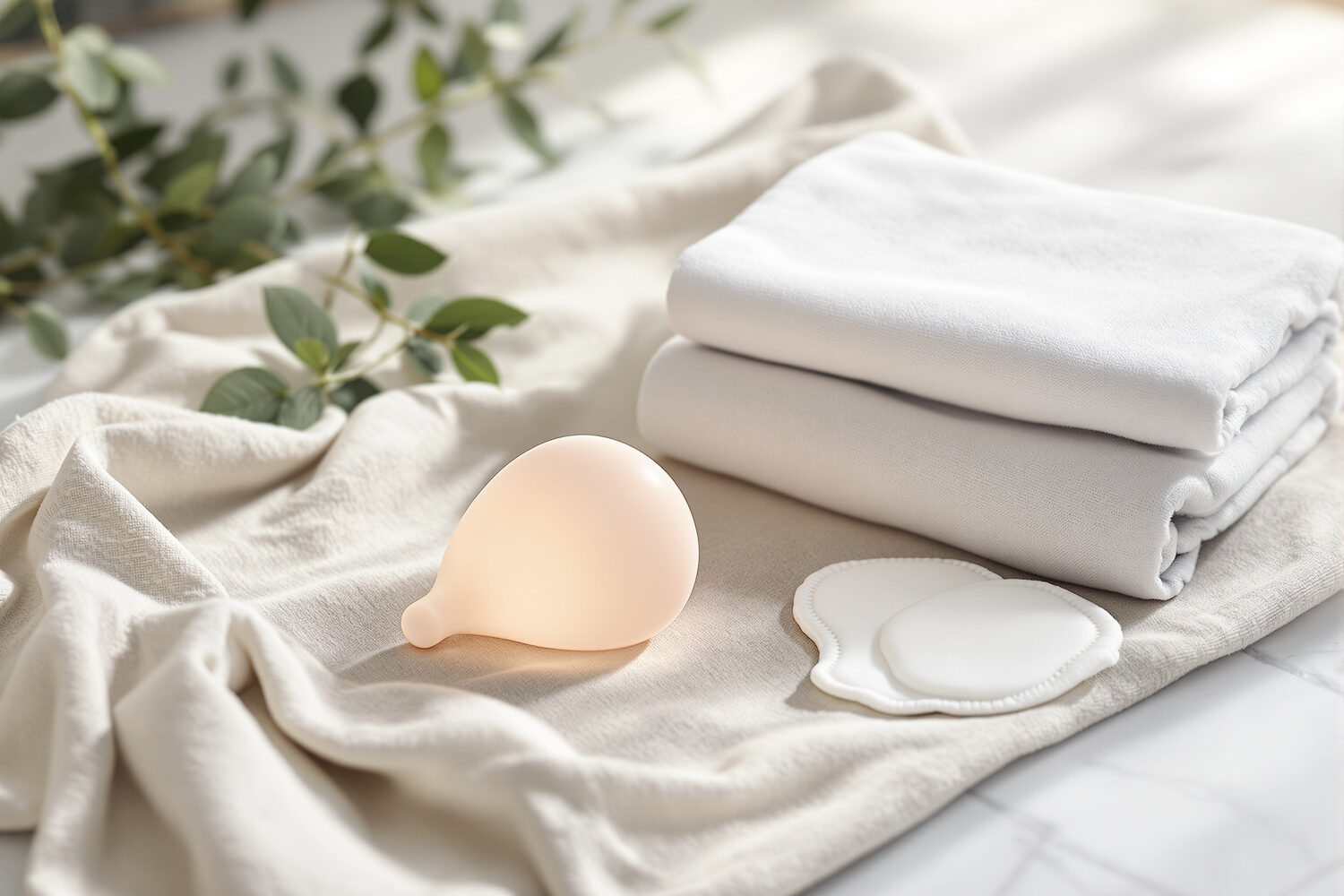
- Switch to a medical-grade silicone menstrual cup. A cup uses no cotton, rayon, string or wrapper at all, is reusable for years, and is the single biggest cut to period-product plastic and waste. There is a short learning curve, but most people adapt within a cycle or two.
- Try reusable organic cotton cloth pads. Washable pads remove disposables entirely and avoid the adhesive-backed plastic of conventional pads.
- Consider period underwear — but check it is PFAS-free. Leakproof underwear is convenient and reusable, yet some brands have tested positive for PFAS “forever chemicals” in the past, so buy from a company that publishes PFAS-free test results.
For specific, researched picks across each of these formats, see our roundup of the best plastic-free period products. None of this has to happen overnight: swapping one box of tampons, or buying one cup, already removes a meaningful amount of plastic from a product you use every month.
The bottom line: do tampons have microplastics?
Do tampons have microplastics? The most accurate answer is that most tampons contain plastic — in the applicator, string, wrapper and often a synthetic veil over a cotton-and-rayon core — and that plastic can shed particles under stress, but no study has yet measured how many microplastics actually move from a tampon into the body. Alongside that, a solid 2024 study found toxic metals, including lead, in every tampon it tested, without yet proving those metals are absorbed.
That leaves a sensible, un-panicked conclusion: the exposure is real and worth reducing, the precautions are cheap, and the research still owes us the in-body numbers. Favor 100% organic cotton, applicator-free tampons, or move to a reusable plastic-free period product like a silicone cup. For the bigger context on where these particles end up and what they do, read how dangerous are microplastics and microplastics and hormones.
Find your plastic-free period swap
From organic cotton tampons to silicone cups and PFAS-free period underwear — the researched, lower-plastic picks that actually cut your exposure.
Frequently Asked Questions
Most do. The absorbent core is usually cotton plus rayon (a semi-synthetic fiber), but the applicator is typically polyethylene or polypropylene plastic, the pull string is often polyester or polypropylene, the individual wrapper is plastic film, and many tampons have a thin synthetic overwrap around the core. Applicator-free and 100% organic cotton tampons cut most of this, though the string and wrapper can still be synthetic.
No study has yet directly measured microplastics shedding from a tampon into the body, so an exact number would be dishonest. But tampons contain plastic components and semi-synthetic fibers, lab tests show synthetic period-product fibers can fragment into micro- and nanoplastics, and a 2025 South Korean study found polypropylene microplastics in every sanitary pad it analyzed. The building blocks are there even though the in-body measurement has not been made.
Yes. A 2024 study from the University of California, Berkeley and Columbia University, the first to measure metals in tampons, tested 30 tampons from 14 brands for 16 metals and detected lead in every single sample. Arsenic tended to be higher in organic tampons and lead higher in non-organic ones. The study did not show that these metals leach out during use or cause harm, only that they are present.
A 100% organic cotton tampon avoids the rayon and the synthetic overwrap, which removes the main sources of plastic fiber in the absorbent core. But many still ship with a plastic applicator, a synthetic string and a plastic wrapper unless the box specifically says cardboard applicator, applicator-free and plastic-free packaging. Organic also does not mean metal-free; the 2024 metals study actually found higher arsenic in organic tampons.
The vaginal lining is thin, highly vascular and absorptive, which is why researchers treat it as a plausible exposure route and why a 2025 study on plastic additives flagged dermal and mucosal contact as a pathway worth studying. That said, absorption of microplastics or metals from a tampon has not actually been measured in people, so the honest position is potential concern, not proven harm. Reducing synthetic materials is a low-cost precaution.
A medical-grade silicone menstrual cup is reusable for years and uses no cotton, rayon or wrapper. Reusable organic cotton cloth pads are another low-waste option. If you prefer tampons, choose 100% organic cotton with a cardboard applicator or no applicator at all. Period underwear works too, but check that a given brand is PFAS-free, since some styles have tested positive for forever chemicals.
Sources
- Shearston JA, Upson K, Gordon M, et al. “Tampons as a source of exposure to metal(loid)s.” Environment International, 2024. Summarized by Columbia University Mailman School of Public Health, “First Study to Measure Toxic Metals in Tampons Shows Arsenic and Lead, Among Other Contaminants,” publichealth.columbia.edu. The first study to measure metals in tampons: 30 tampons from 14 brands tested for 16 metals, with lead detected in every sample.
- University of California. “First study to measure toxic metals in tampons shows arsenic and lead, among other contaminants,” 2024, universityofcalifornia.edu. UC Berkeley summary of the Shearston et al. study, including the organic-vs-non-organic pattern (higher arsenic in organic, higher lead in non-organic) and the caution that presence does not prove absorption.
- American Chemical Society. “Plastic Additives in Single-Use and Reusable Menstrual Products: Potential Implications for Human Health and the Environment.” Environmental Science & Technology, 2025, pubs.acs.org. Found plastic additives in all 41 menstrual products analyzed, with the lowest concentrations in menstrual cups and tampons, and flagged dermal/mucosal contact as an exposure pathway needing more research.
- IDAEA-CSIC. “A scientific study examines the presence of plastic additives in menstrual products,” 2025, idaea.csic.es. Plain-language summary of the Environmental Science & Technology analysis of 41 menstrual products and its exposure-pathway findings.