Brushing your child's teeth feels like one of the most benign health habits imaginable. But look closely at the ingredient list on most kids' toothpastes and a pattern emerges: sodium lauryl sulfate for foaming, FD&C Red 40 or Blue 1 for color, titanium dioxide for whiteness, and a catch-all "flavor" that tells you nothing. These are the same ingredients found in industrial cleaning products, synthetic dyes classified as possible carcinogens, and a pigment the International Agency for Research on Cancer lists as possibly carcinogenic when inhaled.
Children swallow toothpaste. They always have — studies estimate that children under 6 swallow 30–40% of the toothpaste they use in a single brushing session. Which means the ingredient list isn't just a surface concern. It's a twice-daily ingestion question.
The good news: a new generation of kids' toothpastes has emerged that skips every one of these problematic ingredients while still delivering meaningful cavity protection through nano-hydroxyapatite and xylitol — two active ingredients with growing clinical evidence behind them. We screened dozens of formulas to find six that are genuinely clean, effective, and palatable enough that kids will actually use them.
Why Conventional Kids' Toothpaste Is Problematic
The conventional kids' toothpaste aisle is designed to appeal to children — bright colors, cartoon characters, candy-like flavors. That's the marketing. The formulation underneath often prioritizes cost and shelf appeal over safety.
Sodium lauryl sulfate (SLS) is the foaming agent in most commercial toothpastes. It's the same surfactant used in dish soap and industrial degreasers. In toothpaste, it serves no therapeutic purpose — it just makes the paste foam so users feel like something is happening. SLS is a known oral tissue irritant. Studies have linked it to an increased frequency of canker sores (recurrent aphthous ulcers) and to disrupted taste perception. In children's mouths, which have more permeable mucous membranes than adults, the irritation concern is heightened.
Artificial colors — FD&C Blue 1, Red 40, Yellow 5, Yellow 6 — are added purely for visual appeal. None of these dyes has any oral health benefit. Multiple studies, including a widely cited 2007 paper in The Lancet, linked synthetic food dyes to increased hyperactivity in children. The European Union now requires a warning label on products containing these dyes. The FDA has considered but not yet mandated similar disclosure in the United States.
Titanium dioxide (TiO2) is used as a whitening agent in toothpaste. In 2022, the European Food Safety Authority concluded there was insufficient evidence to establish a safe daily intake for titanium dioxide as a food additive, leading to its ban in EU food products. The IARC classifies titanium dioxide as Group 2B — "possibly carcinogenic to humans" — specifically when inhaled as a fine powder. The oral route of exposure for toothpaste users, particularly children who swallow paste, is a meaningful pathway that warrants caution.
"Children under 6 swallow 30–40% of the toothpaste they use per session. The ingredient list isn't a surface concern — it's a twice-daily ingestion question."
Finally, most conventional toothpaste tubes are made from multi-layer plastic laminate — a combination of polyethylene and aluminum that is not recyclable in standard municipal programs. Every squeezed tube ends up in landfill. Some brands are shifting to aluminum tubes or recyclable mono-material packaging, and those choices matter when a product is used every day for years.
The Science Behind Fluoride-Free Alternatives
For decades, fluoride was the only credible active ingredient for cavity prevention in toothpaste. That's no longer the case. Two alternatives have accumulated meaningful clinical evidence: nano-hydroxyapatite and xylitol.
Nano-Hydroxyapatite (nHAP)
Hydroxyapatite is the mineral that makes up approximately 97% of tooth enamel. Nano-scale hydroxyapatite (nHAP) particles — typically in the 20–80 nanometer range — have a surface area large enough to bind directly to enamel, filling microscopic lesions and remineralizing early-stage cavities. The mechanism is similar to fluoride-induced remineralization but without systemic fluoride intake.
A 2019 randomized controlled trial published in the Journal of Clinical Dentistry found nHAP toothpaste to be non-inferior to 500 ppm fluoride toothpaste for caries prevention in children over a 12-month period. A 2021 systematic review in the Journal of Dentistry concluded that nHAP demonstrated comparable remineralization efficacy to fluoride across multiple in vitro and in vivo studies. Japan has used nano-hydroxyapatite as an approved remineralizing agent in toothpaste since the 1980s. It is FDA-recognized as safe for use in oral care in the United States.
Xylitol
Xylitol is a sugar alcohol found naturally in birch trees, corncobs, and many fruits and vegetables. Its mechanism in oral health is distinct from remineralization: it works by starving cavity-causing bacteria. Streptococcus mutans — the primary microorganism responsible for dental caries — cannot metabolize xylitol. When it tries, the process produces a compound that inhibits bacterial growth and reduces acid production. Regular xylitol exposure also disrupts biofilm formation, making it harder for bacteria to adhere to tooth surfaces.
A Cochrane systematic review found that xylitol-containing toothpastes reduced cavities significantly compared to fluoride-only toothpastes in at least one large trial. Formulas that combine xylitol with nano-hydroxyapatite appear to offer complementary mechanisms — xylitol suppressing bacterial activity while nHAP remineralizes existing lesions — making combination products particularly promising.
What We Screened For
Every toothpaste recommended in this guide had to pass all five of our screening criteria.
- No SLS (sodium lauryl sulfate): No foaming agent with a documented link to oral tissue irritation and canker sores.
- No artificial dyes: No FD&C Blue 1, Red 40, Yellow 5, Yellow 6, or any synthetic colorant. Natural colorants from plant sources are acceptable.
- No titanium dioxide: Excluded given the IARC Group 2B classification and the EU ban as a food additive. Children swallow paste — this is not a theoretical risk.
- No synthetic flavors: Flavoring must come from natural sources (essential oils, natural fruit extracts). The catch-all term "flavor" without further qualification was treated as a disqualifier unless the brand provided full flavor ingredient disclosure.
- No microbeads or microplastics: Some older toothpaste formulas used plastic microbeads as abrasives. These are banned in the U.S. under the Microbead-Free Waters Act of 2015, but we screened for any plastic polymer ingredients as an additional check.
Our 6 Top Picks for 2026
Quick Picks
- Best overall: Boka Kids Watermelon Mint — nano-hydroxyapatite, no SLS, no artificial dyes
- Best for toddlers: Jack N' Jill Natural Toothpaste — 40% xylitol, organic flavors, safe from first tooth
- Best taste: Davids Kids Toothpaste — nano-hydroxyapatite + xylitol, strawberry watermelon flavor
- Best for sensitive gums: Dr. Brite Kids Toothpaste — aloe vera + coconut oil, ultra-gentle formula
- Best organic certified: RADIUS Organic Kids Toothpaste — USDA organic, coconut banana flavor
- Best budget pick: Hello Kids Fluoride-Free — widely available at Target/Walmart, xylitol
1. Boka Kids Watermelon Mint
 Best Overall
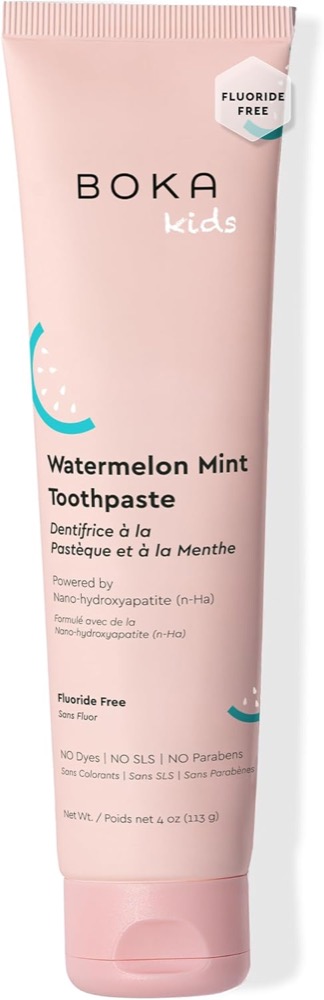
Boka's kids formula centers on nano-hydroxyapatite (nHAP) as the active remineralizing ingredient — no fluoride, no SLS, no artificial colors, no titanium dioxide. The watermelon mint flavor is mild enough for young palates without relying on synthetic flavoring agents. Boka discloses their full ingredient list on every product page. The formula also contains aloe vera and coconut oil for gentle gum support. This is the top pick for families making the switch from conventional fluoride toothpaste and wanting a well-documented, clinical-grade active ingredient as the replacement.
Clinical-grade nano-hydroxyapatite rebuilds enamel — the closest fluoride-free match to what dentists recommend, in a flavor that ends the brushing battle.
Why it's safe: Fluoride-free with no SLS, no artificial dyes, and no titanium dioxide — and nHAP is a naturally occurring tooth mineral that is non-toxic if your child swallows a little.
Check Today’s Price on Amazon →Amazon prices change daily — tap to see today's price and any active discount.
- Free delivery & returns for Prime members
- Full ingredient list disclosed
- Thousands of verified reviews
2. Jack N' Jill Natural Toothpaste
 Best for Toddlers
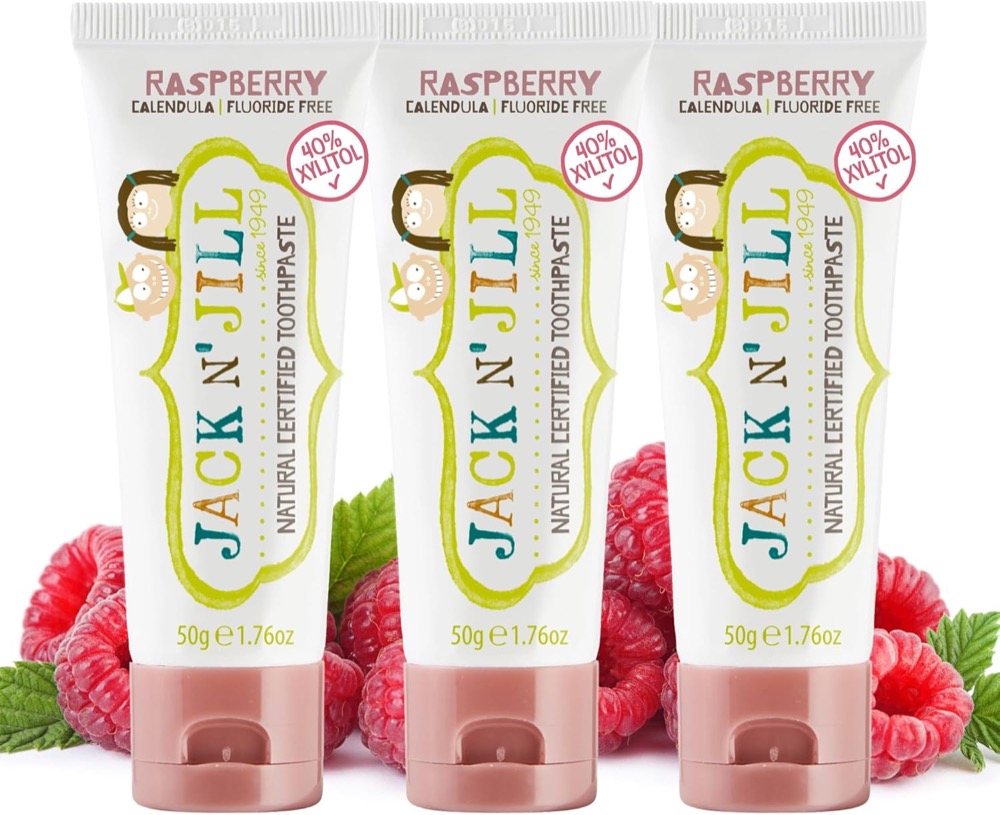
The standout choice for toddlers and very young children. Jack N' Jill contains 40% xylitol — one of the highest concentrations available in a kids' toothpaste — along with certified organic calendula and other plant-based ingredients. No fluoride, no SLS, no parabens, no artificial sweeteners, no artificial colors. The formula is certified organic and comes in flavors derived from organic fruit extracts (strawberry, banana, blueberry, raspberry). Packaging uses biodegradable sugarcane-based tubes. Safe from the eruption of the first tooth. The gentle, genuinely food-grade formula makes it the easiest transition for children who resist brushing.
Designed to be swallowed safely from the first tooth — 40% xylitol starves cavity bacteria with nothing in the tube you'd worry about a baby ingesting.
Why it's safe: Certified organic and fluoride-free with no SLS, no artificial sweeteners, and no artificial colors — every ingredient is food-grade and plant-based.
Check Today’s Price on Amazon →Amazon prices change daily — tap to see today's price and any active discount.
- Free delivery & returns for Prime members
- Certified organic formula
- Thousands of verified reviews
3. Davids Kids Toothpaste
 Best Taste
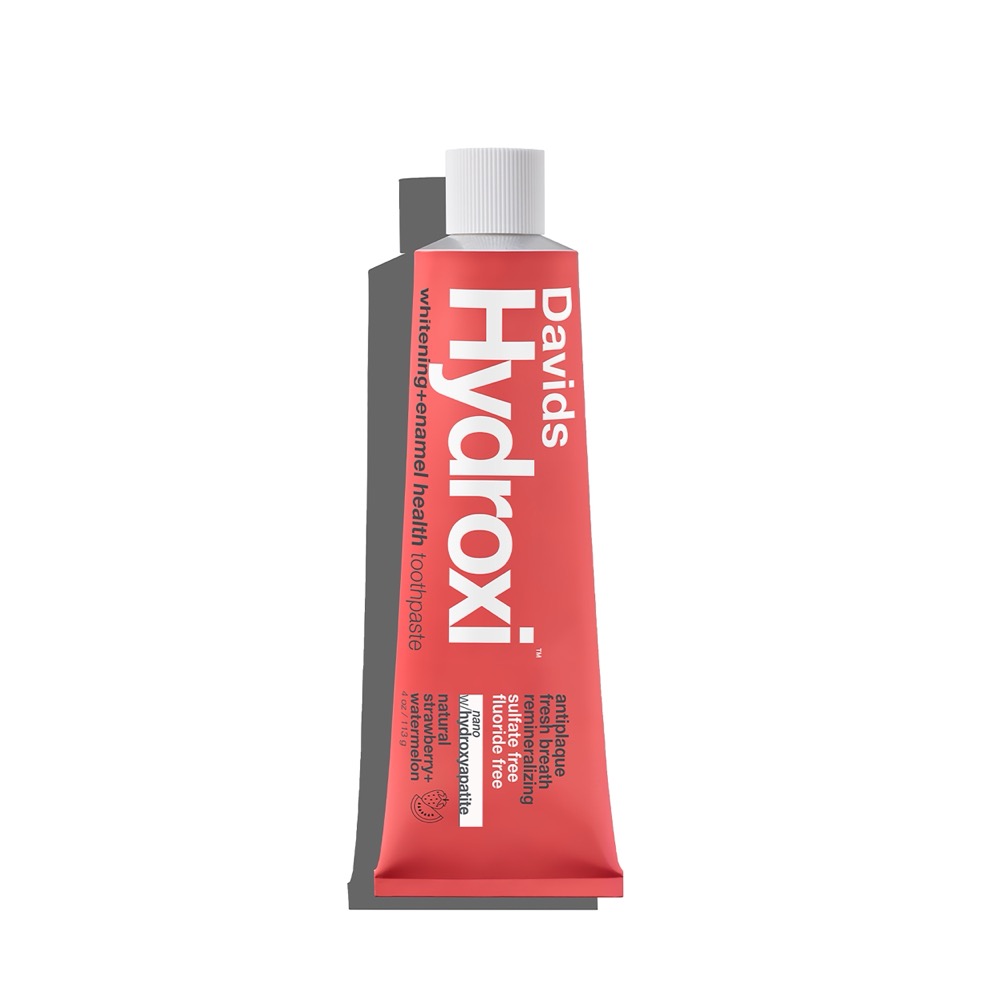
Davids' kids formula combines nano-hydroxyapatite with xylitol for dual-mechanism cavity protection — nHAP remineralizes while xylitol inhibits bacterial acid production. The strawberry watermelon flavor is the most kid-friendly taste profile on this list, making it the top pick for picky brushers who resist anything mint-adjacent. No SLS, no artificial colors, no titanium dioxide, no synthetic preservatives. Davids uses recyclable aluminum tubes — a meaningful packaging improvement over plastic laminate tubes that end up in landfill. Made in the USA with full ingredient transparency.
The flavor that wins over picky brushers, backed by two active ingredients — and packaged in a recyclable aluminum tube instead of landfill-bound plastic.
Why it's safe: Fluoride-free with no SLS, no artificial colors, no titanium dioxide, and no synthetic preservatives — both active ingredients (nHAP and xylitol) are non-toxic if swallowed.
Check Today’s Price on Amazon →Amazon prices change daily — tap to see today's price and any active discount.
- Free delivery & returns for Prime members
- Recyclable aluminum tube
- Made in the USA
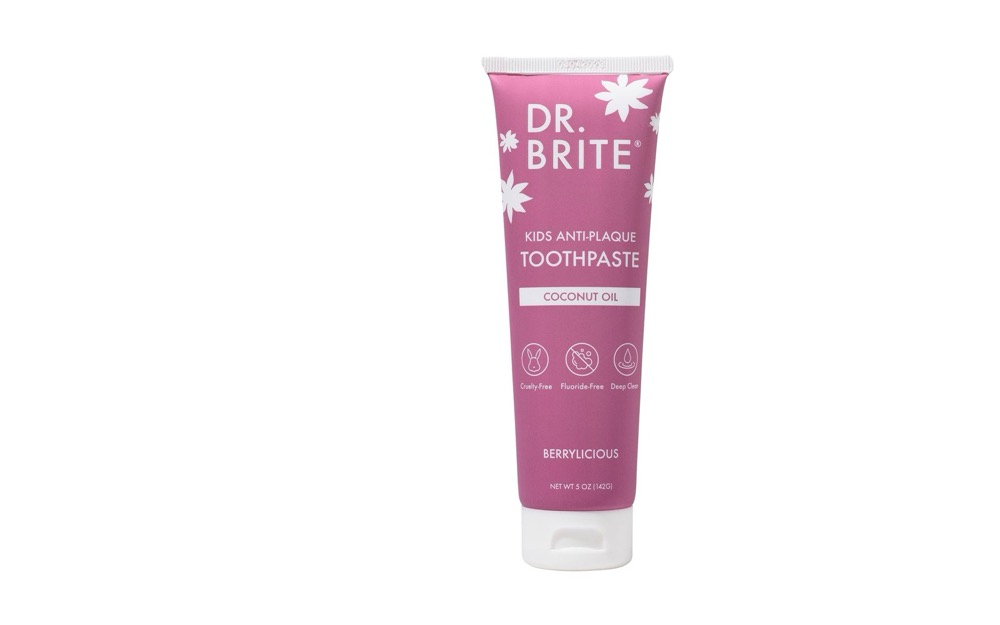
4. Dr. Brite Kids Toothpaste
 Best for Sensitive Gums
The best option for children with sensitive gums, mouth sores, or a history of oral irritation. Dr. Brite's kids formula centers on aloe vera and coconut oil as the primary active and soothing agents, with xylitol for cavity prevention. The formula is SLS-free, free of artificial dyes, free of titanium dioxide, and free of any synthetic fragrance compounds. Aloe vera has documented anti-inflammatory properties in oral tissue. Coconut oil contributes mild antimicrobial effects. This is a gentler, lower-abrasion formula suitable for children with enamel sensitivity or those recovering from orthodontic work. Certified cruelty-free.
Aloe vera and coconut oil calm tender gums while staying low-abrasion — the pick for kids prone to mouth sores or recovering from orthodontic work.
Why it's safe: Fluoride-free, SLS-free, with no artificial dyes, no titanium dioxide, and no synthetic fragrance — and the plant-based ingredients are edible if a little is swallowed.
Check Today’s Price on Amazon →Amazon prices change daily — tap to see today's price and any active discount.
- Free delivery & returns for Prime members
- Certified cruelty-free
- Thousands of verified reviews
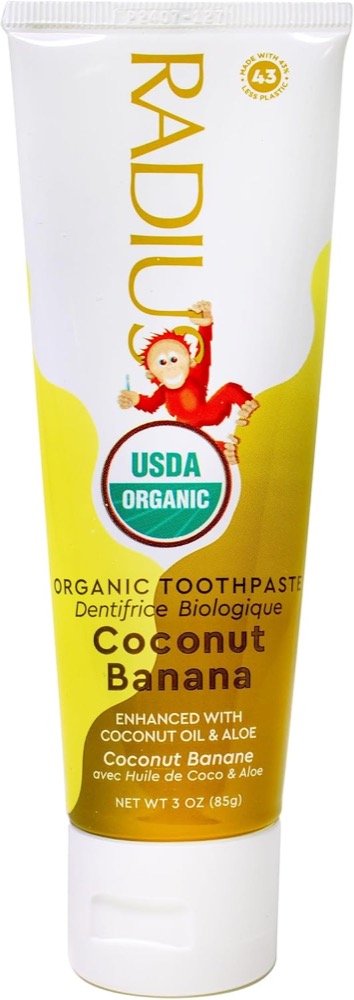
5. RADIUS Organic Kids Toothpaste
 Best Organic Certified
The only USDA-certified organic toothpaste on this list. RADIUS's kids formula meets organic certification standards for its entire ingredient deck — not just select ingredients. The coconut banana flavor uses organic flavoring agents and is a consistent hit with children ages 2 and up. No fluoride, no SLS, no artificial colors, no synthetic preservatives. RADIUS is one of the more established natural oral care brands with a long track record of ingredient transparency. The formula uses a tooth-friendly sugar alcohol as its active cavity-fighting ingredient. RADIUS also produces some of the most sustainably manufactured toothbrushes on the market, making it a natural brand pairing for a full clean oral care routine.
The only fully USDA-certified-organic pick — every ingredient meets organic standards, so there's nothing synthetic in the tube to second-guess.
Why it's safe: Certified organic, fluoride-free, and SLS-free with no artificial colors and no synthetic preservatives — a strictly-sourced formula safe for kids 6 months and up.
Check Today’s Price on Amazon →Amazon prices change daily — tap to see today's price and any active discount.
- Free delivery & returns for Prime members
- USDA-certified organic
- Thousands of verified reviews
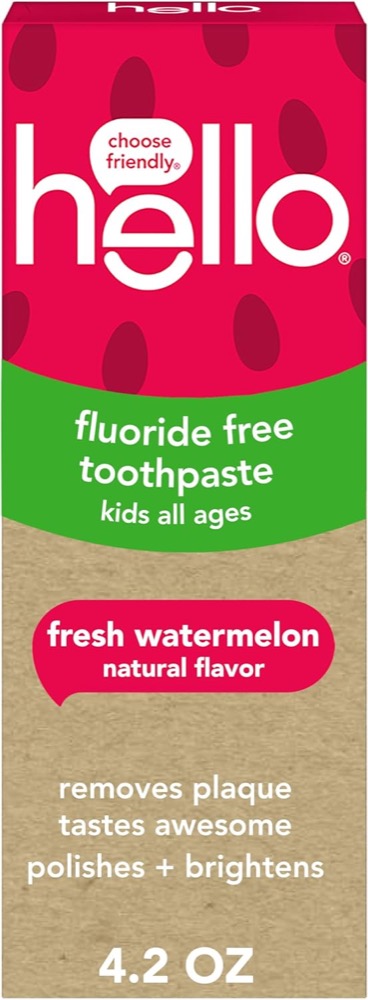
6. Hello Kids Fluoride-Free
 Best Budget Pick
The most accessible and affordable pick on this list — available at Target, Walmart, CVS, and Amazon. Hello Kids Fluoride-Free uses xylitol as its active cavity-fighting ingredient and is SLS-free, dye-free, and free of artificial sweeteners. The natural watermelon flavor uses food-derived flavoring. Hello's ingredient transparency is above average for a mass-market brand. It is not certified organic and uses a standard plastic tube, but at a few dollars per tube it removes every price barrier to switching away from conventional kids' toothpaste. The best first step for families in transition or households that need a widely available option.
The lowest-cost way to ditch SLS, dyes, and fluoride — clean enough to recommend, cheap enough that there's no reason not to switch today.
Why it's safe: Fluoride-free and SLS-free with no artificial dyes and no artificial sweeteners — a xylitol-based formula that's safe for all ages, including toddlers who swallow.
Check Today’s Price on Amazon →Amazon prices change daily — tap to see today's price and any active discount.
- Free delivery & returns for Prime members
- Also at Target, Walmart & CVS
- Thousands of verified reviews
Comparison Table
| Product | Active Ingredient | SLS-Free | No Artificial Dyes | Price |
|---|---|---|---|---|
| Boka Kids | Nano-hydroxyapatite | Yes | Yes | $$ |
| Jack N' Jill | 40% Xylitol | Yes | Yes | $ |
| Davids Kids | nHAP + Xylitol | Yes | Yes | $$ |
| Dr. Brite Kids | Xylitol + Aloe | Yes | Yes | $$ |
| RADIUS Organic | Erythritol (USDA Organic) | Yes | Yes | $ |
| Hello Kids Fluoride-Free | Xylitol | Yes | Yes | $ |
Price tier: $ = under ~$8 · $$ = ~$8–11 per tube. Tap any product for today's live Amazon price.
What to Avoid
The following ingredients appear in many conventional kids' toothpastes and have no oral health benefit — while carrying documented or probable risks for children who swallow toothpaste regularly.
Avoid SLS (Sodium Lauryl Sulfate)
Sodium lauryl sulfate is a synthetic surfactant added to toothpaste purely to create foaming. It has no therapeutic value for teeth or gums. Multiple studies have associated SLS with increased frequency of recurrent aphthous ulcers (canker sores) and with disruption of the taste-receptor proteins in the mouth — which is why food tastes strange immediately after brushing. Children's oral mucosa is more permeable than adults'; the irritation risk is proportionally higher. SLS is avoidable: every toothpaste on our list above is SLS-free without any sacrifice in cleaning efficacy.
Avoid Artificial Colors (FD&C Dyes)
Blue 1, Red 40, Yellow 5, and Yellow 6 are petroleum-derived synthetic dyes added to kids' toothpaste to make it visually appealing. A landmark 2007 study published in The Lancet demonstrated a significant link between a mix of synthetic food dyes and increased hyperactivity in children. The European Union responded by mandating warning labels on products containing these dyes. The FDA has not required equivalent labeling in the U.S. None of these dyes has any oral health function — they exist to make the product look like candy. Avoid any toothpaste listing FD&C dyes in the ingredients.
Avoid Titanium Dioxide
Titanium dioxide is used as a whitening agent in toothpaste — ironic given that it's a kids' formula and children's teeth don't benefit from whitening. The IARC classifies TiO2 as Group 2B (possibly carcinogenic to humans) based on inhalation studies. The European Food Safety Authority banned it as a food additive in the EU in 2022 due to genotoxicity concerns. Children who swallow toothpaste ingest a meaningful amount of titanium dioxide with each brushing session. It is present in many conventional kids' toothpastes and entirely absent from every toothpaste on our recommended list.
Avoid Triclosan
Triclosan is an antimicrobial agent that was banned by the FDA from hand soaps in 2016 due to evidence of endocrine disruption and concerns about antibiotic resistance. Despite that ban, triclosan is still legal in toothpaste and was present in Colgate Total for decades (the formulation was updated in 2019 to remove it). Older stock and some international formulations may still contain it. Check the ingredients list on any toothpaste purchased before 2020 or sourced internationally — the ingredient will appear as "triclosan" in the active ingredients section.
How Much Toothpaste and How Often
Amount and frequency matter as much as formula choice — particularly when the paste contains any active ingredients.
- Under 3 years old: Rice-grain-sized amount, twice daily. No rinsing required for fluoride-free formulas — the xylitol and nHAP benefit from remaining in contact with teeth briefly after brushing.
- Ages 3–6: Pea-sized amount, twice daily. Encourage spitting but don't be alarmed by swallowing — the formulas above are non-toxic when ingested in these quantities.
- Ages 6 and up: Pea-sized amount remains appropriate. Children in this age range typically spit reliably. If transitioning to fluoride toothpaste at this stage (some dentists recommend it), do so under dental guidance.
- Brush for two full minutes: Timer apps and electric toothbrushes with built-in timers help. Duration matters more than pressure — gentle circular motion for two minutes outperforms vigorous scrubbing for 30 seconds.
"For fluoride-free formulas with nHAP or xylitol, skipping the rinse after brushing is actually beneficial — it keeps the active ingredients in contact with enamel longer."
Want the Full Family Toxin-Reduction Guide?
The Complete Plasticproof Guide covers bathroom, kitchen, nursery, and bedroom — with the full research and complete swap list. 47+ peer-reviewed studies, 80+ product recommendations, room-by-room.
Frequently Asked Questions
Yes, fluoride-free toothpaste is considered safe for children — and is actually recommended for toddlers under age 2 to eliminate any risk of fluorosis, a cosmetic enamel condition caused by fluoride ingestion during tooth development. Fluoride-free formulas that use nano-hydroxyapatite (nHAP) or xylitol as active ingredients have demonstrated meaningful cavity-prevention efficacy in clinical trials. The key is choosing a formula with a proven active ingredient rather than just removing fluoride without a replacement.
Nano-hydroxyapatite (nHAP) is a biocompatible mineral that makes up approximately 97% of tooth enamel. When used in toothpaste, nHAP particles bind to the surface of teeth and fill in microscopic lesions, remineralizing enamel through a process that closely mimics the tooth's own repair mechanisms. Multiple clinical studies — including a 2019 trial published in the Journal of Clinical Dentistry — have found nHAP to be non-inferior to fluoride for cavity prevention in children. It is widely used in Japan and gaining rapid adoption in the U.S. and Europe.
The American Academy of Pediatric Dentistry recommends introducing toothpaste as soon as the first tooth erupts — typically around 6 months. For children under age 3, use a rice-grain-sized amount of fluoride-free toothpaste. For children ages 3–6, use a pea-sized amount. Children under 6 should not use fluoride toothpaste unless specifically directed by a dentist, because they cannot reliably spit and will swallow the paste — which poses a fluorosis risk. Fluoride-free formulas with nHAP or xylitol are ideal for this age range.
For the toothpastes recommended in this guide, occasional swallowing is not a safety concern. All six picks are fluoride-free, and their active ingredients — nano-hydroxyapatite, xylitol, and plant-based flavorings — are non-toxic when ingested in toothpaste quantities. Nano-hydroxyapatite is a naturally occurring mineral that is biocompatible and widely used in food and supplement applications. Xylitol is a sugar alcohol found naturally in many fruits and vegetables. By contrast, fluoride toothpaste carries a mandatory FDA poison-control warning precisely because ingestion by young children can cause acute toxicity.
Yes. Xylitol has a well-established evidence base for cavity prevention. Streptococcus mutans, the primary bacteria responsible for tooth decay, cannot metabolize xylitol — meaning it cannot produce the acids that cause enamel erosion. Regular xylitol exposure also disrupts biofilm formation, reducing bacterial adhesion to tooth surfaces. A Cochrane systematic review found that xylitol-containing fluoride toothpastes reduced cavities significantly compared to fluoride-only toothpaste. Formulas combining xylitol with nano-hydroxyapatite appear to offer complementary mechanisms — xylitol inhibiting bacterial activity while nHAP remineralizes existing lesions.
Sources
- Amaechi BT, et al. "Comparative efficacy of a hydroxyapatite and a fluoride toothpaste for prevention and remineralization of dental caries in children." Journal of Clinical Dentistry, 2019;30(Spec Iss B):B26–B36.
- Epple M, et al. "A Critical Review of Modern Concepts for Teeth Whitening." Dentistry Journal, 2019;7(3):79. (includes nHAP remineralization review)
- Ly KA, et al. "Xylitol, sweeteners, and dental caries." Pediatric Dentistry, 2006;28(2):154–163.
- McCann D, et al. "Food additives and hyperactive behaviour in 3-year-old and 8/9-year-old children in the community: a randomised, double-blinded, placebo-controlled trial." The Lancet, 2007;370(9598):1560–1567.
- European Food Safety Authority. "Titanium dioxide (E171) no longer considered safe when used as a food additive." EFSA Press Release, May 2021.
- Levy SM, et al. "Fluoride intake from beverages and foods and risk of dental fluorosis." Journal of Public Health Dentistry, 2001;61(4):216–222. (includes toothpaste ingestion estimates)
Protect Every Room in Your Home
From the bathroom to the nursery to the kitchen — the Complete Plasticproof Guide covers every swap that matters, backed by 47+ studies.