Xtrema

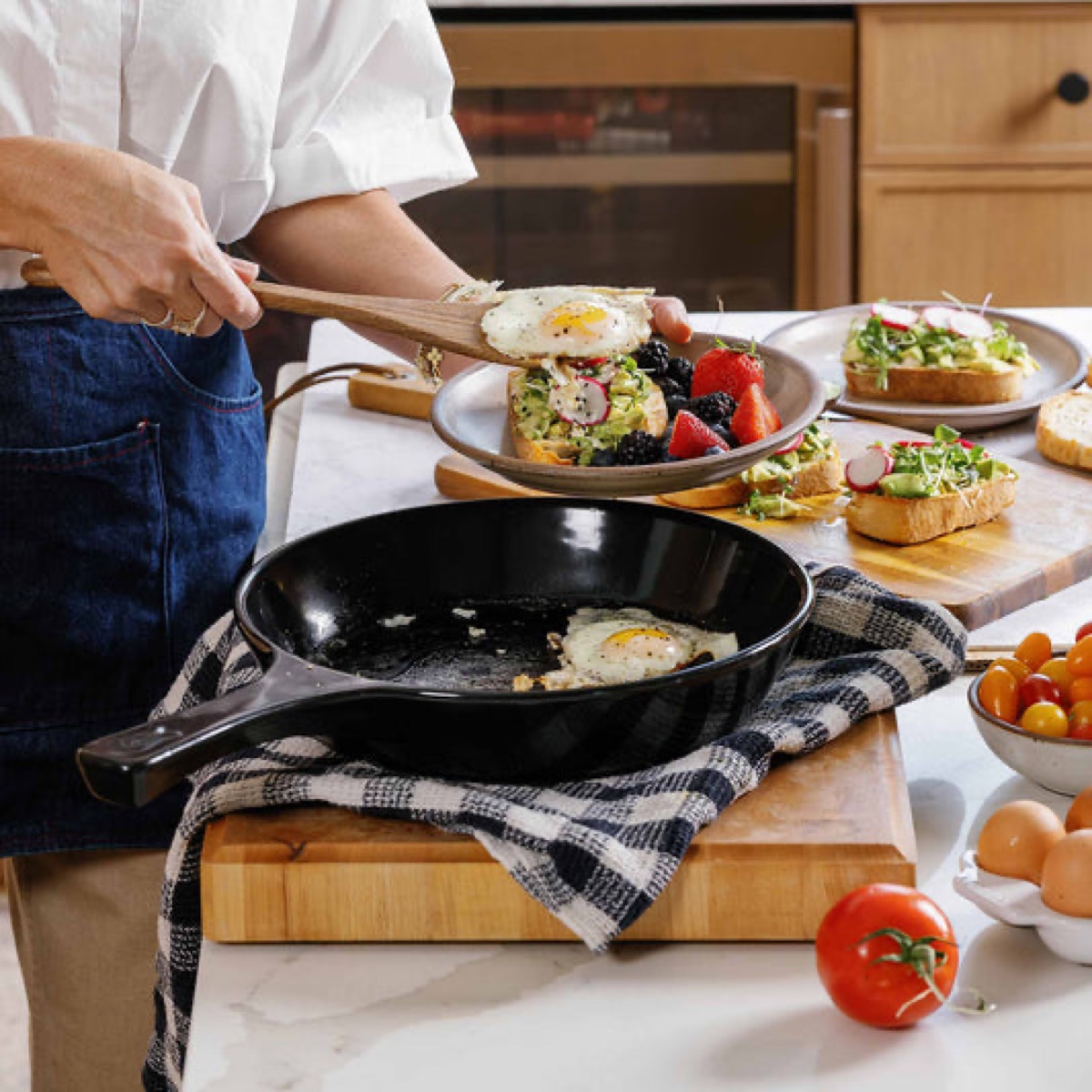
Signature 100% Ceramic Skillet

Plasticproof Excellent $$$Our price tier

A skillet made of ceramic all the way through — no metal core, no non-stick coating. Xtrema states every batch is tested by third-party laboratories for extractable lead and cadmium against California Proposition 65 limits.

Check price at Xtrema
Ceramic all the way throughNo coating, no metal core.
Tested for extractable leadThird-party, per Xtrema.
Nothing to wear offUnlike ceramic-coated pans.
See exactly how we verify this

As an Amazon Associate I earn from qualifying purchases — at no extra cost to you. We show a "Check price on Amazon" link rather than a number because Amazon prices change often.

Why it's safe for your family

  • There is no coating and no metal core: the pan is formed ceramic, fired hard, so there is no layer that can scratch through and nothing bonded on that can degrade at heat. That is a structurally different proposition from "ceramic-coated" pans, which are metal with a sprayed sol-gel layer.
  • Xtrema states the cookware contains no extractable metal, cadmium, lead, PFOA, PTFE, glues, polymers, coatings or dyes, and that each piece is triple-fired at around 2,500 degrees Fahrenheit.
  • Xtrema states every product is tested by third-party laboratories for extractable lead and cadmium against California Proposition 65 limits before shipping, and publishes the test letters.
  • Ceramic is chemically inert against acidic food, so tomato sauce and wine do not react with it the way they do with bare cast iron or aluminum.

Is this really PFAS-free? Yes — and here’s why

PFAS in cookware lives in the non-stick coating. This pan has no coating to contain any: it is a single fired ceramic body. Xtrema states there is no PTFE, no PFOA, no polymers, glues or dyes anywhere in it, and publishes third-party extractable lead and cadmium testing against California Proposition 65 limits.

Fired ceramic100%

What this pan is made of: ceramic, fired three times. There is no layer on top of anything.

Quick specs

Construction
100 percent ceramic — no metal core, no coating
Testing
Third-party extractable lead and cadmium testing (Xtrema’s stated program)
Firing
Triple-fired at about 2,500 degrees Fahrenheit
Use
Stovetop, oven, broiler, microwave and dishwasher

What to avoid instead

Avoid "ceramic non-stick" pans if what you wanted was ceramic. Those are metal pans with a sprayed silica-based coating that wears out in a year or two and then needs replacing; this is solid ceramic with nothing to wear off. The trade is real: solid ceramic is heavier, heats slowly, and will break if you drop it.

How we verify — and what we don't

Straight answer: we're a research team, not a testing lab. Here's exactly what our rating is based on — and what it isn't — so you can weigh it honestly.

What we check

  • What the product is made of, from the maker's own specs and product listing.
  • Whether any part that touches you or your food uses PTFE, PFAS, plastic, or a coating that can degrade.
  • Peer-reviewed research on how that material behaves when heated, scratched, washed, or worn.
  • Known failure modes — how the product actually breaks down in a real home.

What we don't do

  • We have not chemically tested this specific unit in a lab.
  • We don't take payment to rate a product higher — there is no sponsored placement.
  • We don't show star ratings or "trusted by thousands" counts we can't stand behind.
What gets a product rejected

Anything that adds a known microplastic, PFAS, or off-gassing source — a non-stick coating, a plastic surface against food or skin, vinyl/PVC — is downgraded or cut. We only list what clears that bar.

Don't take our word for it — check the sources yourself Xtrema's product details

Common questions

Does it contain heavy metals or not?
Both things are true and the distinction is the whole answer. Independent X-ray fluorescence testing of ceramics detects metals present in the material — that is what XRF does, it reads elemental composition. What matters for food is whether anything leaches out, and that is what the extractable lead and cadmium testing Xtrema publishes measures, against California Proposition 65 limits. Present in the fired body is not the same as available to your food, and we would rather explain that than pretend a ceramic contains no elements.
Is it actually non-stick?
No, and any pan promising both "no coating" and "non-stick" is selling you something. Solid ceramic needs oil and needs preheating done gently. Cook with fat, let the pan come up to temperature slowly, and it releases well; treat it like a coated pan and eggs will weld to it.
What breaks it?
Thermal shock and impact. Do not take it from a hot burner to cold water, do not put a frozen thing into a screaming-hot pan, and do not drop it. Ceramic that survives those three things lasts effectively forever, which is the point of buying one.
Related reading
Best Non-Toxic Cookware
Related reading
Is Nonstick Cookware Safe?

More safe picks

Affiliate disclosure: some links on this page are affiliate links. As an Amazon Associate I earn from qualifying purchases. We earn a small commission from qualifying purchases at no extra cost to you. This does not influence our recommendations — every product is selected based on peer-reviewed research.