Silpat

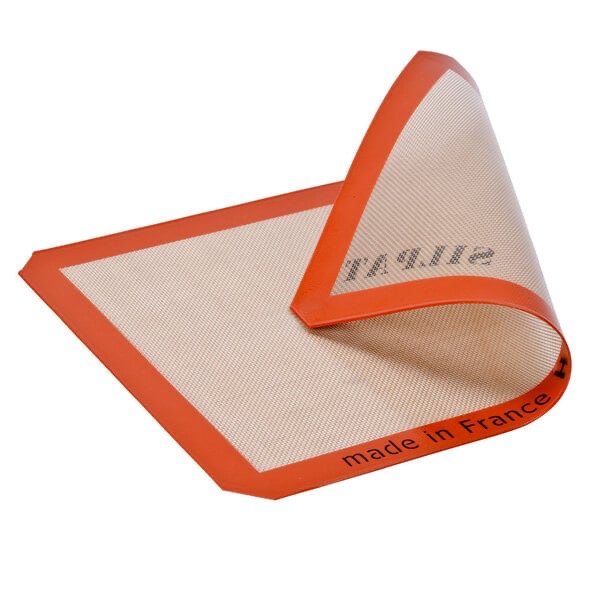
Premium Non-Stick Silicone Baking Mat, Half Sheet

Plasticproof Great $$$Our price tier

Reusable food-grade silicone baking mat, made in France, that replaces parchment and nonstick spray. Silicone is not a fluoropolymer coating — there is no PTFE and no PFOA in it to break down.

Check price on Amazon
Silicone, not a fluoropolymerNo PTFE, no PFOA.
Replaces parchment and sprayThousands of uses per mat.
Rated to 428 degreesSilpat’s stated range.
See exactly how we verify this

As an Amazon Associate I earn from qualifying purchases — at no extra cost to you. We show a "Check price on Amazon" link rather than a number because Amazon prices change often.

Why it's safe for your family

  • The mat is food-grade silicone over a fiberglass mesh, which is what gives it structure without a coating. Silicone is a silicon-and-oxygen polymer, chemically unrelated to the fluoropolymer non-stick coatings that PFAS concerns are about.
  • It replaces two things worth replacing: parchment paper, which is commonly treated with a release coating, and aerosol nonstick spray, which sprays propellants and release agents onto the food surface.
  • Silpat states the mats are free of bisphenol A, phthalates and peroxides, and that all products are FDA and NSF certified and tested to French and European regulations.
  • Silpat states a working range of -40 to 428 degrees Fahrenheit and a service life of up to 3,000 uses — the reason a single mat outlives years of parchment rolls.

Is this really PFAS-free? Yes — and here’s why

PFAS in cookware means fluoropolymer coatings — PTFE and the chemistry used to make it. Silicone is a different family altogether: a silicon-oxygen backbone, cured into a solid sheet rather than sprayed on as a coating. There is no fluorine in it, so there is no fluorinated layer to scratch, flake or break down at heat.

Food-grade silicone90%
Fiberglass mesh core10%

What this mat is made of: cured silicone bonded around a glass-fiber mesh. No PTFE, no PFOA, no sprayed release coating.

Quick specs

Material
Food-grade silicone over fiberglass mesh
Temperature range
-40 to 428 degrees Fahrenheit (Silpat’s stated range)
Certifications
FDA and NSF (Silpat’s stated certifications)
Made in
France
Life
Up to 3,000 uses (Silpat’s stated figure)

What to avoid instead

What this replaces is aerosol nonstick spray and coated parchment. It is not a replacement for a bare metal sheet pan where you want browning: silicone insulates, so the bottoms of cookies brown more gently than on bare steel. That is a feature for delicate work and a drawback for a crisp base.

How we verify — and what we don't

Straight answer: we're a research team, not a testing lab. Here's exactly what our rating is based on — and what it isn't — so you can weigh it honestly.

What we check

  • What the product is made of, from the maker's own specs and product listing.
  • Whether any part that touches you or your food uses PTFE, PFAS, plastic, or a coating that can degrade.
  • Peer-reviewed research on how that material behaves when heated, scratched, washed, or worn.
  • Known failure modes — how the product actually breaks down in a real home.

What we don't do

  • We have not chemically tested this specific unit in a lab.
  • We don't take payment to rate a product higher — there is no sponsored placement.
  • We don't show star ratings or "trusted by thousands" counts we can't stand behind.
What gets a product rejected

Anything that adds a known microplastic, PFAS, or off-gassing source — a non-stick coating, a plastic surface against food or skin, vinyl/PVC — is downgraded or cut. We only list what clears that bar.

Don't take our word for it — check the sources yourself Silpat's product details

Common questions

Is silicone actually safe at oven temperatures?
Within its rated range, which is the part people skip. Silpat states -40 to 428 degrees Fahrenheit for this mat. Broiling, or a hot oven above that, is outside what the maker rates it for, and no baking mat belongs under a broiler. Stay inside the number and this is a stable material that does not shed a coating.
Does it stain or hold smells?
It can pick up color and a faint smell from strong spices or heavily fatty bakes, which is normal for silicone and is not the mat failing. Wash it flat with hot soapy water rather than folding it, and do not cut on it — the fiberglass mesh is what holds the shape and a knife cut ends the mat.
How is this different from a cheap silicone mat?
Mostly the mesh and the tolerances. The fiberglass reinforcement is why it lies flat and does not curl at the edge of the pan, and it is what a mat rated for thousands of uses needs. Unbranded mats are often unreinforced silicone with no stated temperature rating and no stated certifications, which is exactly the thing you would want stated.
Related reading
Does Parchment Paper Have PFAS?
Related reading
Microplastics in Food Packaging

More safe picks

Affiliate disclosure: some links on this page are affiliate links. As an Amazon Associate I earn from qualifying purchases. We earn a small commission from qualifying purchases at no extra cost to you. This does not influence our recommendations — every product is selected based on peer-reviewed research.