Frizzlife

Frizzlife SK99 Under-Sink Water Filter System

Plasticproof Great $$$Our price tier

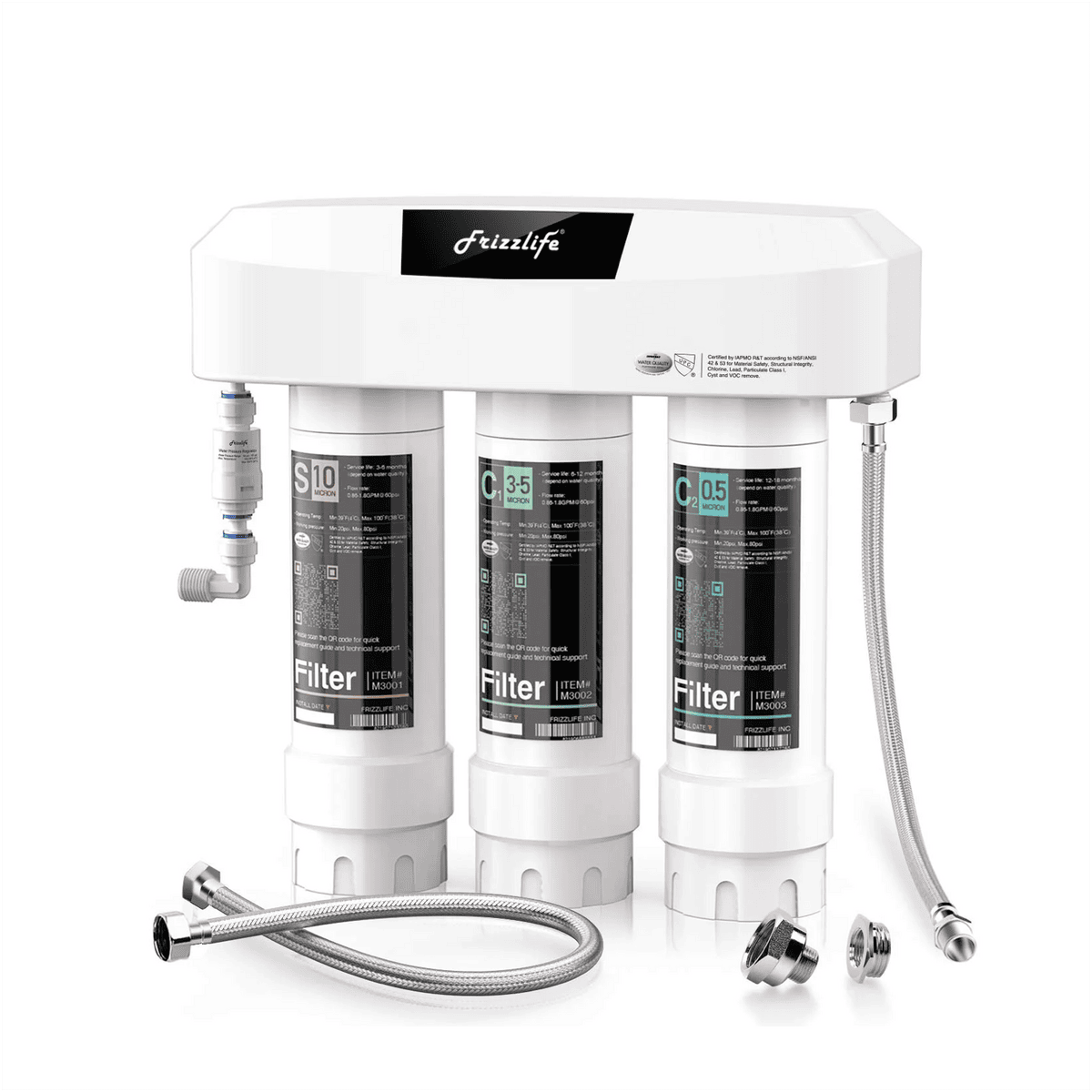
Under-sink filter that connects to the cold line you already have — no new faucet, no drilling — and which Frizzlife states is certified to NSF/ANSI 42, 53 and 372, with a 1600-gallon cartridge.

Check price on Amazon
No drilling, no second faucetConnects to the line you have.
0.5 micron cartridgeA size limit, not just chemistry.
Certified to 42, 53 and 372Per Frizzlife.
See exactly how we verify this

As an Amazon Associate I earn from qualifying purchases — at no extra cost to you. We show a "Check price on Amazon" link rather than a number because Amazon prices change often.

Why it's safe for your family

  • It connects directly into the existing cold-water line, so every drop from your normal kitchen faucet is filtered. Nothing gets drilled into the countertop and no second faucet appears, which is what makes this the practical choice for a rental or a stone counter.
  • Frizzlife states the system is certified to NSF/ANSI 42, 53 and 372 — taste and chlorine, health-effects contaminants including lead, and lead-free materials in the housing itself.
  • The cartridge is rated at 0.5 micron, which is a genuine physical size limit rather than a chemistry claim. Particles at or above that size cannot pass, and common microplastic particles are far larger.
  • Frizzlife publishes third-party laboratory testing showing more than 90 percent reduction of PFOA and PFOS. Be clear about the evidence: that is published lab testing, and the system is not certified against protocol P473 for PFAS.

Quick specs

Method
Three-stage carbon block, direct connect
Certified
NSF/ANSI 42, 53 and 372 (Frizzlife’s stated certifications)
Filtration
0.5 micron
Capacity
About 1600 gallons per cartridge
Flow rate
Over 2 gallons per minute at 60 psi

What to avoid instead

Avoid the cheapest uncertified under-sink kits, the ones sold on a photograph of the cartridge stack and nothing else. Certification is the entire difference between a filter and a plastic housing full of carbon, and it is the one thing you cannot check yourself once it is in the cabinet.

How we verify — and what we don't

Straight answer: we're a research team, not a testing lab. Here's exactly what our rating is based on — and what it isn't — so you can weigh it honestly.

What we check

  • What the product is made of, from the maker's own specs and product listing.
  • Whether any part that touches you or your food uses PTFE, PFAS, plastic, or a coating that can degrade.
  • Peer-reviewed research on how that material behaves when heated, scratched, washed, or worn.
  • Known failure modes — how the product actually breaks down in a real home.

What we don't do

  • We have not chemically tested this specific unit in a lab.
  • We don't take payment to rate a product higher — there is no sponsored placement.
  • We don't show star ratings or "trusted by thousands" counts we can't stand behind.
What gets a product rejected

Anything that adds a known microplastic, PFAS, or off-gassing source — a non-stick coating, a plastic surface against food or skin, vinyl/PVC — is downgraded or cut. We only list what clears that bar.

Don't take our word for it — check the sources yourself Frizzlife's product details

Common questions

Does it remove microplastics?
Its 0.5 micron rating is a physical limit, so particles at or above that size are blocked — and the microplastics measured in tap water studies are typically much larger. What Frizzlife does not hold is an NSF/ANSI 401 microplastics certification, so we describe the mechanism rather than claim the certification. If you want that specific certified claim, look at a filter that carries it.
Will it fit under my sink?
It is a compact three-stage unit rated over 2 gallons per minute, so it does not slow the faucet the way a small cartridge does. Measure the clear height in your cabinet and check you can reach the shutoff valve. Cartridge changes are twist-in, which matters more than it sounds when you are lying on your back in a cupboard.
Is it reverse osmosis?
No, and that is deliberate. This is carbon-block filtration: it keeps the minerals, wastes no water to a drain, needs no tank and no power. Reverse osmosis filters more thoroughly — dissolved solids, fluoride, the full PFAS family — at the cost of drain water, cabinet space and a slower flow.
Related reading
Best Under-Sink Water Filter

More safe picks

Affiliate disclosure: some links on this page are affiliate links. As an Amazon Associate I earn from qualifying purchases. We earn a small commission from qualifying purchases at no extra cost to you. This does not influence our recommendations — every product is selected based on peer-reviewed research.