Epic Water Filters

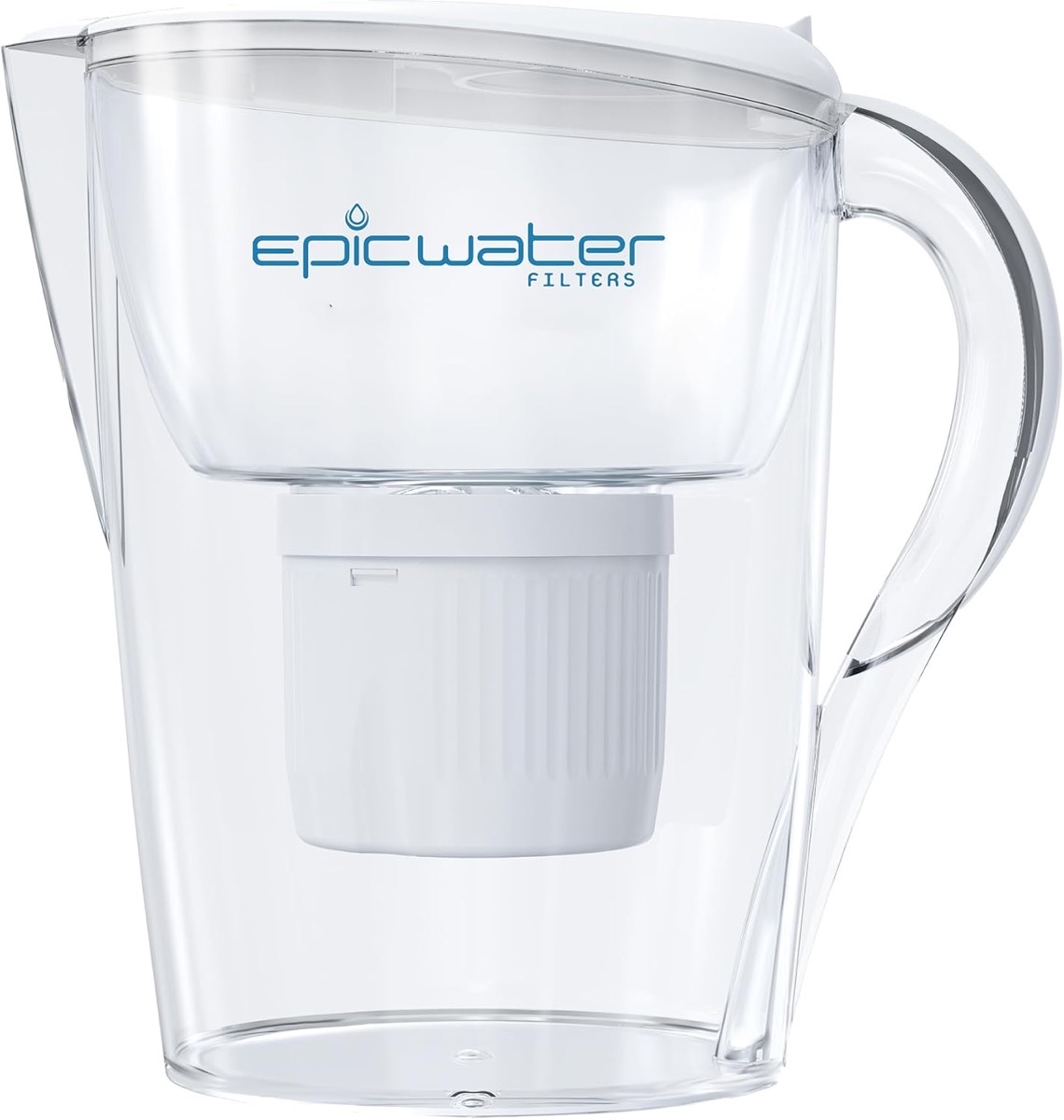
Epic Pure Water Filter Pitcher

Plasticproof Excellent $$$Our price tier

Pitcher with a two-layer filter — nano-fiber over a carbon block — that Epic states is NSF certified to NSF/ANSI 42 and 372 and independently tested to NSF/ANSI 42, 53, 401 and P231, with published reductions for microplastics, PFAS, lead and fluoride.

Check price on Amazon
Made in USA
Two layers, two jobsFiber for particles, carbon for chemistry.
Certified to 42 and 372Plus lab testing to 53, 401, P231.
100-gallon filter lifeAbout three to four months.
See exactly how we verify this

As an Amazon Associate I earn from qualifying purchases — at no extra cost to you. We show a "Check price on Amazon" link rather than a number because Amazon prices change often.

Why it's safe for your family

  • The filter is two layers doing two jobs: an outer nano-fiber layer that works as a physical barrier to particles, and an inner carbon fiber block for the dissolved chemistry — metals, chlorine, PFAS. A single carbon layer has to do both jobs badly.
  • Epic states the filter is NSF certified to NSF/ANSI Standard 42 and NSF/ANSI/CAN 372, and independently tested to NSF/ANSI 42, 53, 401 and protocol P231. Read that split honestly: two certifications, plus laboratory testing against the standards behind the rest of the claims.
  • Epic publishes its own reduction figures for the line — including 99.9 percent for microplastics, PFAS and lead, and 99.2 percent for fluoride. Those are the maker’s published test results, which is stronger than marketing language and weaker than a certification listing for each claim.
  • Epic states the pitcher is made from BPA-free and BPS-free food-grade materials, and the filter is rated for 100 gallons — roughly three to four months for an average household, so the cost per gallon stays reasonable.

Quick specs

Method
Two-stage: nano-fiber layer over a carbon fiber block
Certified
NSF/ANSI 42 and NSF/ANSI/CAN 372 (Epic’s stated certifications)
Tested to
NSF/ANSI 42, 53, 401 and protocol P231
Filter life
100 gallons (about 3 to 4 months)
Body
BPA-free and BPS-free food-grade material

What to avoid instead

Avoid the assumption that any pitcher is equivalent. A basic carbon pitcher is built for taste; it has no fiber barrier and makes no particle claim. If you want a pitcher that names microplastics and PFAS in its own published test results, this is that pitcher — the trade is a slower pour and a filter you actually have to replace on schedule.

How we verify — and what we don't

Straight answer: we're a research team, not a testing lab. Here's exactly what our rating is based on — and what it isn't — so you can weigh it honestly.

What we check

  • What the product is made of, from the maker's own specs and product listing.
  • Whether any part that touches you or your food uses PTFE, PFAS, plastic, or a coating that can degrade.
  • Peer-reviewed research on how that material behaves when heated, scratched, washed, or worn.
  • Known failure modes — how the product actually breaks down in a real home.

What we don't do

  • We have not chemically tested this specific unit in a lab.
  • We don't take payment to rate a product higher — there is no sponsored placement.
  • We don't show star ratings or "trusted by thousands" counts we can't stand behind.
What gets a product rejected

Anything that adds a known microplastic, PFAS, or off-gassing source — a non-stick coating, a plastic surface against food or skin, vinyl/PVC — is downgraded or cut. We only list what clears that bar.

Don't take our word for it — check the sources yourself Epic Water Filters's product details

Common questions

Certified, or tested? What is the difference?
A certification means an independent body has listed the product against a standard and keeps auditing it. "Tested to" means a laboratory ran the standard’s protocol once and the results are published. Epic holds certification for NSF/ANSI 42 and 372, and publishes independent testing against 53, 401 and P231. That is more evidence than most pitchers offer and less than a full certification listing for every claim, and you should price it that way.
How slow is it?
A dense two-layer filter is slower than a plain carbon pitcher, and it slows further as the filter loads. That is the cost of a physical barrier rather than adsorption alone. Fill it and walk away; do not stand at the counter waiting for it.
How much does it cost to run?
Work in gallons, not sticker price. The filter is rated for 100 gallons, so divide the replacement price by 100 to get your real per-gallon cost and compare that with a cheaper pitcher whose filter lasts 40 gallons. Cheap filters that need replacing three times as often are not cheap.
Related reading
Best PFAS Water Filter
Related reading
Best Water Filter Pitchers for Microplastics

More safe picks

Affiliate disclosure: some links on this page are affiliate links. As an Amazon Associate I earn from qualifying purchases. We earn a small commission from qualifying purchases at no extra cost to you. This does not influence our recommendations — every product is selected based on peer-reviewed research.