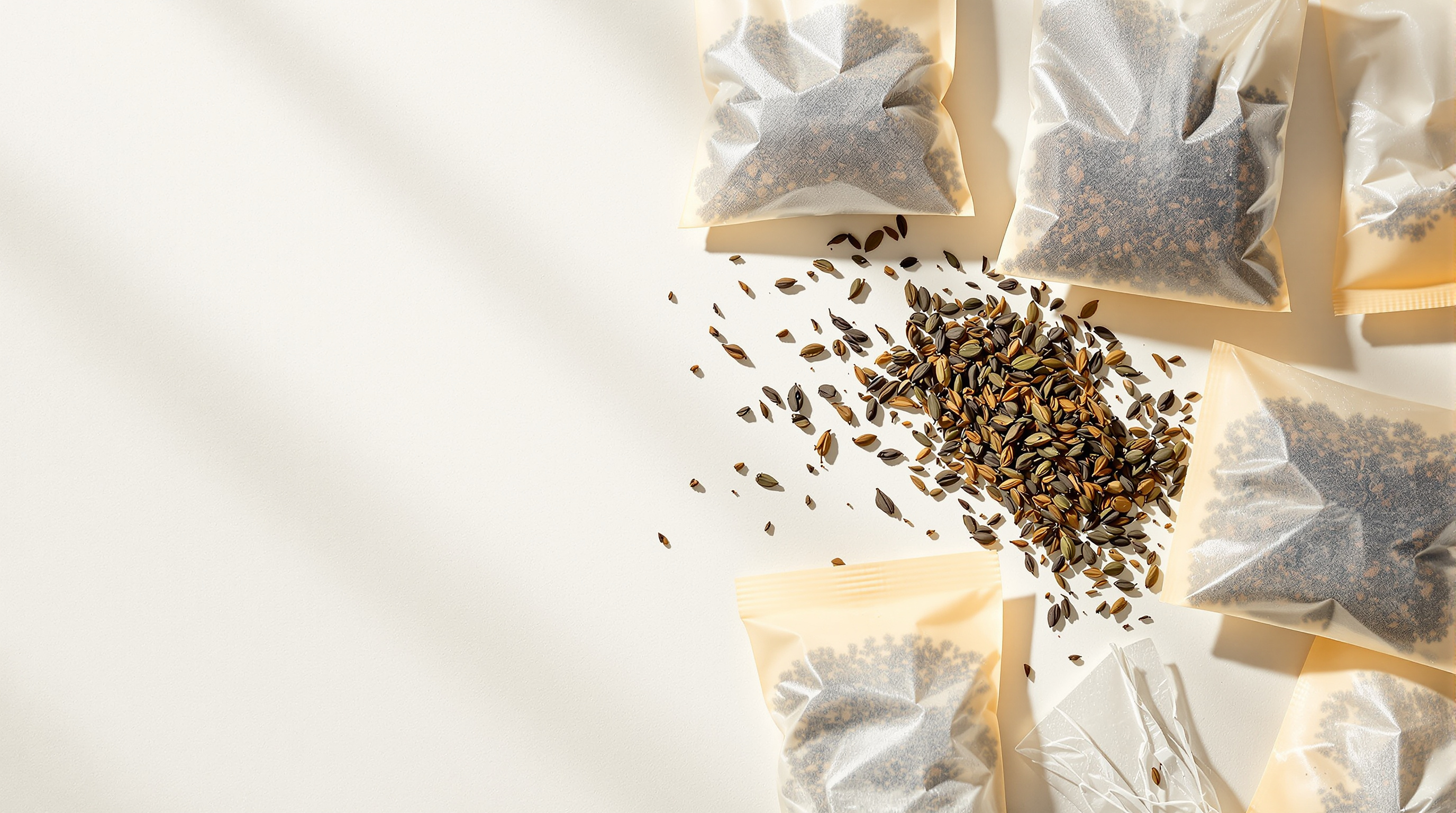
Most “natural” and even “organic” tea bags are still sealed with a thin polypropylene strip that sheds microplastics into hot water. Truly plastic-free tea bags require three things: unbleached paper (no chlorine), a non-heatseal closure (staple, glue, or crimp — no polypropylene adhesive), and no synthetic fiber in the bag body. Only a handful of mainstream brands meet all three. The 6 verified options below do — or you can skip the bag entirely with a stainless steel loose-leaf infuser.
The conversation about microplastics in tea has almost entirely focused on pyramid bags — those shiny mesh sachets that release 11.6 billion microplastic particles per cup according to the now-famous 2019 McGill study. But flat paper bags carry a quieter problem that most tea drinkers don’t know exists: the heatseal.
A heatseal is a thin strip of thermoplastic — almost always polypropylene — fused along the top of the bag with heat and pressure to close it. It’s invisible from the outside when the bag is dry. But when boiling water meets that seal for 3–5 minutes at 90–100°C, the polypropylene can degrade and shed microplastic particles. Some paper bags that appear perfectly natural are, in fact, a plastic delivery system hidden in paper clothing.
What changed in 2024: a peer-reviewed study out of the Universitat Autònoma de Barcelona’s Mutagenesis Group (Banaei et al., Chemosphere, December 2024) pinned actual per-material release numbers to the three tea-bag polymers most brands use, and did what earlier work hadn’t: it followed the particles into human intestinal cells.
The takeaway isn’t “cellulose is safe” — 135 million particles per mL is not zero, and cellulose is often what a “paper” bag is made from. It’s that the material of the bag itself is a release source, on top of any polypropylene heatseal strip. The three tea-bag polymers rank cellulose < nylon-6 < polypropylene by particle count — and every one of them was taken up by intestinal cells. The only way off the release curve entirely is to not brew tea through a plastic-family bag at all: unbleached paper with a non-plastic closure, or a stainless-steel infuser with loose leaf. (See does tea have microplastics for the full research thread and how it maps to daily exposure.)
What does “unbleached” mean in tea bags?
Unbleached tea bag paper hasn’t been treated with chlorine or chlorine dioxide to achieve a white appearance. Standard white bags are bleached during manufacturing, which can leave trace residues of dioxins — a class of persistent organic pollutants — in the paper fiber. When steeped in hot water, those residues may migrate into the cup in small amounts.
Unbleached bags retain a natural tan or brown color from the raw fiber — typically manila hemp, abaca, or wood pulp. The color change is purely cosmetic, but it’s a reliable proxy for cleaner processing. USDA Certified Organic teas tend to require unbleached paper because organic certification standards restrict chlorine-based bleaching agents.
Chlorine residues in bleached tea bags are a genuine concern, but the concentrations reaching your cup are typically very small. The polypropylene heatseal is the larger, more consistent exposure source because thermoplastic degradation at 95°C is rapid and measurable. Fix the heatseal first, then switch to unbleached paper. For brands that pass both tests, see our roundup of 7 real plastic-free tea bag brands.
What is a heatseal tea bag and why does it matter?
A heatseal is a thermoplastic strip — almost always polypropylene or a polypropylene copolymer — that is fused to the paper along the top edge under heat and pressure. It’s the default industrial closure method because it’s fast, cheap, and nearly fail-proof on high-speed bag-filling lines.
The problem: polypropylene does not remain chemically stable when immersed in boiling water for minutes at a time. Heat degrades the polymer chains, releasing both microplastic particles and small amounts of plasticizer additives. The kettle matters too: many plastic electric kettles shed their own microplastics into the water, so a non-toxic electric kettle is worth pairing with a plastic-free bag. A 2021 study in Science of the Total Environment confirmed that paper tea bags with polypropylene heatseals shed measurable microplastic particles under standard steeping conditions, though at lower quantities than full nylon mesh pyramids.
The alternative closures that avoid this entirely are:
- Metal staple — inert, zero leaching, the safest closure
- Natural glue (gelatin or water-soluble starch paste) — breaks down harmlessly in hot water
- Mechanical crimp or fold — common in Japanese green tea bags, no adhesive at all
"A bag can be USDA organic, made from unbleached paper, and ‘sustainable’ by every marketing metric — and still have a polypropylene heatseal on top."
Are non-heatseal tea bags automatically plastic-free?
Not always — but they’re dramatically safer. “Non-heatseal” means the bag is closed without a plastic adhesive strip. But a bag can be non-heatseal and still:
- Be made from bleached paper (dioxin concern)
- Have a pyramid shape made from nylon or PET mesh (the biggest microplastic source)
- Contain PLA (polylactic acid) fiber — marketed as “compostable” but still a plastic that may shed particles at brewing temperatures
The gold standard is three criteria simultaneously: unbleached paper body + non-heatseal closure + no synthetic fiber anywhere in the bag. Only flat paper bags (not pyramids, not sachets with mesh gussets) can clear all three at once. If a brand is selling a “silken” or “cornstarch” pyramid, ask specifically about the material — those names often mean PLA, which is a plastic made from plant starch but a plastic nonetheless.
How do I tell if my current tea bags are heatseal?
There are three reliable tests you can do at home without any equipment:
1. The visual strip test
Hold a dry bag up to a light source and look at the sealed top edge. A polypropylene heatseal appears as a uniform, very straight band that is slightly shinier or more translucent than the paper — the plastic has been melted into the fiber. A stapled bag has a visible metal staple. A glue-sealed bag may show a slightly darker strip, but it will be less uniform and glossy than a heatseal.
2. The peel test
On an unused bag, try gently separating the top sealed edge. A polypropylene heatseal is extremely strong — the paper will tear before the bond separates. A natural glue seal or a folded crimp will come apart more cleanly. Never do this with a bag you intend to drink; it exposes the tea to contamination.
3. The brand disclosure test
The most reliable approach: look for explicit brand statements. Phrases like “no plastic in our bags,” “heat-sealed without polypropylene,” or “plant-fiber sealed” are what you’re after. Brands that meet this standard are proud of it and say so. If the packaging only says “unbleached” or “organic” but doesn’t address the closure, assume heatseal until proven otherwise.
Already researched the full tea bag landscape?
Our deep-dive Best Non-Toxic Tea Bags 2026 ranks the top plastic-free brands by taste, price, and safety — including Numi, Traditional Medicinals, and Yogi Tea. The guide below focuses on the unbleached + non-heatseal shortlist specifically.
Which tea bag brands are unbleached and non-heatseal?
The 6 brands below have been verified to use unbleached paper with no polypropylene heatseal. Where possible, they also disclose this explicitly. All are available in the US and ship via Amazon Prime.
1. Vahdam India Original Masala Chai Tea Bags — Best Overall
Vahdam is a New Delhi-based brand that ships directly from source and is explicit about material safety. Their flat paper bags use unbleached, food-grade paper sealed with natural glue — no polypropylene heatseal. USDA Organic certified, non-GMO, and Rainforest Alliance certified. The masala chai is also one of the most complex and aromatic bags you’ll find at this price. The brand also produces green, black, and herbal teas in the same construction.
Unbleached Paper Natural Glue Seal USDA OrganicDrinkers say Vahdam's masala chai comes close to homemade, well-balanced with a sweet finish, and many are repeat buyers who like that the brand is explicit about its materials. The honest downsides: opinions on strength split hard, with some finding it too mild or short on cinnamon while others want more kick; a few called the packaging wasteful with extra boxes and labels; and buyers noted the pack shrank from 16 to 12 ounces while the price held, raising the cost per ounce.
✓ Ships free with Prime · Free returns · Amazon A-to-z purchase guarantee (on eligible items)
2. FGO Organic Green Tea — Best Value (100-Count)
FGO's organic green tea comes 100 bags to a resealable pouch, which the brand markets as eco-conscious tea bags. It's a simple, organic everyday green tea, and the 100-count pouch makes it one of the best-value picks here for daily drinkers. Caffeinated, and widely available on Amazon.
Organic 100 Tea Bags Resealable PouchDrinkers describe a smooth, earthy green that does not overpower, and it is frequently named a best-value organic bag, with unbleached hemp-fiber bags and no strings or staples. There were few specific complaints in the reviews; the main honest caveat is that green tea turns bitter if you brew it with boiling water, so owners recommend water around 160 to 180 degrees.
✓ Ships free with Prime · Free returns · Amazon A-to-z purchase guarantee (on eligible items)
3. Organic Hibiscus Flowers (Loose-Leaf, 1 lb) — Best Herbal / Caffeine-Free
EarthWise Aromatics packs whole organic hibiscus flowers (Flor de Jamaica) as loose-leaf herbal tea — 100% certified organic, one full pound to a bag. Because it's loose leaf, there's no tea bag at all: brew it in a stainless steel or glass infuser (see below) and you have zero bag material in the cup. Naturally caffeine-free and pleasantly tart, it works hot as tea or cold as an agua fresca, and a full pound makes it a strong value for regular drinkers.
Certified Organic Loose Leaf Caffeine-FreeDrinkers love the vibrant crimson cup and the tart, cranberry-like tang, and whole flowers give a fuller body than bagged hibiscus. The honest downsides: it is strong and quite sour on its own, over-steeping turns it bitter with a drying finish, and many recommend a shorter steep, a smaller dose, or a little sweetener or a rooibos blend to tame the pucker.
✓ Ships free with Prime · Free returns · Amazon A-to-z purchase guarantee (on eligible items)
4. ITO EN Oi Ocha Japanese Green Tea Bags — Best for Green Tea
ITO EN is Japan’s largest green tea company, and their Oi Ocha line uses traditional Japanese flat paper bag construction with a mechanical crimp closure — no plastic adhesive of any kind. The paper is unbleached natural fiber. Japanese tea industry standards have historically been more conservative about bag materials than US or European counterparts, and ITO EN’s construction reflects that. The tea itself is first-flush Japanese green tea (sencha), light and vegetal. Brews beautifully at 70–80°C for 1–2 minutes.
Unbleached Paper Mechanical Crimp Seal Japanese First-FlushDrinkers call Oi Ocha a reliable daily Japanese sencha, clean and balanced with a rich, slightly savory sweetness. The honest downsides: it turns bitter if you brew it too hot, and reviewers point out that the bags come individually wrapped in plastic sachets, which is worth weighing on a plastic-free list.
✓ Ships free with Prime · Free returns · Amazon A-to-z purchase guarantee (on eligible items)
5. Teekanne Organic Herbal Tea — Best European Herbal Option
Teekanne is a German tea brand founded in 1882 and is one of the largest tea producers in Europe. Their “Naturland Organic” line uses unbleached paper with a natural fiber heat-seal alternative — their proprietary sealing process does not use polypropylene. The individual bags are also packaged without individually wrapped plastic envelopes, reducing secondary plastic waste. The chamomile, peppermint, and hibiscus rose blends are excellent. Naturland is Germany’s leading organic certification, similar to but more stringent than USDA Organic in some processing standards.
Unbleached Paper Naturland Organic No Individual Plastic WrapDrinkers say Teekanne's organic blends deliver clean, thoughtfully balanced flavor, with some rating them above comparable wellness teas. The honest downsides: experience swings by blend, some of the fruitier ones come off heavily sweetened while others taste watery and need a longer steep, and a reviewer of the multivitamin blend picked up a faint metallic aftertaste.
✓ Ships free with Prime · Free returns · Amazon A-to-z purchase guarantee (on eligible items)
6. FORLIFE Brew-in-Mug Extra-Fine Tea Infuser with Lid — Best Skip-the-Bag Solution
If you want to eliminate bag material entirely from the equation — no paper, no seal, no chance of any leaching — a stainless steel infuser basket is the logical end point. FORLIFE’s brew-in-mug basket features extra-fine 304 stainless steel mesh that holds even fine-cut teas without letting leaf through. The lid doubles as a drip-catching saucer. Pair it with any of the loose-leaf teas above (the organic hibiscus flowers, and ITO EN also sells loose-leaf) and you have a completely plastic-free cup — leaf to lip. This is especially relevant for hormone health and gut health, where repeated daily microplastic exposure is the concern.
304 Stainless Steel No Bag Required Zero Microplastic PathOwners like that it brews a full mug, keeps leaves out, and has no plastic parts to worry about. The honest downsides: getting spent leaves out of the fine basket is a chore, some found enough residue still settling in the cup, one owner saw a cut develop in the basket after only a handful of uses, and at over fifteen dollars it costs more than twice what a basic infuser runs.
✓ Ships free with Prime · Free returns · Amazon A-to-z purchase guarantee (on eligible items)
How do these brands compare on the key criteria?
| Brand | Paper Type | Closure | Organic Cert | Format |
|---|---|---|---|---|
| Vahdam India | Unbleached | Natural glue | USDA Organic | Flat bag |
| FGO Organic Green Tea | Eco-conscious | Not specified | Organic | Tea bags (100 ct) |
| Organic Hibiscus Flowers | N/A (loose leaf) | N/A (loose leaf) | Certified Organic | Loose leaf |
| ITO EN Oi Ocha | Unbleached | Mechanical crimp | Japanese JAS | Flat bag |
| Teekanne Organic | Unbleached | No PP adhesive | Naturland Organic | Flat bag |
| FORLIFE Infuser | No paper (steel) | N/A | N/A (hardware) | Stainless steel basket |
What about PLA “compostable” pyramid bags?
PLA (polylactic acid) bags are marketed as plant-based and compostable, and technically the raw material — corn starch — is natural. But PLA is still a plastic polymer. When heated to 95°C in water, PLA can degrade and shed micro-scale particles. The 2019 McGill study tested nylon and PET pyramids, not PLA specifically, so we don’t yet have the same definitive particle count for PLA bags at brewing temperatures.
What we do know: PLA requires industrial composting conditions (sustained high heat) to break down — it does not compost in home bins or soil. Several brands that switched from nylon pyramids to “biodegradable” PLA pyramids were still releasing particles in subsequent testing. Until more specific research is published, PLA pyramid bags should be treated as a partial upgrade from nylon, not a complete solution. Flat unbleached paper bags with no plastic seal remain the safest bagged option.
Want to understand the full microplastic health picture?
Daily tea habit aside, repeated low-dose microplastic exposure from food and drink packaging has been linked to hormonal disruption and gut inflammation. See what the research shows.
The honest verdict: what should you actually buy?
If you drink tea daily, the single highest-leverage switch is from a polypropylene-seal paper bag or nylon pyramid to any of the six options above. You don’t need to spend more — Vahdam India and ITO EN are both around the same price as mainstream brands at major retailers.
The upgrade path in order of impact:
- Stop using pyramid mesh bags (nylon, PET, or PLA) immediately — these are the highest exposure source by a large margin.
- Switch to flat unbleached paper bags with a staple or glue seal — Vahdam India, ITO EN, ST. DALFOUR, or Teekanne Organic.
- Upgrade to loose leaf in a stainless steel infuser (FORLIFE basket + any loose-leaf tea) for zero bag material exposure.
Each step reduces your daily microplastic intake meaningfully. Step 3 is the end point — a completely plastic-free cup from leaf to lip, brewed without any polymer material touching your water.
For a broader look at which specific tea bag brands rank highest across taste, safety, and value — including Numi, Pukka, Traditional Medicinals, and more — see our full buyer’s guide.
Frequently Asked Questions
Unbleached tea bag paper has not been treated with chlorine or chlorine dioxide. Standard white bags are bleached to achieve a bright appearance, which can leave trace dioxin residues. Unbleached bags retain a natural tan or brown color and skip this step entirely. Unbleached paper is safer, but it does not guarantee the bag is also free of a polypropylene heatseal.
A heatseal uses a polypropylene strip fused to the paper top edge with heat and pressure. When boiling water contacts this seal, the polypropylene can degrade and shed microplastic particles. Research confirms paper heatseal bags shed fewer particles than full nylon mesh pyramids, but they are not microplastic-free. Alternatives (staple, natural glue, crimp) eliminate this exposure source.
Not automatically. A bag can be non-heatseal but still made from nylon or PLA mesh (pyramid bags), or still use bleached paper. The gold standard is three criteria at once: unbleached paper body + non-heatseal closure (staple, glue, or crimp) + no synthetic fiber anywhere. Only flat paper bags can meet all three simultaneously.
Hold a dry bag to the light and look for a straight, slightly glossy band at the top edge — that’s a heatseal. A staple is obvious. A glue seal looks more matte and irregular. Try gently separating the top edge: heatseal bonds are very strong and the paper tears first. The most reliable method is reading the brand’s explicit disclosure — good brands state “no plastic in our bags” directly.
Verified unbleached, non-heatseal brands include Vahdam India (natural glue seal, USDA Organic), ST. DALFOUR (natural adhesive, AB Organic), ITO EN Oi Ocha (mechanical crimp, JAS certified), Teekanne Organic (no PP adhesive, Naturland certified), and Arbor Teas (loose leaf in unbleached kraft pouches, USDA Organic). For zero bag contact, use a FORLIFE or similar stainless steel infuser with any loose leaf tea.
Unbleached paper with a staple or natural-glue closure — no polypropylene, no nylon, no PET or PLA mesh. This construction releases no detectable microplastics under normal steeping conditions. The complete upgrade is loose-leaf tea in a stainless steel or glass infuser, which removes all bag material from the equation entirely.
Sources
- Hernandez LM, et al. “Plastic Teabags Release Billions of Microparticles and Nanoparticles into Tea.” Environmental Science & Technology, 2019. (McGill University)
- Guo X, et al. “Characterization of microplastics released from paper tea bags with polypropylene sealing materials.” Science of the Total Environment, 2021.
- Dioxin residues in chlorine-bleached food packaging: Chemosphere, 1997–2004 literature review.
- Rossi G, et al. “Polylactic acid biopolymer: thermal degradation kinetics.” Polymer Degradation and Stability, 2018. (PLA decomposition at elevated temperatures)
- USDA National Organic Program: materials standards for certified organic food packaging, 7 CFR Part 205.
- Naturland e.V. (Germany): Organic processing standards for food packaging, 2023 edition.