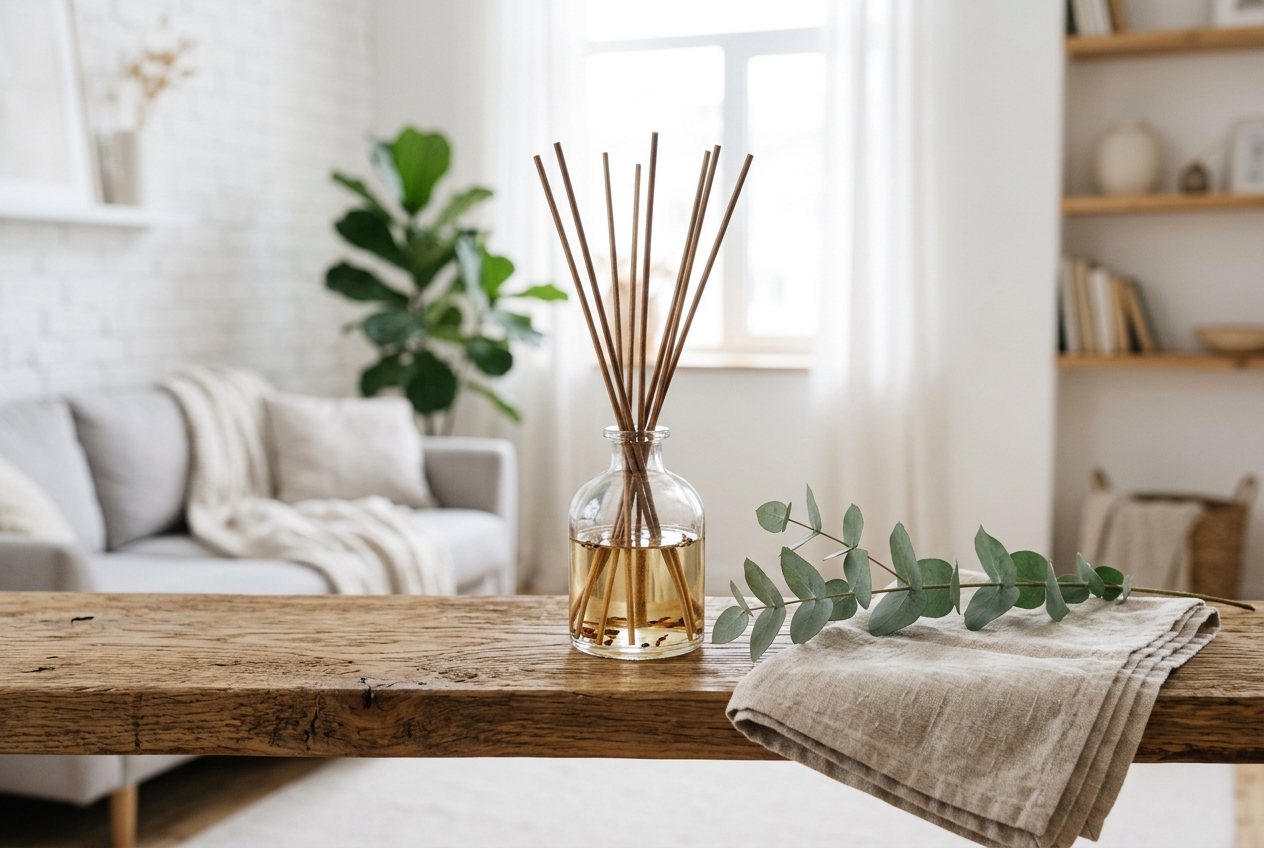
The best non-toxic air fresheners in 2026 include Vitruvi Stone Diffuser + Organic Essential Oils (best overall, ~$119), Moso Natural Air Purifying Bags (best budget, ~$10), Dr. Bronner's Pure Castile Spray as a DIY room spray base (best DIY-friendly, ~$12), Grow Fragrance Certified Toxin-Free Air Freshener (best ready-to-use spray, ~$15), Aura Cacia Pure Essential Oil Diffuser Blend (best essential oil blend, ~$8), and Enviroscent Bed & Bath Sticks (best passive option, ~$8). All six are free from phthalates, formaldehyde, synthetic fragrances, and the volatile organic compounds that make conventional air fresheners a genuine indoor air quality hazard.
Air fresheners are uniquely problematic among household products because their entire purpose is to release chemicals into the air. Unlike a cleaning product that contacts a surface and gets wiped away, an air freshener is designed to saturate the air column of your living space — the same air that fills your lungs 12 to 20 times per minute, 24 hours a day. The chemicals in that air freshener are inhaled deeply into lung tissue, absorbed through mucous membranes, and — in the case of plug-ins and passive diffusers — released continuously for days or weeks without interruption. The exposure is chronic, involuntary, and virtually impossible to avoid once the product is in use.
Below you will find a detailed breakdown of what is actually in conventional air fresheners, why those ingredients are concerning, what to look for in safer alternatives, full reviews of six non-toxic options, a comparison table, and answers to the most common questions about making the switch.
Top 3 Picks at a Glance
What Is Actually in Conventional Air Fresheners
The average American household uses air fresheners regularly — plug-ins in bathrooms, sprays in kitchens, gel discs in closets, scented candles in living rooms. The air freshener market exceeds $12 billion annually in the United States alone. But unlike food, drugs, or even cosmetics, air fresheners face almost no regulatory scrutiny regarding their chemical composition. The chemicals in these products are released directly into indoor air, where concentrations can build to levels far exceeding outdoor pollution standards — and the people inhaling them have no way to know what they are breathing.
Phthalates are the most pervasive hidden chemical in conventional air fresheners. They are used as solvents and fixatives to make fragrances last longer and disperse more evenly through the air. Phthalates are classified as endocrine disruptors — they interfere with the hormone systems of humans and animals at extremely low concentrations. Research published in Environmental Health Perspectives has linked phthalate exposure to reduced testosterone levels, reproductive abnormalities in male infants, early puberty in girls, increased risk of asthma, and neurodevelopmental effects in children. The particular concern with air freshener phthalates is the route of exposure: inhalation delivers these chemicals directly to the bloodstream through the lungs, bypassing the digestive system's partial detoxification mechanisms.
Formaldehyde is a known human carcinogen classified by the International Agency for Research on Cancer (IARC) as a Group 1 carcinogen — the highest level of certainty. It is present in many air fresheners either as a direct ingredient or as a breakdown product of other chemicals (particularly terpenes that react with ozone in indoor air). A 2006 study published in Environmental Science & Technology found that plug-in air fresheners containing limonene (a common terpene fragrance) produced formaldehyde when the limonene reacted with ambient indoor ozone — even at ozone levels well below EPA standards. This means that even air fresheners marketed as "natural" because they use terpene fragrances can generate formaldehyde inside your home through secondary chemical reactions.
Volatile organic compounds (VOCs) are emitted by virtually all conventional air fresheners. A landmark 2011 study by Anne Steinemann at the University of Washington tested 25 common fragranced products — including air fresheners, laundry products, and cleaners — and found that they collectively emitted over 133 different VOCs, of which 24 are classified as toxic or hazardous under at least one federal law. The average air freshener emitted 17 VOCs. Among the VOCs detected were acetaldehyde (a probable human carcinogen), benzene (a known human carcinogen), and chloromethane (a neurotoxin). Critically, none of these chemicals appeared on any product label. The EPA has documented that indoor VOC levels are consistently 2 to 5 times higher than outdoor levels, and air fresheners are a primary contributor to this disparity.
1,4-Dichlorobenzene (1,4-DCB) is found in many solid air fresheners, moth balls, and toilet deodorizers. It is a volatile chlorinated hydrocarbon that the EPA classifies as a possible human carcinogen. A study in the journal Environmental Health Perspectives found detectable levels of 1,4-DCB in the blood of 96% of Americans tested — with air freshener use identified as a primary exposure source. Chronic low-level inhalation of 1,4-DCB has been associated with reduced lung function and liver damage in occupational exposure studies.
Synthetic musks — including galaxolide, tonalide, and musk ketone — are used in air fresheners to provide base notes and extend fragrance duration. These chemicals are lipophilic, meaning they accumulate in human fat tissue over time rather than being metabolized and excreted. Swedish researchers have detected synthetic musks in human breast milk, blood serum, and adipose tissue. Some synthetic musks have demonstrated estrogenic activity in laboratory studies, raising concerns about their role as endocrine disruptors. Like phthalates, synthetic musks are never disclosed on air freshener labels — they are hidden within the single word "fragrance."
The "fragrance" loophole
Under US federal law, the chemical composition of a fragrance is considered a trade secret. Manufacturers can use the single word "fragrance" or "parfum" on a label to represent a blend of dozens — sometimes hundreds — of individual chemicals, including phthalates, synthetic musks, aldehydes, and VOCs. A 2019 analysis by the Campaign for Safe Cosmetics found that the average fragrance blend contains 14 undisclosed chemicals. Until this loophole is closed, the only way to know what you are breathing is to choose products that voluntarily disclose every ingredient or carry third-party certifications requiring full transparency.
What to Look for in a Non-Toxic Air Freshener
Not all "natural" or "organic" air fresheners are genuinely safe. These marketing terms have no regulatory definition when applied to air care products. Here is what actually matters when choosing a safer alternative:
- No synthetic fragrances. If the label says "fragrance," "parfum," or "proprietary blend" without disclosing every component, unknown chemicals — including phthalates and synthetic musks — may be present. Choose products scented exclusively with named, 100% pure essential oils, or choose unscented odor absorbers like activated charcoal.
- No phthalates. Phthalates should be explicitly absent. Look for "phthalate-free" on the label. Be aware that products can contain phthalates without listing them if they are part of a "fragrance" blend.
- No formaldehyde or formaldehyde-releasing preservatives. Avoid products containing DMDM hydantoin, quaternium-15, imidazolidinyl urea, or diazolidinyl urea — all of which release formaldehyde over time.
- No aerosol propellants. Aerosol sprays use propellants like butane, propane, or isobutane that contribute to indoor air pollution independent of the fragrance ingredients. Choose pump sprays, diffusers, or passive options instead.
- Full ingredient disclosure. The best non-toxic air fresheners list every ingredient on the label without hiding behind the word "fragrance." Transparency is the single best indicator of product safety.
- Third-party certification. Made Safe, EWG Verified, or USDA Certified Organic certifications require independent verification of ingredient safety and full disclosure. These certifications have genuine scientific meaning — marketing terms like "green" and "natural" do not.
The safest air freshener is one that eliminates odors rather than masking them with chemicals. Activated charcoal, baking soda, and proper ventilation accomplish what no spray can — they actually remove the problem.
Full Product Reviews
Vitruvi Stone Diffuser + Organic Essential Oils
The Vitruvi Stone Diffuser is a ceramic ultrasonic diffuser that converts water and pure essential oils into a fine, cool mist without heat — preserving the therapeutic properties of the oils and avoiding the combustion byproducts of candles or the chemical cocktail of plug-in warmers. The diffuser operates at a near-silent whisper, covers rooms up to 500 square feet, and runs for up to 7 hours on the interval setting. The matte ceramic housing is handcrafted and designed to blend into home decor rather than look like a piece of medical equipment. What makes Vitruvi stand out is the quality of the paired essential oils: 100% pure, organic, undiluted, and free from synthetic extenders. A single diffuser permanently replaces plug-ins, spray air fresheners, and scented candles — eliminating every category of synthetic air freshener chemical exposure. The upfront cost of ~$119 for the diffuser (oils sold separately at $16-28 per bottle) is higher than a pack of plug-in refills, but the per-month cost over the diffuser's multi-year lifespan is comparable, and the health benefit is incomparable.
Pros
- 100% pure essential oils — no synthetic chemicals at all
- Ultrasonic (no heat) preserves oil integrity
- Beautiful ceramic design fits any decor
- Covers up to 500 sq ft, runs up to 7 hours
- Permanently replaces plug-ins and sprays
- Whisper-quiet operation
Cons
- Higher upfront cost (~$119 for diffuser alone)
- Essential oils are an ongoing expense ($16-28 per bottle)
- Requires electricity and water refilling
- Not suitable for all pet households (some oils toxic to cats)
Moso Natural Air Purifying Bags
The Moso Natural Air Purifying Bag takes the opposite approach to every other product on this list: instead of adding fragrance to the air, it removes odors and impurities by absorbing them. Each bag contains activated bamboo charcoal — a highly porous material with a surface area of roughly 3,000 square meters per gram. That pore structure traps odor molecules, excess moisture, bacteria, allergens, and some airborne chemicals through adsorption. The result is air that smells cleaner because it genuinely is cleaner — not because an artificial scent is masking the problem. Each bag works for approximately two years. Monthly reactivation is simple: place the bag in direct sunlight for one hour, which releases trapped moisture and refreshes the charcoal's adsorptive capacity. After two years, the charcoal can be scattered in a garden as a soil amendment rather than going to a landfill. At ~$10 per bag, this is the most affordable long-term air freshening solution on this list — and it contains exactly one ingredient: bamboo charcoal. No chemicals, no fragrance, no electricity, no maintenance beyond monthly sunlight exposure.
Pros
- Zero chemicals — literally just bamboo charcoal
- Actually removes odors rather than masking them
- Lasts two years with monthly sunlight reactivation
- No electricity, no maintenance, no waste
- Safe around children, pets, and sensitive individuals
- Most affordable option (~$10 for 2 years)
Cons
- Does not add any fragrance — only removes odors
- Requires monthly sunlight reactivation
- Effectiveness is gradual, not instant
- Limited coverage area per bag (90-250 sq ft)
Dr. Bronner's Pure Castile Spray (DIY Room Spray Base)
Dr. Bronner's Pure Castile Liquid Soap is not sold as an air freshener — but it is one of the best bases for making a non-toxic room spray at home. The formula is built on saponified organic coconut, olive, hemp, and jojoba oils, with organic essential oils providing scent. The recipe is simple: add one tablespoon of castile soap to a 16 oz spray bottle filled with distilled water, plus 10-15 drops of any essential oil. The soap acts as an emulsifier that keeps the oil evenly dispersed in the water, so the spray delivers a consistent, fine mist rather than oily droplets. Available in lavender, peppermint, eucalyptus, tea tree, citrus, and unscented varieties, each bottle provides enough concentrate for dozens of spray bottles. Every ingredient is disclosed, USDA Certified Organic, Fair Trade certified, and produced in a carbon-neutral facility. The per-use cost is pennies per spray bottle — making this the most economical scented option on the list by a wide margin. Dr. Bronner's has over 75 years of ingredient transparency and ethical sourcing, making them one of the most trusted names in non-toxic household products.
Pros
- USDA Certified Organic, Fair Trade certified
- Full ingredient transparency — every component disclosed
- Extremely economical — pennies per spray bottle
- Multiple essential oil scent options
- One bottle makes dozens of room spray refills
- 75+ years of brand trust and ethical sourcing
Cons
- Requires DIY mixing — not a grab-and-spray product
- Scent does not linger as long as synthetic fragrances
- Soap can leave a slight film if over-concentrated
- Not specifically formulated as an air freshener
Grow Fragrance Certified Toxin-Free Air Freshener
Grow Fragrance is the closest non-toxic equivalent to a conventional spray air freshener — it comes in a ready-to-use bottle, delivers instant room fragrance with a few pumps, and is available in a wide range of scents. The difference is what is inside: 100% plant-based ingredients, no phthalates, no formaldehyde, no parabens, no synthetic dyes, no aerosol propellants, and no undisclosed "fragrance" chemicals. The product carries Made Safe certification, meaning every ingredient has been independently screened by a nonprofit toxicology panel against known harmful substances. The scent profiles are sophisticated — Jasmine, Bamboo, Fresh Linen, Lavender Blossom, and others — achieved through plant-derived fragrance compounds and essential oils rather than synthetic chemistry. The pump spray mechanism eliminates the aerosol propellants (butane, propane) found in conventional spray air fresheners. Scent longevity is moderate — expect 1-2 hours of noticeable fragrance per application, which is less than synthetic alternatives but entirely adequate for freshening a room before guests arrive or neutralizing cooking odors. For anyone who wants the convenience of a spray format without the chemical concerns, Grow Fragrance is the best option available.
Pros
- Made Safe certified — independently verified non-toxic
- 100% plant-based formula, every ingredient disclosed
- Ready-to-use spray — no mixing or equipment needed
- Wide variety of sophisticated scent options
- No aerosol propellants — pump spray only
- Beautiful packaging, makes a good gift
Cons
- Scent lasts 1-2 hours (shorter than synthetic alternatives)
- Higher per-ounce cost than DIY options
- Small 5 oz bottle size
- Limited retail availability — primarily online
Aura Cacia Pure Essential Oil Diffuser Blend
For anyone who already owns a diffuser — or who wants to pair an essential oil with any of the DIY methods on this list — Aura Cacia offers some of the most reliable pure essential oil blends on the market. Each blend is 100% pure essential oils with no synthetic extenders, no carrier oil fillers, and no fragrance additives. Aura Cacia verifies purity through GC/MS (gas chromatography/mass spectrometry) testing, which is the gold standard for detecting adulteration in essential oils. The brand is owned by Frontier Co-op, a member-owned cooperative with over 45 years in the natural products industry. Popular blends include "Chill Pill" (sweet orange, lavender, patchouli), "Energize" (lemon, grapefruit, peppermint), and "Medieval Mix" (clove, orange, rosemary, cinnamon). Single-origin oils like lavender, eucalyptus, tea tree, and peppermint are also available. At ~$8 per bottle, these blends provide hundreds of diffuser sessions — making the per-use cost negligible. The key advantage over competing essential oil brands is the third-party purity testing: cheaper oils often contain synthetic linalool or limonene mixed with a minimal amount of real essential oil, which defeats the purpose of switching to non-toxic air freshening.
Pros
- 100% pure essential oils verified by GC/MS testing
- No synthetic extenders, fillers, or fragrance additives
- Wide variety of blends and single oils
- Hundreds of diffuser sessions per bottle
- Affordable at ~$8 per blend
- Backed by Frontier Co-op's 45+ year reputation
Cons
- Requires a diffuser — not a standalone air freshener
- Small 0.5 oz bottles for blends
- Some oils are not safe around cats or birds
- Not every blend appeals to every nose
Enviroscent Bed & Bath Sticks
Enviroscent Bed & Bath Sticks are the non-toxic answer to plug-in air fresheners — they provide continuous, passive fragrance without electricity, without flame, without aerosol, and without any of the chemicals that make conventional plug-ins problematic. Each stick is made from natural, plant-based ingredients infused with essential oil blends. The fragrance releases gradually through evaporation, scenting a room for up to 30 days per set. The scent profile is notably more subtle and natural than plug-in alternatives — closer to what you would smell walking through a garden than the aggressive synthetic intensity of a Glade or Air Wick refill. Scent options include Lemon Leaf + Thyme, Lavender, Eucalyptus + Sage, and seasonal varieties. The sticks arrive on a small wooden tray that sits on a nightstand, bathroom counter, or shelf. There are no hidden chemicals, no phthalates, no formaldehyde, and no undisclosed "fragrance" compounds — every ingredient is listed and plant-derived. For anyone who wants set-it-and-forget-it air freshening without plugging something into a wall outlet or remembering to refill a diffuser, Enviroscent provides the simplest possible solution at a budget-friendly price point.
Pros
- Completely passive — no electricity, no flame, no spray
- Plant-based ingredients with full disclosure
- Lasts up to 30 days per set
- No phthalates, formaldehyde, or synthetic fragrance
- Attractive design — sits discreetly on any surface
- Very affordable at ~$8 per set
Cons
- Scent is subtle — may not satisfy those accustomed to strong synthetic fragrances
- Limited coverage area (best for small to medium rooms)
- Ongoing replacement cost every 30 days
- Fewer scent options than spray or diffuser alternatives
Head-to-Head Comparison
| Product | Type | Phthalate-Free | Certified | Price |
|---|---|---|---|---|
| Vitruvi Stone Diffuser | Ultrasonic diffuser | Yes | Organic oils | ~$119 (diffuser) |
| Moso Natural | Charcoal bags | Yes | N/A (1 ingredient) | ~$10 |
| Dr. Bronner's (DIY) | DIY spray base | Yes | USDA Organic | ~$12 |
| Grow Fragrance | Pump spray | Yes | Made Safe | ~$15 |
| Aura Cacia | Essential oil blend | Yes | GC/MS verified | ~$8 |
| Enviroscent | Passive sticks | Yes | Plant-based | ~$8 |
| Conventional plug-in | Heated liquid | No | No | ~$5-8 |
Switching your air freshener is one step in a broader shift toward a less toxic home. For a complete household overhaul, see our kitchen plastic detox guide. To understand the broader science of chemical exposure through household products, read our deep dive on microplastics in food packaging. And for other room-by-room swaps, check our guides to non-toxic cleaning spray, non-toxic laundry detergent, and non-toxic dish soap.
Frequently Asked Questions
Most conventional plug-in air fresheners emit volatile organic compounds (VOCs) and phthalates into indoor air continuously. A 2011 study by the Natural Resources Defense Council found that 12 out of 14 popular plug-in and spray air fresheners contained phthalates, including products labeled "all-natural" and "unscented." Phthalates are endocrine disruptors linked to reproductive harm, hormonal disruption, and developmental issues in children. The continuous low-level exposure from plug-ins is particularly concerning because there is no break from the chemical exposure — they emit 24 hours a day. Safer alternatives include essential oil diffusers, activated charcoal bags, and plant-based sprays that use only disclosed, non-toxic ingredients.
Essential oil diffusers do not purify air in the way an air purifier with a HEPA filter does. They do not remove particulate matter, allergens, or pollutants. However, certain essential oils have demonstrated antimicrobial properties in laboratory settings — tea tree oil, eucalyptus oil, and thyme oil have been shown to reduce airborne bacteria and fungi in enclosed spaces. A 2009 study in BMC Complementary and Alternative Medicine found that a blend of essential oils reduced airborne bacteria by 89% within 15 minutes in a controlled environment. The primary benefit of an essential oil diffuser over a conventional air freshener is what it does NOT add to the air: no phthalates, no formaldehyde, no synthetic fragrance chemicals, and no VOCs from petroleum-derived ingredients.
Avoid phthalates (endocrine disruptors used to make fragrances last longer), formaldehyde (a known human carcinogen), synthetic musks like galaxolide and tonalide (which bioaccumulate in human tissue), 1,4-dichlorobenzene (found in many solid air fresheners and linked to lung damage), benzene, toluene, and any ingredient listed simply as "fragrance" or "parfum" without full disclosure. Also avoid aerosol propellants like butane and propane, which contribute to indoor air pollution. The single word "fragrance" on a label can legally represent dozens of undisclosed chemicals — it is the biggest red flag in air freshener ingredient lists.
Yes. Activated bamboo charcoal works through adsorption — the porous structure of the charcoal traps odor molecules, moisture, allergens, and some pollutants. Unlike air fresheners that mask odors with fragrance, charcoal actually removes the odor-causing molecules from the air. Each bag remains effective for about two years; placing the bag in direct sunlight for one hour each month reactivates the charcoal by releasing trapped moisture and refreshing the pore structure. For those who want both odor elimination and a pleasant scent, pairing charcoal bags with an essential oil diffuser provides the best of both approaches without any synthetic chemicals.
Caution is warranted. Cats are particularly sensitive to essential oils because they lack a key liver enzyme (glucuronyl transferase) needed to metabolize certain compounds. Oils that are toxic to cats include tea tree, eucalyptus, peppermint, citrus oils, clove, and cinnamon. Dogs are less sensitive but can still be affected by concentrated exposure. Birds are extremely sensitive to any airborne chemicals, including essential oils. If diffusing in a home with pets, use a passive diffuser (not a nebulizer), keep diffusion sessions short (30-60 minutes), ensure the room is well-ventilated with an exit route for the animal, and avoid oils known to be toxic to your specific pet species. Always consult your veterinarian before introducing essential oil diffusion into a home with pets.
Sources
- Natural Resources Defense Council. "Clearing the Air: Hidden Hazards of Air Fresheners." NRDC Report, 2007. NRDC.org
- Steinemann, A. "Fragranced consumer products: exposures and effects from emissions." Air Quality, Atmosphere & Health, 2016. PubMed
- Nazaroff, W.W. & Weschler, C.J. "Cleaning products and air fresheners: exposure to primary and secondary air pollutants." Atmospheric Environment, 2004.
- Singer, B.C. et al. "Indoor secondary pollutants from household product emissions in the presence of ozone." Environmental Science & Technology, 2006. PubMed
- Zota, A.R. et al. "Temporal trends in phthalate exposures: findings from the National Health and Nutrition Examination Survey." Environmental Health Perspectives, 2014. PubMed
- US EPA. "Volatile Organic Compounds' Impact on Indoor Air Quality." EPA.gov
- Steinemann, A. "Fragranced consumer products and undisclosed ingredients." Environmental Impact Assessment Review, 2009. PubMed
- Inouye, S. et al. "Antibacterial activity of essential oils and their major constituents against respiratory tract pathogens by gaseous contact." Journal of Antimicrobial Chemotherapy, 2001. PubMed