Brita

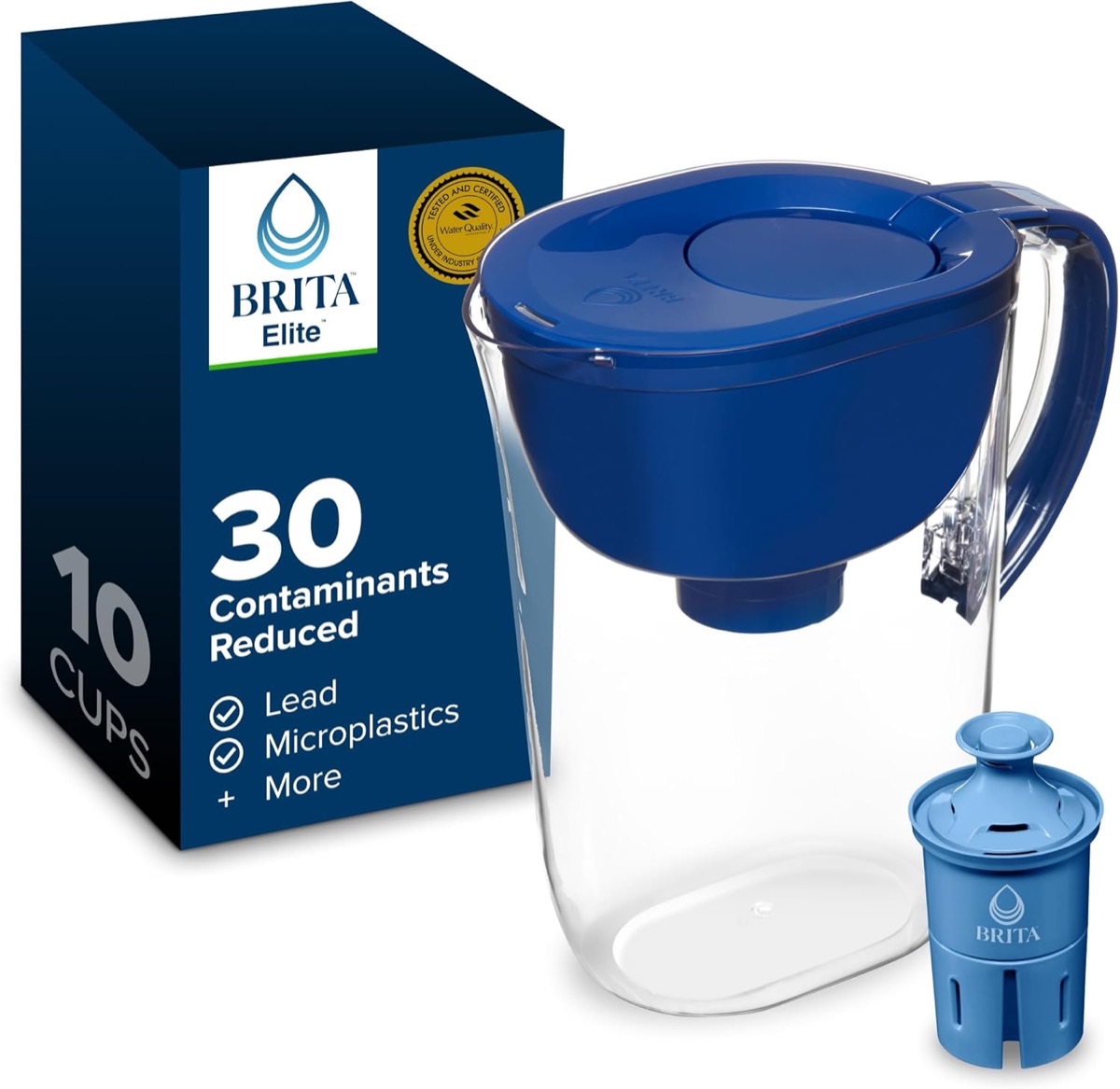
Brita Everyday Elite Water Filter Pitcher

Plasticproof Great $$$Our price tier

The pitcher most people already own, with Brita’s Elite filter — certified by WQA against NSF/ANSI 42, 53 and 401, which is where its lead and its microplastic-particle claims come from, and by IAPMO against Standard 53 for PFOA/PFOS.

Check price on Amazon
Certified for lead99.5 to 99.6 percent, per Brita.
Microplastics 0.5 to 1 micronA certified claim with a size limit.
120-gallon filter lifeAbout six months.
See exactly how we verify this

As an Amazon Associate I earn from qualifying purchases — at no extra cost to you. We show a "Check price on Amazon" link rather than a number because Amazon prices change often.

Why it's safe for your family

  • Brita’s own performance data sheet is unusually specific, and it is worth reading before anything a review site says: the Elite filter (model OB06) is certified by WQA against NSF/ANSI Standards 42, 53 and 401.
  • Lead is the strongest claim on the sheet — reductions of 99.5 and 99.6 percent at the two test pH levels, against a certified standard rather than a house test.
  • The NSF/ANSI 401 list on that sheet is where the microplastics claim lives, and it is specific about size: microplastic particles in the 0.5 to 1 micron range. That is a real certified claim, and it is also a size limit, which matters more than the marketing.
  • Brita states the Elite filter is separately certified by IAPMO R&T against NSF/ANSI Standard 53 for the reduction of PFOA and PFOS, and rates the filter for 120 gallons — about six months for an average family, the longest life of the everyday pitchers here.

Quick specs

Method
Activated carbon block with ion exchange
Certified by
WQA against NSF/ANSI 42, 53 and 401; IAPMO R&T for PFOA/PFOS
Lead
99.5 to 99.6 percent reduction (Brita’s data sheet)
Microplastics
Certified claim for particles 0.5 to 1 micron
Filter life
120 gallons (about 6 months)

What to avoid instead

What to avoid is the standard white Brita filter, which is a different product with a much shorter list: it is built for taste and chlorine and carries none of the claims above. If you own a Brita pitcher already, the cheapest real upgrade in this whole category is putting an Elite filter in it instead of buying anything new.

How we verify — and what we don't

Straight answer: we're a research team, not a testing lab. Here's exactly what our rating is based on — and what it isn't — so you can weigh it honestly.

What we check

  • What the product is made of, from the maker's own specs and product listing.
  • Whether any part that touches you or your food uses PTFE, PFAS, plastic, or a coating that can degrade.
  • Peer-reviewed research on how that material behaves when heated, scratched, washed, or worn.
  • Known failure modes — how the product actually breaks down in a real home.

What we don't do

  • We have not chemically tested this specific unit in a lab.
  • We don't take payment to rate a product higher — there is no sponsored placement.
  • We don't show star ratings or "trusted by thousands" counts we can't stand behind.
What gets a product rejected

Anything that adds a known microplastic, PFAS, or off-gassing source — a non-stick coating, a plastic surface against food or skin, vinyl/PVC — is downgraded or cut. We only list what clears that bar.

Don't take our word for it — check the sources yourself Brita's product details

Common questions

Does it actually remove microplastics?
Within a stated size range, yes — and we corrected our own guide after reading Brita’s performance data sheet. The NSF/ANSI 401 claims certified for the Elite filter include microplastic particles of 0.5 to 1 micron. What that does not cover is the finer end, the sub-micron and nanoplastic fraction. For those you need a membrane pitcher or reverse osmosis, where the pore size itself is the barrier.
Is it certified for PFAS?
For two of them. Brita states the Elite filter is certified by IAPMO R&T against NSF/ANSI 53 for the reduction of PFOA and PFOS specifically. "PFAS" as a family is thousands of compounds, and no pitcher certification covers all of them — a filter certified against protocol P473 or a reverse osmosis system is the stronger answer if PFAS is your main reason for filtering.
Is there anything in the data sheet people miss?
Two things. The filter media contains silver to keep the filter itself hygienic, and Brita notes a small amount may pass into the water, well below the World Health Organization guideline. And the sheet states plainly that this is not a purifier: do not use it on water that is microbiologically unsafe or of unknown quality.
Related reading
Does a Brita Filter Remove Microplastics?
Related reading
Brita vs Berkey vs Reverse Osmosis

More safe picks

Affiliate disclosure: some links on this page are affiliate links. As an Amazon Associate I earn from qualifying purchases. We earn a small commission from qualifying purchases at no extra cost to you. This does not influence our recommendations — every product is selected based on peer-reviewed research.