Quick Picks
Silicone bibs have replaced fabric bibs in many households because they wipe clean in seconds and catch crumbs in a built-in pocket. But not all silicone is the same — cheap imports may use lower-grade silicone that contains fillers, or have painted designs containing lead or cadmium.
Food-grade silicone (meeting FDA 21 CFR 177.2600 or European LFGB standards) is made from purified silicon dioxide and contains no BPA, BPS, PVC, phthalates, or latex. It does not leach chemicals at food-contact temperatures and is considered one of the safest materials for baby products.
We evaluated bibs on four criteria: (1) silicone grade — food-grade or medical-grade only, (2) third-party testing for heavy metals and phthalates, (3) crumb-catcher depth and spill protection, and (4) comfort and adjustability for babies 6-36 months. Every bib below uses 100% food-grade silicone — no plastic coatings, no fabric liners.
Mushie Silicone Bib (2-Pack)
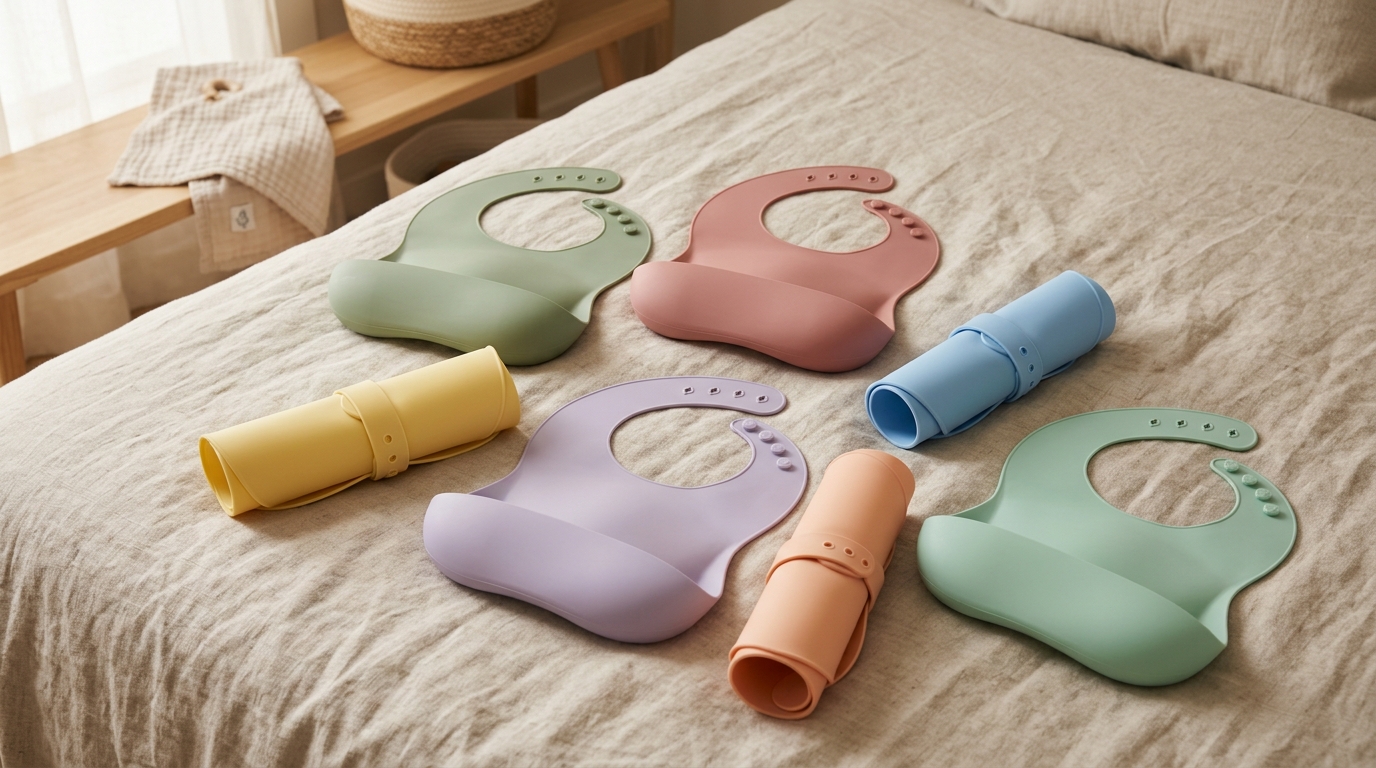
Mushie bibs are made from 100% LFGB-certified food-grade silicone — the strictest silicone safety standard in Europe, exceeding FDA requirements. The deep crumb catcher holds a full meal's worth of dropped food. Five adjustable snaps fit babies from 6 to 36 months. The matte finish resists staining better than glossy silicone. Rolls up for travel and is fully dishwasher safe.
Pros
- LFGB-certified food-grade silicone
- Deep crumb catcher
- 5 snap adjustments for long-term fit
- Matte finish resists staining
Cons
- Stiffer than fabric bibs — some babies resist at first
- Limited to solid colors (no prints)
- Two-pack pricing adds up
BapronBaby Bib-Apron
BapronBaby pioneered the bib-apron hybrid — a full-torso silicone bib that ties in the back and covers chest, lap, and arms. Made from food-grade silicone with CPSIA certification (U.S. children's product safety). The design is ideal for baby-led weaning when messes extend well beyond the chest. Machine washable and fully waterproof. The neck opening is generously sized so it works from 6 months through toddlerhood.
Pros
- Full-torso coverage — chest, arms, and lap
- CPSIA certified for children's safety
- Ties adjust for any size
- Ideal for baby-led weaning messes
Cons
- Higher price point than standard bibs
- Tie-back takes longer to put on than snaps
- Bulkier to travel with
Green Sprouts Silicone Bib
Green Sprouts makes the most affordable food-grade silicone bib on this list. BPA-, PVC-, and phthalate-free with a basic crumb pocket that catches most spills. The soft, flexible silicone is gentle on baby's neck. Three snap closures at the back. The company is a certified B Corp focused on plant-based and non-toxic baby products. Simple but effective.
Pros
- Most affordable food-grade option
- BPA/PVC/phthalate-free
- B Corp certified company
- Soft and flexible
Cons
- Shallower crumb pocket than Mushie
- Only 3 snap adjustments
- May stain with tomato-based foods
Avanchy Silicone Bib
Avanchy's bib features the deepest crumb pocket we found — a reinforced silicone trough that stays open during meals rather than collapsing. Made from 100% food-grade silicone, BPA- and phthalate-free. The adjustable neck closure uses four snaps. The bib is slightly stiffer than Mushie, which keeps the pocket shape but may feel less flexible on smaller babies. Dishwasher safe on the top rack.
Pros
- Deepest crumb catcher — stays open
- Food-grade silicone
- 4 snap adjustments
- Fits from 4 months (earlier than most)
Cons
- Stiffer silicone may bother some babies
- Limited color options
- Higher price than Green Sprouts
Lalo Silicone Bib
Lalo's silicone bib combines Scandinavian-inspired aesthetics with food-grade safety. Made from platinum-grade silicone (the highest purity grade, used in medical implants), it is free from BPA, BPS, PVC, lead, cadmium, and phthalates. Four adjustable snaps at the neck, a wide crumb catcher, and a soft matte finish. Available in muted earth tones that coordinate with Lalo's high chair and tableware.
Pros
- Platinum-grade silicone (highest purity)
- Beautiful muted color palette
- Wide crumb catcher
- Coordinates with Lalo feeding line
Cons
- Premium price for a single bib
- Only available from Lalo's website or select retailers
- Earth tones may show stains more than dark colors
Natemia Silicone Bib (3-Pack)
Natemia offers a 3-pack of food-grade silicone bibs at the price of a single premium bib. Each bib is BPA-, PVC-, lead-, and phthalate-free with a standard crumb pocket and four adjustable snaps. The silicone is thinner than Mushie or Lalo, making it more flexible and easier for babies to tolerate, but less durable long-term. Good for daycare (where bibs get lost) or as backup bibs.
Pros
- Best per-bib value (3 for ~$20)
- Thin, flexible silicone is gentle
- BPA/PVC/lead/phthalate-free
- Good for daycare or travel backups
Cons
- Thinner silicone may tear with rough handling
- Crumb pocket is shallower
- Colors may stain faster
| Bib | Silicone Grade | Crumb Catcher | Age Range | Price | Best For |
|---|---|---|---|---|---|
| Mushie | LFGB Food-Grade | Deep | 6-36 mo | ~$14 | Best Overall |
| BapronBaby | Food-Grade (CPSIA) | Full torso | 6 mo - 3+ yr | ~$25 | Best Coverage |
| Green Sprouts | Food-Grade | Standard | 6-24 mo | ~$8 | Budget Pick |
| Avanchy | Food-Grade | Deepest | 4-36 mo | ~$12 | Best Catcher |
| Lalo | Platinum-Grade | Wide | 6-36 mo | ~$16 | Best Design |
| Natemia 3-Pack | Food-Grade | Standard | 6-30 mo | ~$7/ea | Best Value Pack |
Food-grade silicone (FDA 21 CFR 177.2600 or LFGB certified) is considered one of the safest materials for baby products. It is made from purified silicon dioxide — a naturally occurring mineral — and does not leach BPA, BPS, phthalates, or microplastics. It is heat-resistant to 400°F+, does not harbor bacteria like fabric, and is hypoallergenic. The key is ensuring the product uses pure food-grade silicone without fillers.
Look for FDA or LFGB certification on the packaging. You can also do a pinch test — pure food-grade silicone will not change color when pinched or twisted. If white spots appear, the silicone contains fillers. Reputable brands like Mushie, Lalo, and Avanchy publish their testing certifications. Avoid bibs with a strong chemical smell or unusually low prices, as these may use industrial-grade silicone.
Most silicone bibs are designed for 6+ months, coinciding with the start of solid foods. Some bibs (like Avanchy) fit from 4 months if the neck snaps adjust small enough. The bib should fit snugly enough to catch crumbs but not press against the baby's throat. Silicone bibs are generally not recommended for newborns, who do not need bibs during breastfeeding or bottle feeding.
Silicone bibs can be rinsed under running water, wiped with a damp cloth, or placed on the top rack of the dishwasher. For stains (especially from tomato-based foods), soak in a mixture of baking soda and warm water for 30 minutes. Direct sunlight can also bleach out stubborn stains naturally. Avoid abrasive scrubbers that can scratch the silicone surface.
Sources
- Zimmermann L, Dierkes G, Ternes TA, et al. "Benchmarking the in vitro toxicity and chemical composition of plastic consumer products." Environmental Science & Technology, 2019. PubMed
- Hahladakis JN, Velis CA, Weber R, et al. "An overview of chemical additives present in plastics." Journal of Hazardous Materials, 2018. PubMed