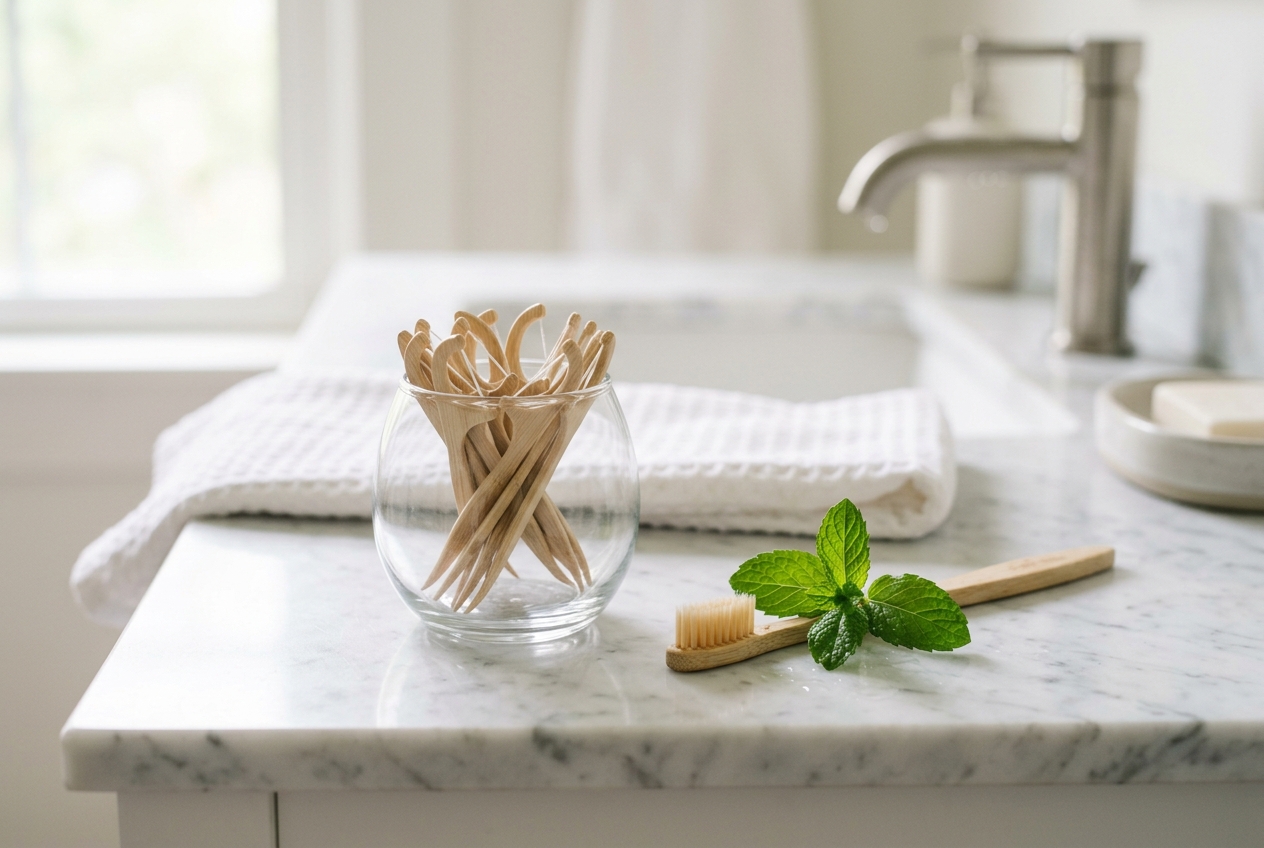
The best plastic-free floss picks and eco-friendly dental floss in 2026 include Dental Lace Refillable Floss (best overall, ~$10), Bite Fresh Floss Picks (best plastic-free floss pick, ~$8), Cocofloss Coconut Oil Floss (best for tight teeth, ~$9), Lucky Teeth Bamboo Charcoal Floss (best budget, ~$8), Terra & Co. Brilliant Black Floss (best activated charcoal, ~$10), and Dr. Tung's Smart Floss (best widely available, ~$5). All six are free from PTFE/PFAS coatings, and all offer significantly lower environmental impact than conventional plastic floss picks — using silk, bamboo charcoal, coconut oil-infused fibers, or plant-based materials that biodegrade rather than persist for centuries.
Every time you use a conventional floss pick, you are dragging a PFAS-coated nylon thread between your teeth — directly against some of the most absorbent tissue in the human body. Oral mucosa absorbs chemicals at rates 10 to 20 times higher than skin, with direct entry into the bloodstream bypassing the liver's first-pass metabolism. The plastic handle snaps, goes in the trash, and joins the roughly 3 billion floss picks Americans discard annually. The nylon thread fragments into microplastic fibers that enter wastewater systems and, ultimately, rivers and oceans. This is a product used for approximately 30 seconds and designed to last 500 years.
Below you will find a plain-language explanation of what is actually in conventional floss picks, why it matters, detailed reviews of six safer alternatives, a comparison table, and answers to the most common questions about making the switch to plastic-free dental care.
Top 3 Picks at a Glance
What Is Actually in Conventional Floss Picks
The average American flosses 3-4 times per week, and floss picks have become the dominant format — outselling traditional spool floss in most retail channels since 2019. Each pick consists of a polypropylene or polystyrene plastic handle molded around a strand of nylon or PTFE (polytetrafluoroethylene) thread. Both the handle and the thread carry significant health and environmental concerns that most consumers never consider, because dental floss is a product so small and so briefly used that it escapes scrutiny.
PTFE and PFAS in dental floss are the most immediate health concern. PTFE — the same polymer used in Teflon non-stick cookware — is classified as a per- and polyfluoroalkyl substance (PFAS). It is what gives "Glide" type flosses their signature slippery texture. A landmark 2019 study published in the Journal of Exposure Science & Environmental Epidemiology by researchers at the Silent Spring Institute found that women who flossed with Oral-B Glide had significantly higher blood levels of a PFAS compound called PFHxS compared to those who used non-PTFE floss. PFAS are known as "forever chemicals" because they do not break down in the environment or in the human body. They bioaccumulate in blood and organs over a lifetime. The CDC's National Health and Nutrition Examination Survey (NHANES) has detected PFAS in the blood of 98% of Americans tested — and dental floss is a confirmed exposure route.
Nylon microplastic shedding is the second concern. Conventional nylon floss frays and sheds microscopic plastic fibers during use. These fibers are swallowed, absorbed through oral mucosa, or spit into the sink where they enter wastewater treatment systems. A 2021 study published in Environment International found that microplastic fibers from personal care products — including dental floss — are among the most common microplastic pollutants found in treated wastewater effluent. Nylon fibers have been detected in human blood, placental tissue, and lung tissue in studies published between 2021 and 2024. Each use of conventional nylon floss releases hundreds of microscopic fiber fragments that are too small to be filtered by municipal wastewater treatment.
Single-use plastic waste is the environmental dimension. Floss picks are classified as "non-recyclable" by virtually every municipal recycling program due to their small size, mixed-material construction, and biological contamination. They pass through sorting screens at recycling facilities and contaminate other recycling streams. Beach cleanup organizations, including the Ocean Conservancy, consistently rank dental floss picks among the top 20 most common plastic debris items found on beaches worldwide. The polypropylene handles photodegrade into microplastic fragments over decades, entering soil, groundwater, and marine food chains. For a product used for half a minute, the environmental persistence ratio is staggering.
Artificial waxes and flavorings round out the ingredient concerns. Many conventional flosses are coated with petroleum-derived paraffin wax, artificial sweeteners like saccharin, and synthetic mint flavorings. These are applied to a thread that slides directly against gum tissue — mucous membrane that absorbs chemicals efficiently into the bloodstream. The FDA does not require dental floss manufacturers to disclose all coating ingredients, so consumers have no way to know exactly what chemicals they are introducing into their oral cavity multiple times per week.
The oral absorption problem
The oral mucosa — the tissue lining your mouth and gums — is one of the most permeable membranes in the human body. Pharmaceutical companies exploit this property for sublingual drug delivery precisely because chemicals absorbed through oral tissue bypass the digestive system and enter the bloodstream directly. When PFAS-coated floss slides between your teeth and against your gums, those fluorinated compounds have a direct route into your circulatory system. A 2019 study in the Journal of Exposure Science & Environmental Epidemiology confirmed this pathway, finding elevated PFAS blood levels specifically correlated with PTFE floss use.
What to Look for in Plastic-Free Floss
Not all "natural" or "eco-friendly" flosses are genuinely plastic-free or PFAS-free. These marketing terms have no regulatory definition in the dental care industry. Here is what actually matters when choosing a safer floss:
- No PTFE or PFAS coatings. The floss thread should not be made from polytetrafluoroethylene or coated with any perfluorinated compound. Look for silk, bamboo charcoal fiber, or plant-waxed alternatives. If the packaging says "Glide" or "smooth slide" without specifying the material, PTFE is likely involved.
- Biodegradable thread material. Silk floss biodegrades in 60-90 days in composting conditions. Bamboo charcoal fiber breaks down in 3-6 months. Nylon persists for 30-40 years. PTFE persists effectively forever. The thread material determines the product's environmental footprint.
- Natural wax coatings. Effective floss needs a coating for smooth glide between teeth. Look for candelilla wax (plant-derived), beeswax, coconut oil, or plant-based wax rather than petroleum-derived paraffin wax or microcrystalline wax.
- Refillable or compostable packaging. Glass containers with metal lids (like Dental Lace) create zero packaging waste after the initial purchase. Cardboard packaging is the next best option. Avoid standard plastic dispensers — they are rarely recycled and add to the waste stream.
- No artificial flavors or sweeteners. If the floss is flavored, the flavoring should come from essential oils (peppermint oil, tea tree oil) rather than synthetic mint flavoring or artificial sweeteners like saccharin. These additives are in direct contact with oral mucosa.
- Transparent ingredient disclosure. The best eco-friendly floss brands list every material and coating on their packaging or website: the thread fiber, the wax coating, and any flavoring. If the brand cannot or will not disclose what the floss is made of, that is a red flag.
A product that touches your gum tissue 3-4 times per week for your entire adult life should not contain forever chemicals that the manufacturer refuses to disclose.
Full Product Reviews
Dental Lace Refillable Floss
Dental Lace represents the gold standard for zero-waste dental floss. The system consists of a small glass container with a stainless steel lid and a spool of mulberry silk floss coated in candelilla wax (a plant-derived wax from the candelilla shrub). After the initial purchase, you order only refill spools — the glass container lasts indefinitely. The silk thread is naturally slightly textured, which gives it effective plaque-gripping properties comparable to nylon floss. The candelilla wax coating provides smooth glide between tight contact points without relying on PTFE or petroleum wax. The silk is fully biodegradable and compostable, breaking down within 60-90 days in home composting conditions. Dental Lace also offers a vegan version using plant-based fiber instead of silk for those who prefer to avoid animal-derived materials. The container is small enough to travel with, and the metal lid includes a built-in thread cutter. At ~$10 for the starter kit and ~$7 for refills, the ongoing cost is comparable to premium conventional floss.
Pros
- True zero-waste system — refillable glass container
- Mulberry silk is fully biodegradable and compostable
- Candelilla wax coating — no PTFE, no petroleum wax
- Effective plaque removal comparable to nylon floss
- Vegan option available (plant-based fiber)
- Compact glass container with built-in metal cutter
Cons
- Silk thread is less durable than nylon — may snap on very tight teeth
- Glass container is breakable (though small and sturdy)
- Not widely available in retail stores — primarily online
- Silk version is not vegan
Bite Fresh Floss Picks
For people who strongly prefer the floss pick format over traditional spool floss, Bite offers the most genuinely plastic-free option on the market. The handle is made from plant-based bioplastic (PLA derived from cornstarch) rather than polypropylene, and the thread is a compostable fiber rather than nylon or PTFE. The entire pick is designed to be industrially compostable, breaking down in commercial composting facilities within 90-180 days. The thread is coated with coconut-derived wax for smooth glide and lightly flavored with natural peppermint oil. Bite built their reputation on zero-waste toothpaste tablets, and the floss picks follow the same design philosophy: eliminate single-use plastic from a product category that generates enormous waste. The picks arrive in compostable packaging — no plastic wrap, no plastic container. The trade-off is that PLA-based handles are less rigid than polypropylene, so the picks may flex slightly more during use. For most users, this is barely noticeable. At ~$8 for a pack of 150 picks, the per-use cost is comparable to conventional plastic floss picks.
Pros
- Only genuinely plastic-free floss pick format available
- Plant-based PLA handle — industrially compostable
- Compostable thread with coconut-derived wax coating
- Natural peppermint flavor from essential oil
- Compostable packaging — zero plastic in entire product
- 150-count pack at competitive price point
Cons
- PLA handle slightly less rigid than plastic — may flex
- Requires industrial composting — will not break down in home compost
- Thread may fray faster than nylon on very rough tooth surfaces
- Only available online through Bite's website or Amazon
Cocofloss Coconut Oil Floss
Cocofloss was developed by a dentist (Dr. Chrystle Cu) specifically to address the problem that most flosses are too slippery to effectively remove plaque from tight contact points. The floss is made from textured polyester filaments woven into a spongy, loofah-like structure that scrubs tooth surfaces as it passes through. It is infused with coconut oil — which has documented antimicrobial properties against Streptococcus mutans, the primary bacterium responsible for tooth decay — and coated with coconut-derived microcrystalline wax for glide. The texture makes a visible difference: after flossing with Cocofloss, the thread often comes out visibly loaded with plaque and debris, which demonstrates its mechanical cleaning effectiveness. The floss comes in several naturally-derived flavors including coconut, strawberry, orange, and mint — all from essential oils and natural extracts, no artificial sweeteners. While Cocofloss is not fully biodegradable (polyester is a synthetic material), it is PTFE-free, PFAS-free, and free from petroleum wax, making it a significant step up from conventional Glide-type flosses for oral health safety. For people with crowded teeth or tight contact points who find silk floss too fragile, Cocofloss offers the best combination of cleaning effectiveness and ingredient safety.
Pros
- Dentist-developed for superior plaque removal
- Coconut oil infusion — natural antimicrobial properties
- Textured, loofah-like structure scrubs tooth surfaces
- PTFE-free, PFAS-free, no petroleum wax
- Multiple natural flavors from essential oils
- Excellent for tight teeth and crowded arches
Cons
- Polyester thread is not biodegradable
- Higher per-spool cost than drugstore floss
- Thicker texture may not suit very tight contact points
- Plastic spool container (recyclable but still plastic)
Lucky Teeth Bamboo Charcoal Floss
Lucky Teeth offers activated bamboo charcoal floss at a price point that makes switching from conventional floss genuinely accessible. The thread is made from bamboo charcoal fiber — bamboo that has been carbonized at high temperatures, ground into fine particles, and spun into thread. Activated charcoal has well-documented adsorptive properties: it binds to bacteria, toxins, and tannins on contact, which is why it is used in water purification and medical toxicology. In floss form, this means the thread actively absorbs bacteria and compounds from between teeth as it cleans, rather than simply pushing them aside. The floss is coated with candelilla wax for smooth glide and lightly flavored with natural peppermint oil. The bamboo charcoal fiber is biodegradable, breaking down in composting conditions within 3-6 months. The packaging is a small glass jar — no plastic dispenser. At ~$8 for a 2-pack (approximately 66 yards total), Lucky Teeth is the most affordable biodegradable floss option per yard on this list. The thread is slightly thicker than silk floss, which works well for normal to wide spacing but may feel bulky for very tight contact points.
Pros
- Most affordable eco-friendly floss per yard
- Activated charcoal adsorbs bacteria and toxins
- Bamboo charcoal fiber is fully biodegradable
- Glass jar packaging — no plastic dispenser
- Candelilla wax coating — plant-derived, no petroleum
- Natural peppermint flavor
Cons
- Thicker thread may be difficult for very tight teeth
- Charcoal can leave dark residue on fingers
- Thread is less smooth than PTFE or silk — requires more effort
- Limited retail availability — primarily online
Terra & Co. Brilliant Black Floss
Terra & Co. takes the bamboo charcoal floss concept and elevates it with a premium formulation. The Brilliant Black Floss uses bamboo charcoal fiber infused with activated charcoal powder and coated with a blend of organic essential oils including tea tree oil and peppermint oil. Tea tree oil (Melaleuca alternifolia) has demonstrated antimicrobial activity against oral pathogens in multiple peer-reviewed studies, including a 2020 systematic review in the Journal of Clinical and Experimental Dentistry. The combination of charcoal adsorption and tea tree oil's antimicrobial properties creates a floss that actively fights bacteria rather than merely displacing it. The floss comes packaged in a sleek glass jar with a metal lid and cardboard outer sleeve — zero plastic in the entire product and packaging. Terra & Co. is a certified B Corporation, meaning the company meets verified standards for social and environmental performance. The floss feels slightly waxier and smoother than Lucky Teeth's offering, making it more comfortable for daily use. At ~$10 for a single spool, it is the most premium-priced charcoal floss on this list, but the ingredient quality and B Corp certification justify the difference for many consumers.
Pros
- Activated charcoal + tea tree oil — dual antimicrobial action
- Bamboo charcoal fiber — fully biodegradable
- Glass jar packaging — zero plastic in product or packaging
- Certified B Corporation — verified ethical standards
- Smoother wax coating than most charcoal flosses
- Organic essential oil blend for fresh breath
Cons
- Highest price per spool of charcoal floss options
- Charcoal leaves dark residue on fingers and may stain light-colored sinks
- Tea tree oil flavor is strong — not for everyone
- Only available online or at specialty stores
Dr. Tung's Smart Floss
Dr. Tung's Smart Floss has been available in natural grocery stores and pharmacies for over two decades, making it the most accessible eco-conscious floss option for people who want to walk into a store and buy it today. The floss uses a unique expanding design — the polyester thread is lightly compressed when dry but expands and fluffs when it contacts saliva, filling the interdental space more completely than flat nylon or PTFE thread. This expansion mechanism has been clinically shown to remove up to 55% more plaque than regular floss in a study conducted by the University of Saskatchewan. The thread is coated with a blend of natural plant and bee wax (not petroleum wax) and lightly flavored with cardamom essential oil — a distinctive, pleasant flavor that sets it apart from the standard mint. The packaging is a small cardboard box with a minimal plastic inner dispenser. While the polyester thread is not biodegradable, the product is PTFE-free, PFAS-free, and free from artificial flavors, making it a meaningful step up from conventional floss. For people transitioning from conventional floss and wanting something they can buy at Whole Foods, Sprouts, or a local co-op, Dr. Tung's is the easiest first switch. At ~$5 for 30 yards, the per-yard cost is the lowest on this list.
Pros
- Most widely available in retail stores — Whole Foods, Sprouts, co-ops, pharmacies
- Expanding design removes up to 55% more plaque than regular floss
- Natural plant and bee wax coating — no petroleum wax
- Lowest price on this list at ~$5 per spool
- PTFE-free, PFAS-free, no artificial flavors
- Unique cardamom flavor from essential oil
Cons
- Polyester thread is not biodegradable
- Contains beeswax — not vegan
- Small plastic dispenser inside cardboard box
- Expanding texture takes some getting used to
Head-to-Head Comparison
| Floss | Material | PFAS-Free | Biodegradable | Price |
|---|---|---|---|---|
| Dental Lace | Mulberry silk | Yes | Yes (60-90 days) | ~$10 |
| Bite Fresh Picks | Plant-based PLA | Yes | Yes (industrial) | ~$8 |
| Cocofloss | Textured polyester | Yes | No | ~$9 |
| Lucky Teeth | Bamboo charcoal | Yes | Yes (3-6 months) | ~$8 |
| Terra & Co. | Bamboo charcoal | Yes | Yes (3-6 months) | ~$10 |
| Dr. Tung's | Expanding polyester | Yes | No | ~$5 |
| Conventional (Glide) | PTFE / Nylon | No (PFAS) | No (500+ years) | ~$3-5 |
Switching your dental floss is one step in a broader shift toward a less toxic bathroom routine. For a full bathroom overhaul, see our guide to non-toxic toothpaste. To understand the broader science of microplastics in personal care products, read our deep dive on microplastics in food packaging. And for the kitchen, check our guides to non-toxic dish soap and non-toxic cleaning spray.
Frequently Asked Questions
Yes. A 2019 study published in the Journal of Exposure Science & Environmental Epidemiology found that people who flossed with Oral-B Glide and similar PTFE-based flosses had significantly higher levels of PFAS (per- and polyfluoroalkyl substances) in their blood. PTFE — the same polymer used in Teflon non-stick coatings — is classified as a PFAS compound. It creates that slippery, gliding texture that many conventional flosses advertise. PFAS are persistent, bioaccumulative chemicals linked to thyroid disruption, immune suppression, and increased cancer risk. Switching to silk, bamboo charcoal, or plant-waxed floss eliminates this daily exposure route entirely.
Yes, and the scale is significant. Americans use approximately 3 billion floss picks per year. Each pick is a single-use polypropylene or polystyrene plastic item that cannot be recycled due to its small size and contamination with biological material. These picks end up in landfills where they persist for 500+ years, or in waterways where they fragment into microplastics. Beach cleanups consistently rank dental floss picks among the top 20 most commonly found plastic debris items. Because each pick is used for approximately 30 seconds before disposal, the use-to-waste ratio is among the worst of any consumer product.
Silk floss is comparably effective to nylon floss for plaque removal when used correctly. Silk is naturally slightly textured, which helps it grip and remove plaque from tooth surfaces and below the gumline. Some silk flosses are coated with candelilla wax or plant-based wax to improve glide. The key difference is that silk floss is biodegradable — it breaks down in compost within 60-90 days — while nylon floss persists in the environment for decades. The American Dental Association confirms that any floss used correctly and consistently will effectively remove interdental plaque. The material matters less than the technique and frequency.
Activated charcoal in dental floss has mild surface-stain-absorbing properties, but clinical evidence for meaningful whitening from floss alone is limited. The charcoal can help absorb some surface discoloration between teeth, but it will not change the intrinsic color of tooth enamel. The primary benefit of bamboo charcoal floss is its natural antibacterial properties — activated charcoal has been shown to absorb bacteria and toxins — and its biodegradability. The bamboo fiber base decomposes within 3-6 months in composting conditions. For whitening, a dedicated treatment is more effective; for daily interdental cleaning with a lower environmental footprint, bamboo charcoal floss is an excellent choice.
The most eco-friendly flossing method is a refillable silk floss system like Dental Lace, where the silk floss comes in a reusable glass container with metal lid, and you purchase only the refill spools. The silk is biodegradable and compostable, and the container creates zero waste after the initial purchase. The next best option is loose silk or bamboo charcoal floss sold in compostable packaging. If you prefer the convenience of floss picks, brands like Bite now offer plant-based picks that are compostable. A reusable water flosser is another zero-waste option, though studies suggest it works best as a complement to traditional flossing rather than a replacement.
Sources
- Boronow, K.E. et al. "Serum concentrations of PFASs and exposure-related behaviors in African American and non-Hispanic white women." Journal of Exposure Science & Environmental Epidemiology, 2019. PubMed
- Mamsen, L.S. et al. "Concentrations of perfluoroalkyl substances (PFASs) in human embryonic and fetal organs." Environment International, 2019. PubMed
- Leslie, H.A. et al. "Discovery and quantification of plastic particle pollution in human blood." Environment International, 2022. PubMed
- Ragusa, A. et al. "Plasticenta: First evidence of microplastics in human placenta." Environment International, 2021. PubMed
- Karpiński, T.M. & Szkaradkiewicz, A.K. "Chlorhexidine — pharmaco-biological activity and application." European Review for Medical and Pharmacological Sciences, 2015.
- Teles, R.P. & Teles, F.R.F. "Antimicrobial agents used in the control of periodontal biofilms." Periodontology 2000, 2009.
- Ocean Conservancy. "International Coastal Cleanup Report." 2023. Ocean Conservancy
- US EPA. "PFAS Strategic Roadmap: EPA's Commitments to Action 2021-2024." EPA.gov
- Kato, T. et al. "Antibacterial effects of coconut oil and lauric acid against Streptococcus mutans." Nigerian Medical Journal, 2015.
- Carbajal, A.R.R. et al. "Antimicrobial activity of Melaleuca alternifolia (tea tree oil) on oral pathogens: A systematic review." Journal of Clinical and Experimental Dentistry, 2020.