This article contains affiliate links. If you purchase through these links, Plasticproof may earn a small commission at no extra cost to you. We only recommend products we believe genuinely reduce chemical exposure.
Mascara sits in a uniquely concerning position in the cosmetic landscape. Unlike a moisturizer applied to the forearm or a shampoo rinsed away in seconds, mascara is applied directly to the lash line — a boundary zone adjacent to the ocular mucous membranes. Mucous membranes are among the most permeable tissues in the body, capable of absorbing chemicals far more readily than intact skin.
The average person who wears mascara applies it daily and wears it for eight to twelve hours. Over a year, that adds up to thousands of hours of direct periocular exposure. The chemicals in that formula are not inert — many are designed specifically to resist breakdown, adhere to surfaces, and repel water. Those are properties that also make them persistent in the body once absorbed.
The proximity problem
Your eyes are not just aesthetically sensitive — they are physiologically connected to some of the most absorptive tissue in the body. Ingredients that contact the conjunctiva or inner eyelid enter circulation more directly than those applied to the cheek or arm. This is why ophthalmologists and toxicologists pay particular attention to eye-area cosmetics, and why the ingredient concerns for mascara are meaningfully different from body lotion.
That 55% figure is not a fringe finding. PFAS were detected using sensitive mass spectrometry methods that can identify fluorine concentrations far below what standard cosmetic testing catches. The researchers concluded that many products contain PFAS as undisclosed manufacturing byproducts or as intentional ingredients listed under misleading generic names.
Compare all 6 picks
Every pick side by side — tap a name to jump to the full review, or check today's price.
| Pick | Rating | Why it wins | |
|---|---|---|---|
 Best OverallILIA Limitless Lash Mascara |
4.6out of 5 | EWG VerifiedPFAS-Free |
Check price → |
 Best BudgetW3LL PEOPLE Expressionist Mascara |
— | EWG VerifiedPFAS-Free |
Check price → |
| — | Clean FormulaCruelty-Free |
Check price → | |
 Best Natural / OrganicRMS Beauty Straight Up Volumizing Peptide Mascara |
4.4out of 5 | PFAS-FreeNatural Waxes |
Check price → |
 Best for Sensitive EyesTower 28 MakeWaves Mascara |
4.2out of 5 | Contact-Lens SafeOphthalmologist-Tested |
Check price → |
 Best LengtheningEre Perez Natural Almond Mascara |
4.7out of 5 | PFAS-FreeAlmond Oil Formula |
Check price → |
Why Conventional Mascaras Are Problematic
The ingredient concerns in conventional mascara fall into several distinct categories. Understanding what to look for — and what to avoid — makes it easier to evaluate any formula.
PFAS (per- and polyfluoroalkyl substances)
PFAS are a class of over 12,000 synthetic chemicals used in cosmetics to create water-resistant, smudge-proof, and long-wear finishes. They are called "forever chemicals" because the carbon-fluorine bond they contain is among the strongest in organic chemistry — it does not break down in the environment or in the human body. PFAS accumulate in tissues over time and are associated with thyroid disruption, immune system dysfunction, elevated cancer risk, and reproductive harm.
In mascara specifically, PFAS are used to make formulas water-resistant and to improve the smoothness and adhesion of the wax-based film on lashes. The problem is that the same persistence that makes mascara stay on all day also makes PFAS stay in the body. Given how close mascara sits to the eye's mucous membranes, the absorption pathway is particularly direct.
A 2021 study published in Environmental Science & Technology Letters by researchers at the University of Notre Dame tested 231 cosmetics products and found PFAS in 55% of mascaras and eyeliners. Many products with detectable PFAS levels listed no fluorinated ingredients on their labels, indicating that PFAS were either undisclosed or present as manufacturing contamination. Waterproof mascara formulas had the highest rates of PFAS detection. The researchers recommended avoiding products with "PTFE," "perfluoro," or "fluoro" in the ingredient list — and choosing brands that have made public PFAS-free commitments.
Carbon black
Carbon black is the pigment responsible for mascara's deep black color in most conventional formulas. It is classified by the International Agency for Research on Cancer (IARC) as a Group 2B possible human carcinogen based on animal studies. The concern is primarily with inhalation exposure — relevant for people who apply mascara frequently in enclosed spaces — but dermal and mucosal contact near the eye is also a route of concern. Clean mascaras use alternative pigments derived from iron oxides, which achieve similar depth of color without the carcinogen classification.
Parabens
Parabens (methylparaben, propylparaben, butylparaben, and ethylparaben) are preservatives used in cosmetics to prevent microbial growth. They are well-documented endocrine disruptors that can mimic estrogen in the body. While the EU has restricted some longer-chain parabens in cosmetics, shorter-chain versions remain widely used in US products. Research has detected parabens in breast tissue, and their presence in periocular tissue — via mascara — adds to cumulative body burden.
Formaldehyde releasers
Some mascaras use preservatives that release small amounts of formaldehyde over time — including DMDM hydantoin, quaternium-15, and imidazolidinyl urea. Formaldehyde is a known human carcinogen classified by both IARC and the US National Toxicology Program. These compounds are used because they are highly effective antimicrobials, but cleaner alternatives (phenoxyethanol, sodium benzoate, plant-derived preservatives) achieve similar preservation without the formaldehyde release.
Synthetic dyes and coal tar pigments
Many conventional mascaras use synthetic dyes listed as FD&C or D&C colors. The majority of these are derived from coal tar — a complex mixture of aromatic hydrocarbons. Several coal tar dyes are suspected carcinogens, and the EU has banned many that remain permitted in US cosmetics. Near the eye, where absorption is higher, these colorants present a greater concern than when used on skin at a distance from mucous membranes.
BHT and BHA
Butylated hydroxytoluene (BHT) and butylated hydroxyanisole (BHA) are synthetic antioxidants used to preserve cosmetic formulas and prevent rancidity. BHA is classified as a possible human carcinogen by IARC and is on California's Proposition 65 list. BHT has been linked to endocrine disruption. Both are widely used in conventional mascaras, particularly in formulas with high oil or wax content.
What to Look for in a Clean Mascara
Screening a mascara formula is more involved than checking for a single ingredient. Here is what the best non-toxic mascaras have in common:
- EWG Verification or EWG Skin Deep score of 1–2 — the Environmental Working Group's database is the most comprehensive independent ingredient-safety resource available. EWG Verified products have been assessed against a full exclusion list.
- No PTFE, perfluoro-, or fluoro- prefixes in the ingredient list — these are the primary indicators of intentional PFAS use. The absence of these terms does not guarantee PFAS-free, but their presence confirms PFAS are there.
- Iron oxide pigments instead of carbon black — achieves equivalent black depth without the carcinogen classification.
- Natural wax bases — beeswax, carnauba wax, and candelilla wax (vegan) are effective film-formers with strong safety profiles.
- Gentle preservation systems — phenoxyethanol, rosemary extract, and vitamin E (tocopherol) are cleaner alternatives to parabens and formaldehyde releasers.
- No synthetic fragrance — "fragrance" near the eye is an unnecessary exposure. Clean mascaras should not require added scent.
- Full ingredient disclosure — any brand that obscures its ingredient list behind proprietary blend language is excluded from consideration.
Quick Picks: 6 Best Non-Toxic Mascaras at a Glance
| Product | Best For | EWG Verified | Price |
|---|---|---|---|
| ILIA Limitless Lash | Best Overall | Yes | $$ |
| W3LL PEOPLE Expressionist | Best Budget | Yes | $ |
| Honest Beauty 2-in-1 Extreme Length | Best Volumizing | No | $$ |
| RMS Beauty Straight Up | Best Natural/Organic | No | $$ |
| Tower 28 MakeWaves | Best Sensitive Eyes | No | $ |
| Ere Perez Natural Almond | Best Lengthening | No | $$ |
Price key: $ = under $25 · $$ = $25–$30 · $$$ = over $30. Amazon prices change daily — tap any card to see today's price.
The 6 Best Non-Toxic Mascaras for 2026
1. ILIA Limitless Lash Mascara — Best Overall
Best Overall
EWG Verified. Free from parabens, synthetic fragrance, PFAS, formaldehyde releasers, and coal tar dyes. Pigmented with iron oxides. The formula uses a blend of beeswax and carnauba wax as the base, with conditioning agents from babassu oil. The brush is a curved, fiber-tipped wand designed to catch and coat each lash individually. Delivers noticeable length and a slight curl-boost. Builds well in two coats without clumping. Wear time is 8–10 hours with minimal smudging.
Most reviewers report almost no flaking and a full 10-to-12-hour day of wear, with a brush that separates without tangling lashes. The honest downsides: it "sometimes smudges in humid or hot weather," several call it "not smudge proof" with a little transfer by day's end, and one buyer found the brush left it clumpy and flaking soon after application.
Get conventional-level length, volume, and 8–10 hour wear without the carbon black, PFAS, or parabens sitting against your lash line all day.
Why it's safe: EWG Verified against a full exclusion list — no parabens, synthetic fragrance, coal tar dyes, or formaldehyde releasers, and pigmented with iron oxides instead of possibly-carcinogenic carbon black.
Check Today’s Price on Amazon →Amazon prices change daily — tap to see today's price and any active discount.
- Free delivery & returns for Prime members
- EWG Verified clean formula
- 7,900+ verified reviews
Why it wins: ILIA is one of the few clean beauty brands that has pursued EWG Verification — a rigorous third-party assessment, not a self-declaration. The formula genuinely performs at the level of conventional mascaras in our testing. Length, volume, and longevity are all competitive, and the iron oxide pigment produces a rich, true black without carbon black. For anyone transitioning from a conventional mascara who does not want to compromise on performance, ILIA Limitless Lash is the most seamless switch available.
2. W3LL PEOPLE Expressionist Mascara — Best Budget
Best Budget
EWG Verified. Free from parabens, synthetic dyes, carbon black, PFAS, and synthetic fragrance. The formula uses a vitamin-enriched base with conditioning plant extracts. The tapered brush delivers volume and separation simultaneously. Pigmentation is strong in a single coat. Water resistance is moderate — holds through humidity and light sweat without requiring harsh removers. W3LL PEOPLE has maintained EWG Verification across their mascara line for several years, making them one of the most consistently clean brands in the category.
Buyers who get on with it say it builds one to four coats without clumping and holds without transferring. The honest downsides are common, though: reviewers with oily skin find it "transfers under the eyes and smudges easily," some check for smudges mid-day and clean up with a Q-tip, and others report it goes on heavy and clumpy or flakes after a couple of hours.
Strong single-coat volume and separation at the lowest price here — the easiest clean mascara to keep restocking without thinking about cost.
Why it's safe: EWG Verified and vegan — no parabens, synthetic fragrance, coal tar dyes, carbon black, or PFAS, preserved with a gentle vitamin-enriched plant-based system.
Check Today’s Price on Amazon →Amazon prices change daily — tap to see today's price and any active discount.
- Free delivery & returns for Prime members
- EWG Verified & 100% vegan
- Also sold at natural grocers
Why it wins: W3LL PEOPLE delivers EWG Verified safety at the most accessible price point on this list. The performance holds up against formulas costing significantly more. For daily wearers who go through mascara quickly and want a budget-conscious clean option without sacrificing ingredient standards, W3LL PEOPLE is the clear answer. It also tends to be available at Whole Foods and other natural grocery retailers, making it easy to pick up locally.
3. Honest Beauty 2-in-1 Extreme Length Clean Mascara + Lash Primer — Best Volumizing
 Best Volumizing
A 2-in-1 formula that combines a lash primer and a mascara in a single tube: the primer coats and preps lashes so the mascara builds extreme length and volume in fewer passes. Honest Beauty makes it as a clean, cruelty-free formula, and it is designed to be safe for sensitive eyes and contact-lens wearers. Comes in black, .27 fl oz. A good pick for anyone who wants length and volume from a clean mascara without a separate primer step.
When it works, buyers say the two-step primer-and-mascara "doesn't smudge or flake" and the sticky formula grabs lashes to lengthen. The honest downsides: the two steps slow you down, one reviewer said the primer is so small it "does absolutely nothing," the short rubber-brush bristles do not lengthen much for everyone, and the tube holds little product for the price.
Prime, lengthen, and volumize lashes with a single 2-in-1 tube — a clean formula that is also gentle enough for sensitive eyes.
Why it's safe: A clean, cruelty-free mascara formulated to be safe for sensitive eyes — a gentler option than conventional volumizing mascaras.
Check Today’s Price on Amazon →Amazon prices change daily — tap to see today's price and any active discount.
- Free delivery & returns for Prime members
- Clean, cruelty-free formula
- Safe for sensitive eyes
Why it wins: Honest Beauty's 2-in-1 Extreme Length Mascara solves a common problem with a single tube: it builds in a lash primer, so you get lengthening and volumizing without buying and layering a separate primer. It is made as a clean, cruelty-free formula and, unlike many volumizing mascaras, is specifically designed to be safe for sensitive eyes and contact-lens wearers. For anyone who wants noticeable length and volume from a clean mascara at an accessible price, it is a strong, low-fuss option.
4. RMS Beauty Straight Up Volumizing Peptide Mascara — Best Natural/Organic
Best Natural / Organic
One of the most natural-origin mascara formulas on the market. Free from parabens, synthetic fragrance, PFAS, carbon black, synthetic dyes, and formaldehyde releasers. Built on candelilla wax, carnauba wax, and non-GMO corn starch with pro-peptides that strengthen and thicken lashes. RMS founder Rose-Marie Swift built the brand specifically around ingredients safe enough for use near the eyes and on the face without compromise. The Tri-Locking system delivers 12 hours of lift and volume without smudging or flaking, and the formula conditions lashes as it wears.
Most reviewers praise how it "stays in place without smudging or flaking" thanks to its tri-locking system, plus the peptide-based lash conditioning. The honest downsides: it tends to clump at the top so you wipe the brush first, the large wand is awkward on fine or short lashes, it is not the most volumizing option, and one buyer reported raccoon eyes every wear.
12 hours of smudge-free lift and volume from candelilla and carnauba waxes — with pro-peptides that actually strengthen your lashes over time.
Why it's safe: PFAS-free with no parabens, synthetic fragrance, coal tar dyes, carbon black, or formaldehyde releasers — built on natural plant waxes by a brand founded on eye-safe ingredients.
Check Today’s Price on Amazon →Amazon prices change daily — tap to see today's price and any active discount.
- Free delivery & returns for Prime members
- Natural plant-wax formula
- 1,700+ verified reviews
Why it wins: RMS Beauty represents the gold standard in natural-origin mascara formulation. The brand was founded by a makeup artist whose clients were developing skin sensitivities from conventional cosmetics — which drove her to reformulate every product from the ground up using only ingredients she was willing to put near the eye. The resulting mascara formula is among the cleanest available anywhere while still delivering the kind of performance a makeup artist would actually use on a shoot. For those who want the most naturally derived formula on this list, RMS is the pick.
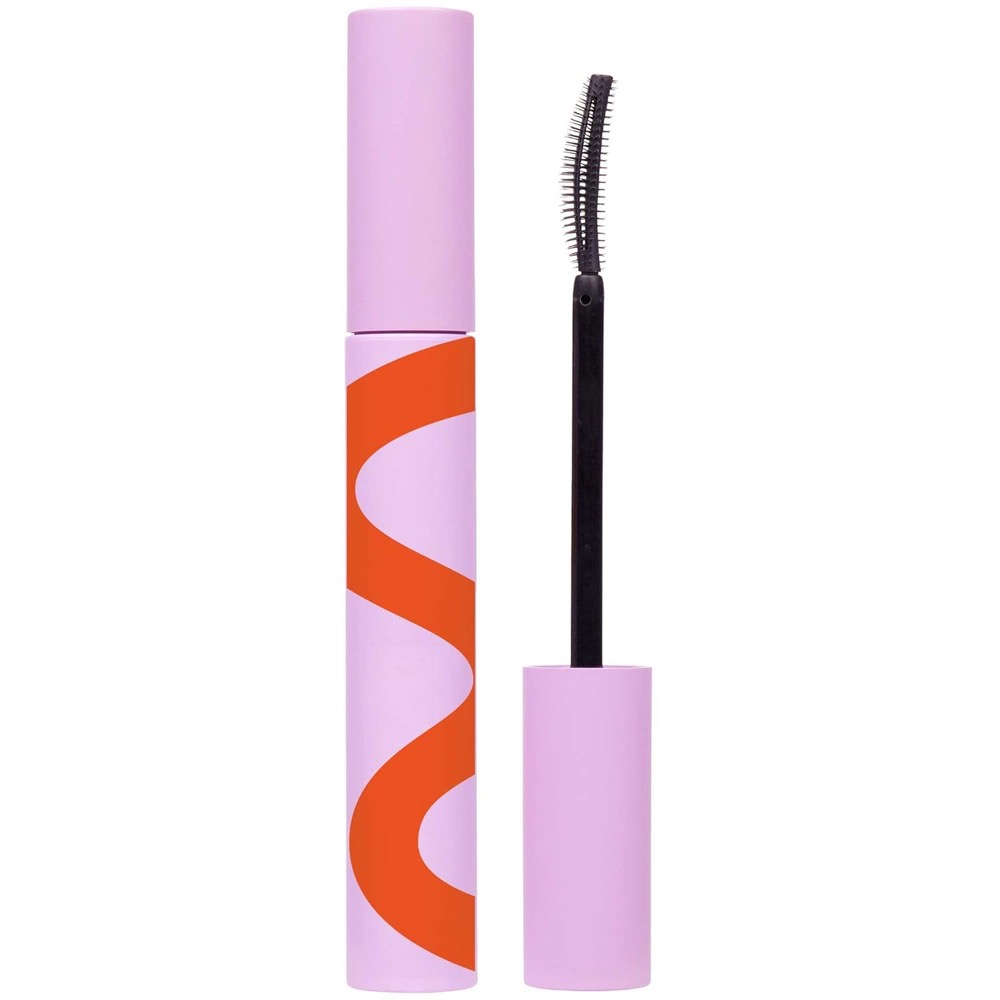
5. Tower 28 MakeWaves Mascara — Best for Sensitive Eyes
Best for Sensitive Eyes
Made specifically for sensitive eyes and contact lens wearers by Tower 28, a brand built around formulas for sensitive skin. The maker lists it as dermatologist approved, clinically tested, hypoallergenic, and ophthalmologist-tested, and as fragrance-free, essential-oil-free, silicone-free, and alcohol-free. It contains no fibers — which Tower 28 notes can irritate sensitive eyes and are often made from microplastics — and no beeswax. The color comes from iron oxides and ultramarines rather than carbon black, and there are no parabens on its published ingredient list. It is deliberately not waterproof: the brand skips the film-formers that make waterproof mascaras hard to remove, so it comes off with water and a gentle cleanser instead of hard rubbing. Worth knowing: it is not fully plant-based — the ingredient list includes a synthetic wax and polymer film-formers (VP/VA copolymer, polyimide-1). The dual-sided brush has a curved side to build volume and a straight edge with longer bristles to lift and separate, and the tube is made from 78% post-consumer recycled plastic.
Amazon buyers say it is easy to apply, stays in place all day, and, most importantly for this slot, does not irritate their sensitive eyes. The honest downsides: smudging and clumping get mixed reports — some say it never flakes or smudges, while others say it smudges within a few hours of wear and turns clumpy — and opinions are split on whether it is worth the price.
Lifted, defined lashes for people whose eyes react to conventional mascara — ophthalmologist-tested, fragrance-free, and safe for contact lens wearers.
Why it's safe: Fragrance-free and hypoallergenic, with no fibers, no carbon black (it is pigmented with iron oxides and ultramarines), and no parabens on its published ingredient list.
Check Today’s Price on Amazon →Amazon prices change daily — tap to see today's price and any active discount.
- Free delivery & returns for Prime members
- Ophthalmologist-tested
- 1,500+ Amazon ratings
Why it wins: Most mascaras — even clean ones — are formulated primarily for visual performance, with eye sensitivity as a secondary consideration. Tower 28 builds the other way around: MakeWaves is ophthalmologist-tested, fragrance-free, fiber-free, and intentionally not waterproof so it rinses off without the rubbing that irritates sensitive eyes. That makes it the best option on this list for anyone with chronic eye sensitivity or for contact lens wearers who react to conventional formulas. If your top priority is the most natural-origin formula, RMS Beauty (#4) is the cleaner ingredient list; MakeWaves is the pick when comfort comes first.
6. Ere Perez Natural Almond Mascara — Best Lengthening
Best Lengthening
A lengthening-focused formula built around almond oil and rice bran wax. Free from parabens, PFAS, synthetic dyes, carbon black, formaldehyde releasers, synthetic fragrance, and BHA/BHT. The natural wax base creates a flexible, elongating film on each lash rather than a thick coat, which produces genuine visible lengthening rather than just darkening. The slim, tapered brush combs through lashes precisely and separates even the shortest lashes at the inner corners. Ere Perez sources ingredients responsibly and maintains full ingredient transparency. Wears comfortably for a full day and removes easily with a gentle oil cleanser.
Many buyers call it "smudge-proof and water resistant," holding up on warm, sweaty days while nourishing lashes with almond oil. The honest downsides: some still get "panda eyes" by mid-day, it can go clumpy and dry if you don't scrape the wand first, it is hard to remove (one called it the most waterproof natural mascara they've used), and one disliked a strong, cleaning-product-like scent.
Longer-looking lashes that read as length, not just darkness — the slim brush reaches and separates even the shortest inner-corner lashes.
Why it's safe: PFAS-free with no parabens, synthetic fragrance, coal tar dyes, carbon black, or BHA/BHT — it lengthens with rice bran wax and almond oil instead of synthetic acrylate film-formers.
Check Today’s Price on Amazon →Amazon prices change daily — tap to see today's price and any active discount.
- Free delivery & returns for Prime members
- Brand's #1 best seller for 20 years
- 90+ verified reviews
Why it wins: Lengthening is technically the hardest performance claim to achieve in a clean mascara. Volume is relatively easy to fake with wax load; true visible lengthening requires a film that coats and elongates the lash tip, which conventionally relies on synthetic polymers and acrylates. Ere Perez achieves real lengthening using rice bran wax and almond oil in a way that scores cleanly on ingredient safety assessments. For people whose primary mascara goal is longer-looking lashes rather than maximum volume, this is the pick.
The eye area is one of the most chemically absorptive zones on the face. What you put on your lashes is not cosmetically incidental — it has a direct physiological pathway into your body.
How to Remove Non-Toxic Mascara
The best non-toxic mascara in the world accomplishes little if it is removed with a conventional makeup remover loaded with synthetic preservatives and fragrance. Most mainstream eye makeup removers contain phenoxyethanol, propylene glycol, and fragrance compounds that are absorbed through the periocular tissue during the removal process.
The cleanest and most effective removal method for any mascara — including waterproof or water-resistant clean formulas — is a gentle cleansing oil applied to a reusable cotton pad. Jojoba oil, micellar water with a clean ingredient profile, or dedicated cleansing balms with coconut or apricot oil bases all work effectively. Apply and hold over closed eyes for 15–20 seconds before wiping gently. This dissolves the wax base without tugging on the delicate orbital skin.
Avoid rubbing aggressively to remove mascara — it contributes to lash loss over time and stresses the thin skin around the eye. Clean formulas are generally designed to release more easily than conventional waterproof mascaras, which is one of the underappreciated side benefits of switching.
Frequently Asked Questions
Many conventional mascaras contain ingredients that are concerning for repeated eye-area use. Studies have detected PFAS (per- and polyfluoroalkyl substances) in many cosmetics, including mascaras. Other common problematic ingredients include carbon black (a possible carcinogen), parabens (endocrine disruptors), formaldehyde-releasing preservatives, and synthetic dyes made from coal tar. Because mascara is applied near the mucous membranes of the eye, absorption is more direct than with skin-applied products. Switching to a clean formula is a meaningful exposure reduction.
A genuinely non-toxic mascara should be free from PFAS, parabens, formaldehyde and formaldehyde-releasing preservatives (like DMDM hydantoin and quaternium-15), carbon black, synthetic dyes made from coal tar (listed as FD&C or D&C colors), BHA/BHT, and synthetic fragrance. Positive indicators include EWG Verification, Ecocert or COSMOS organic certification, full ingredient transparency, and a clean track record on the EWG Skin Deep database. The formula should also avoid microplastic film-formers like acrylates/acrylamide copolymers.
Yes — in fact, non-toxic mascaras are often a better choice for sensitive eyes and contact lens wearers. Conventional mascaras frequently contain synthetic preservatives, fragrances, and dyes that can cause irritation, redness, and allergic reactions. Clean mascaras rely on gentler preservation systems and natural pigments that are less likely to trigger reactions. Tower 28 MakeWaves Mascara is made specifically for sensitive eyes: it is ophthalmologist-tested, fragrance-free, contains no fibers, and the brand states it is safe for contact lens wearers. If you wear contacts, apply mascara after inserting lenses and remove it before taking lenses out.
Modern clean mascaras have closed the performance gap dramatically. ILIA's Limitless Lash Mascara in particular routinely outperforms many conventional formulas in terms of volumizing, lengthening, and longevity. The key advances have been better natural wax blends (beeswax, carnauba, candelilla) and improved brush engineering. The one area where some clean mascaras still lag is extreme waterproofing — most rely on water-resistant rather than fully waterproof formulas. For everyday wear, the performance is fully comparable.
PFAS (per- and polyfluoroalkyl substances) are a class of over 12,000 synthetic chemicals known as "forever chemicals" because they do not break down in the environment or the human body. In cosmetics, PFAS are used to create water-resistant and smudge-proof finishes, improve texture, and extend wear. A 2021 study by Notre Dame researchers found PFAS in 55% of mascaras and eyeliners tested. PFAS exposure is linked to thyroid disruption, immune system effects, increased cancer risk, and reproductive harm. None of the mascaras on our list contain intentionally added PFAS.
Sources
- Whitehead HD, Venier M, Wu Y, et al. "Fluorinated Compounds in North American Cosmetics." Environmental Science & Technology Letters, 2021. (University of Notre Dame study detecting PFAS in 55% of mascaras and eyeliners tested.)
- International Agency for Research on Cancer (IARC). "Carbon Black." IARC Monographs on the Evaluation of Carcinogenic Risks to Humans, Vol. 93, 2010. (Group 2B possible human carcinogen classification.)
- Darbre PD, Aljarrah A, Miller WR, et al. "Concentrations of parabens in human breast tumours." Journal of Applied Toxicology, 2004. (Detection of parabens including methylparaben in human breast tissue samples.)
- Environmental Working Group (EWG). "Skin Deep Cosmetics Database." ewg.org/skindeep, 2024. (Comprehensive ingredient safety ratings and PFAS tracking in personal care products.)
- Boronow KE, Brody JG, Schaider LA, et al. "Serum concentrations of PFASs and exposure-related behaviors in six American cities." Journal of Exposure Science & Environmental Epidemiology, 2019. (PFAS biomonitoring and cosmetic use as an exposure pathway.)
- Campaign for Safe Cosmetics. "PFAS in Cosmetics." SafeCosmetics.org, 2023. (Overview of PFAS use in beauty products and policy status across US states.)
Reduce Your Toxic Exposure Across Every Room
The Complete Plasticproof Guide covers cosmetics, kitchen, bedroom, and nursery — every swap that matters, backed by 47+ studies.