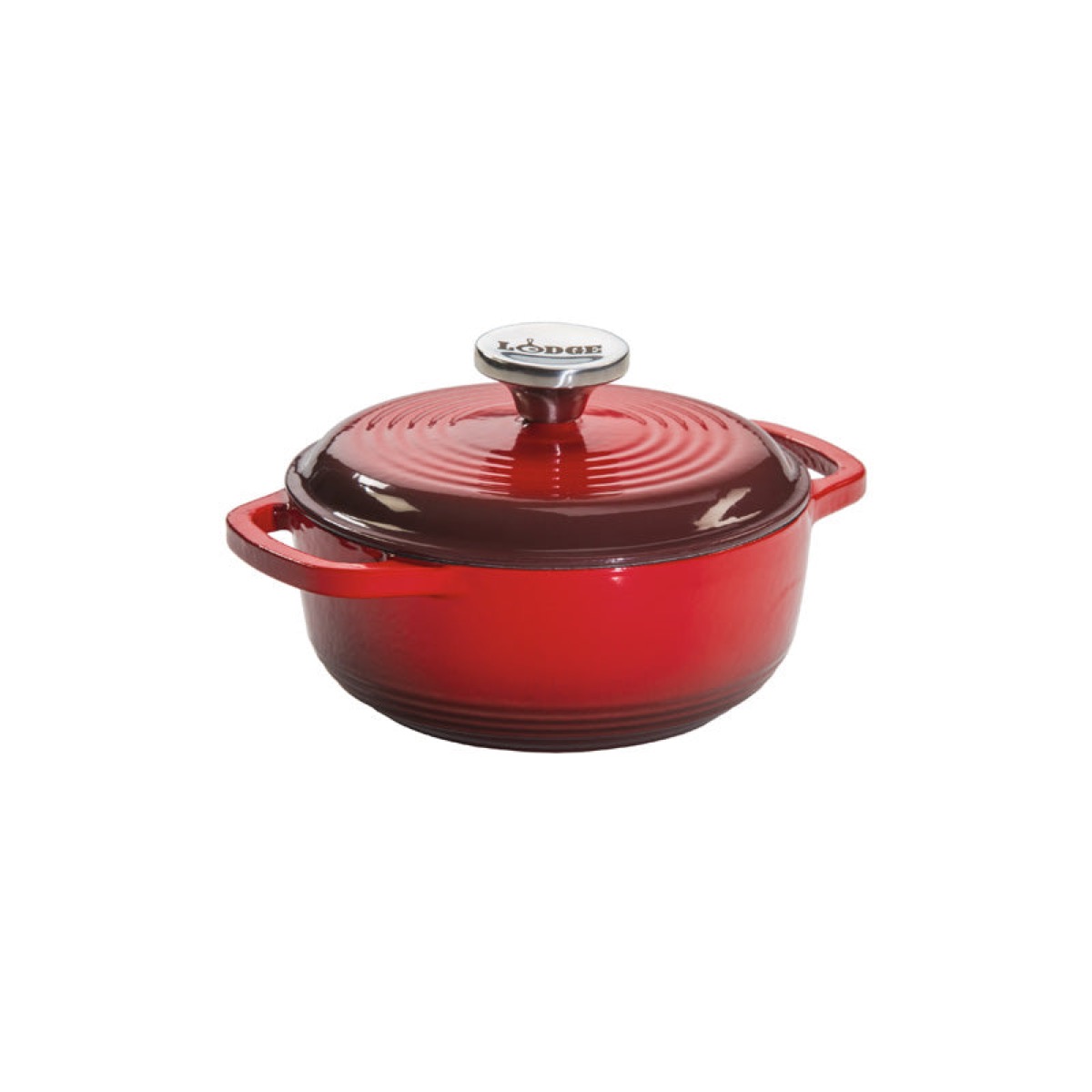
Essential Enamel Cast Iron Dutch Oven
A porcelain-enamel-over-cast-iron pot that braises, bakes and simmers with zero nonstick coating or plastic.
As an Amazon Associate I earn from qualifying purchases — at no extra cost to you. We show a "Check price on Amazon" link rather than a number because Amazon prices change often.
Why it's safe for your family
- The cooking surface is porcelain enamel — glass fused to cast iron at very high temperature — so there is no PTFE, no PFOA and no synthetic non-stick layer anywhere on it.
- Because enamel is glass rather than a polymer, there is no coating that breaks down with heat; it can go from stovetop to a hot oven without a temperature ceiling imposed by a coating.
- The enamel is non-reactive, so unlike bare cast iron it handles tomatoes, wine and other acidic braises without picking up a metallic taste or stripping seasoning.
- Nothing needs seasoning or re-seasoning, and there is no coating with a service life — cared for, the pot outlasts any non-stick pan by decades.
Is this really PFAS-free? Yes — and here's why
PFAS in cookware live in non-stick coatings — thin polymer films applied over metal that scratch, degrade and eventually have to be replaced. Porcelain enamel is a different thing entirely: powdered glass fused to iron at high heat, forming a hard glass surface. It is a coating in the literal sense, but it is glass, not fluoropolymer, so there is nothing fluorinated to come off into food.
What touches your food: fused porcelain enamel — glass. No PTFE, no PFOA, no non-stick polymer.
Quick specs
What to avoid instead
This replaces a non-stick coated pot. Those coatings are fluoropolymer films that scratch with normal use and degrade at high heat, which is exactly how a coated pan becomes a source of particles in your food.
How we verify — and what we don't
Straight answer: we're a research team, not a testing lab. Here's exactly what our rating is based on — and what it isn't — so you can weigh it honestly.
What we check
- What the product is made of, from the maker's own specs and product listing.
- Whether any part that touches you or your food uses PTFE, PFAS, plastic, or a coating that can degrade.
- Peer-reviewed research on how that material behaves when heated, scratched, washed, or worn.
- Known failure modes — how the product actually breaks down in a real home.
What we don't do
- We have not chemically tested this specific unit in a lab.
- We don't take payment to rate a product higher — there is no sponsored placement.
- We don't show star ratings or "trusted by thousands" counts we can't stand behind.
Anything that adds a known microplastic, PFAS, or off-gassing source — a non-stick coating, a plastic surface against food or skin, vinyl/PVC — is downgraded or cut. We only list what clears that bar.